Page 2 of 6
AN69.1-3 | Blood Vessels — SDL Guide (Part 2)
Arterioles, Capillaries, and Venules
Arterioles (diameter 10–100 µm):
- Tunica intima: endothelium only (no subendothelial layer; no distinct elastic lamina in the smallest arterioles)
- Tunica media: 1–3 layers of smooth muscle — this makes arterioles the primary resistance vessels controlling blood pressure
- Adventitia: thin

Figure: Arterioles, Capillaries, and Venules
Capillaries (diameter 7–10 µm — barely large enough for a red cell):
- No tunica media or adventitia
- Wall = single layer of endothelial cells + basement membrane + scattered pericytes (contractile cells that regulate capillary blood flow)
- Three structural types:
1. Continuous capillaries — tight junctions between endothelial cells; found in muscle, lung, skin, CNS (blood-brain barrier). Most restrictive.
2. Fenestrated capillaries — endothelial cells have pores (fenestrae) bridged by a thin diaphragm; found in kidney glomerulus, intestinal villi, endocrine glands. Allow rapid exchange.
3. Sinusoidal capillaries (sinusoids) — large diameter, incomplete basement membrane, gaps between endothelial cells; found in liver, spleen, bone marrow. Allow passage of cells and large proteins.
Venules (10–100 µm):
- Pericyte-covered endothelium; thin or absent smooth muscle
- Site of leukocyte diapedesis (white cell emigration) during inflammation — postcapillary venules are most permeable
Veins (compared to arteries of similar diameter):
- Larger lumen, thinner wall, less organised layers
- Tunica media: sparse smooth muscle, more collagen → veins collapse when empty; arteries remain patent
- Intraluminal valves in veins of limbs (absent in veins of head, neck, thoracic viscera) — prevent retrograde flow against gravity
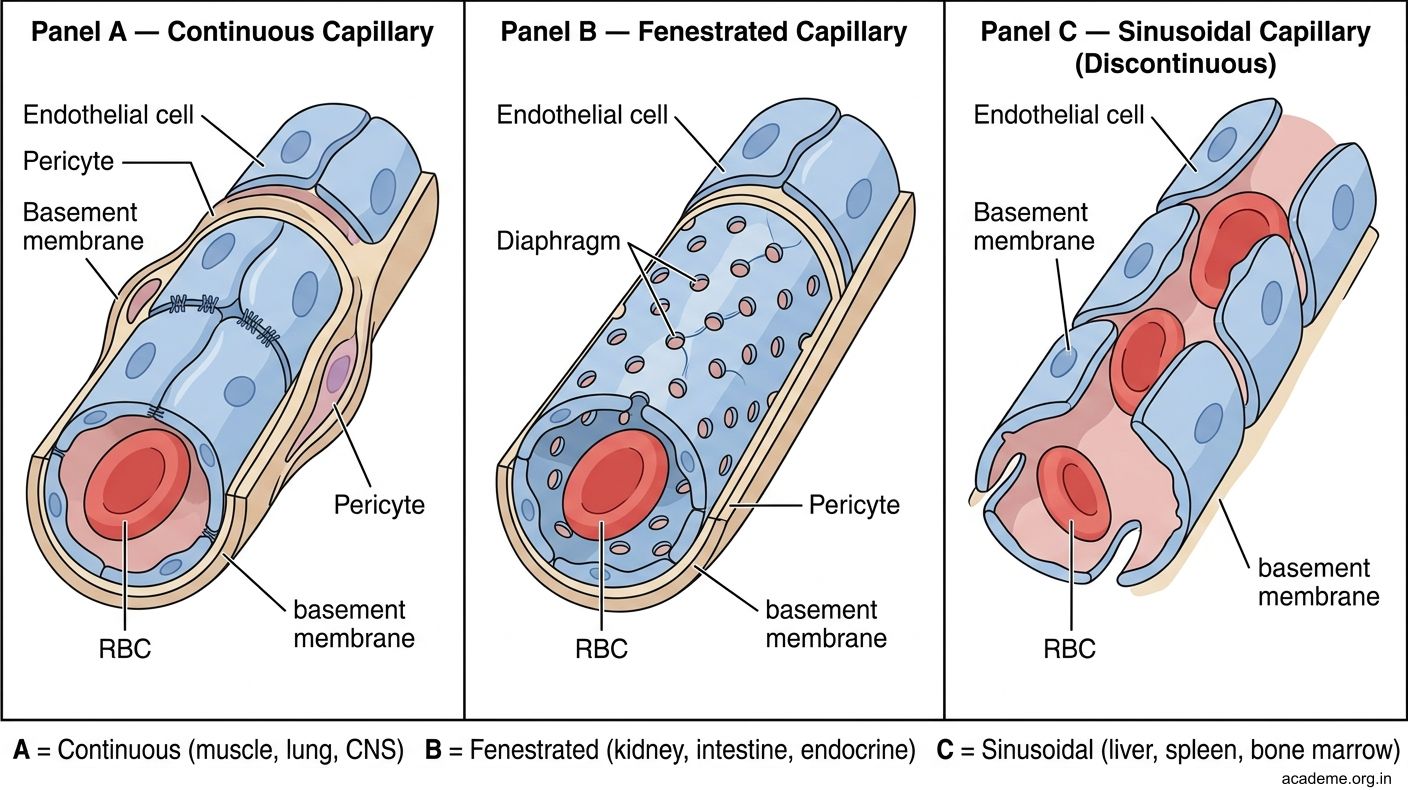
Figure: Arterioles, Capillaries, and Venules
Ultrastructure of Blood Vessels (AN69.3)
Under electron microscopy, blood vessel walls reveal key ultrastructural features:

Figure: Ultrastructure of Blood Vessels (AN69.3)
Endothelial cell ultrastructure:
- Tight junctions (zonula occludens) between adjacent endothelial cells — the structural basis of the blood-brain barrier and selective permeability. Absent or incomplete in sinusoids.
- Weibel-Palade bodies — elongated membrane-bound organelles unique to endothelial cells; store von Willebrand factor (coagulation) and P-selectin (leukocyte adhesion)
- Caveolae — flask-shaped invaginations of the plasma membrane facilitating transcytosis (transport of molecules across the endothelial cell)
- Endothelial cells contain intermediate filaments (vimentin) and actin microfilaments enabling shape change
Basement membrane (basal lamina):
- Produced by endothelial cells and pericytes/smooth muscle
- Components: type IV collagen (structural scaffold), laminin (cell adhesion), heparan sulphate proteoglycans (charge barrier in kidney)
- Thickened in diabetes (a major cause of diabetic microangiopathy)
Smooth muscle cell ultrastructure (tunica media):
- Spindle-shaped cells with central oval nucleus
- Contractile filaments: actin + myosin (no striations — smooth muscle)
- Cells linked by gap junctions enabling coordinated vasoconstriction
- Dense bodies — anchoring structures for actin filaments (analogous to Z-discs in striated muscle)
Elastic fibres:
- Core of elastin protein surrounded by fibrillin microfibrils
- Fenestrations in elastic lamellae allow diffusion across the media
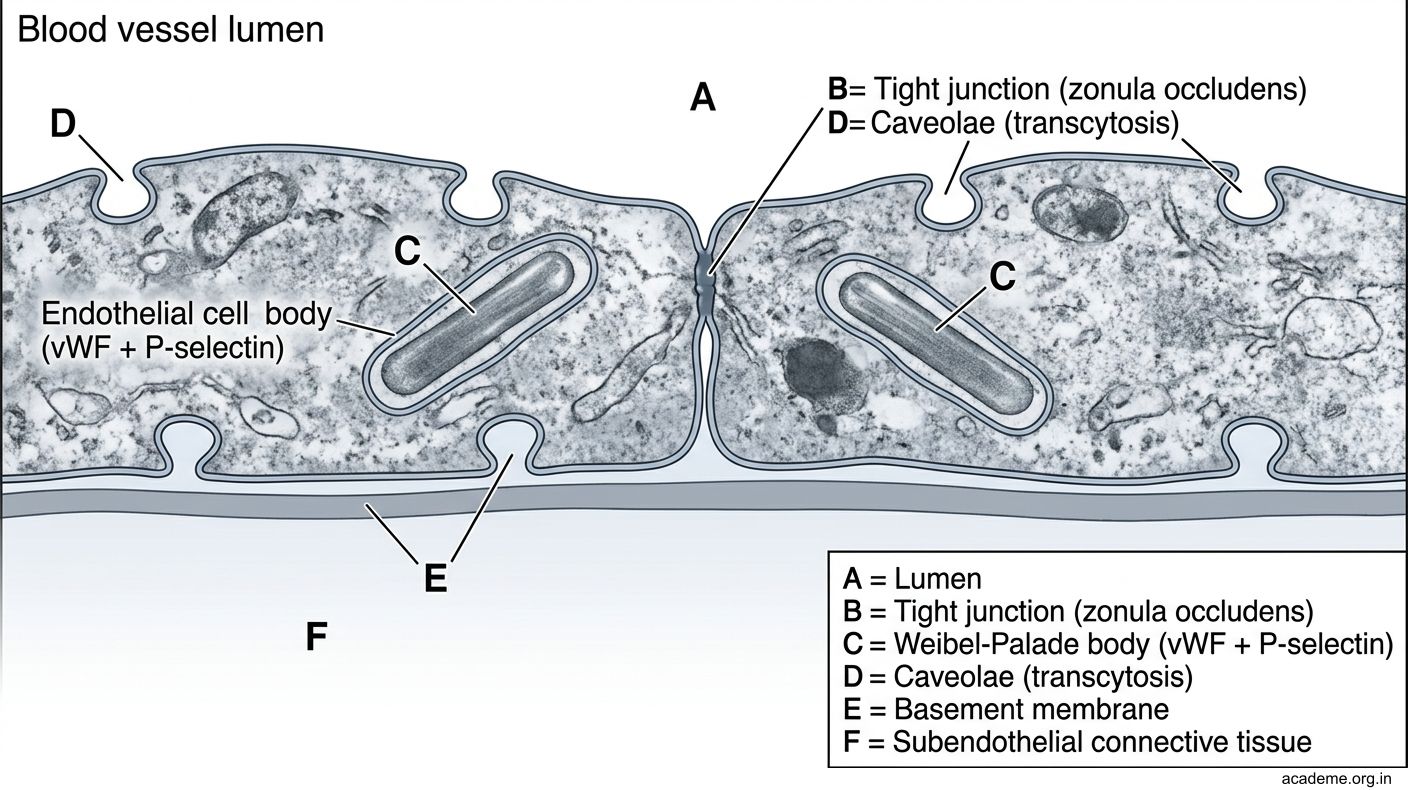
Figure: Ultrastructure of Blood Vessels (AN69.3)
SELF-CHECK — 2 : Ultrastructure and Capillary Types
A biopsy of a kidney glomerulus under electron microscopy shows endothelial pores (fenestrae) with thin diaphragms and a prominent glomerular basement membrane. The filtration barrier also includes podocyte foot processes. Which type of capillary best describes the glomerular endothelium?
A. Continuous capillary
B. Fenestrated capillary
C. Sinusoidal capillary
D. Lymphatic capillary
Reveal Answer
Answer: B. Fenestrated capillary