Page 12 of 19
CM3.6-8 | CM3.6-8 | Vector Biology and Control Measures — SDL Guide (Part 2)
Vector Control: Biological, Environmental, and Personal Protection Measures
Vector control is most effective when multiple approaches are combined in an integrated vector management (IVM) strategy, rather than relying on a single insecticide. The non-chemical approaches are particularly important because they carry no risk of insecticide resistance, are environmentally safe, and are sustainable.
Biological control uses living organisms to reduce vector populations:
- Bacillus thuringiensis israelensis (Bti): a soil bacterium that produces crystal proteins toxic specifically to mosquito larvae (and some blackfly larvae) when ingested. It does not harm fish, birds, mammals, or non-target insects. Applied as granules or briquettes to breeding sites. One of the safest and most effective larval control agents.
- Gambusia affinis (mosquito fish): a small freshwater fish that feeds voraciously on mosquito larvae. Introduced into ponds, drains, and wells to reduce larval densities. Widely used under NVBDCP in India for malaria control in rural areas.
- Copepods (tiny crustaceans): prey on Aedes larvae in containers; used in community water storage vessels.
Environmental management targets breeding sites:
- Source reduction: eliminate breeding sites—drain stagnant pools, fill depressions, remove discarded containers, clear drains, cover water storage tanks.
- Water management: rice field intermittent irrigation (alternate wetting and drying) reduces Anopheles breeding; flushing irrigation channels disrupts larvae.
- Housing improvement: wire-mesh screens on windows and doors, eave closure.
Personal protection measures:
- Insecticide-treated bed nets (ITNs) / long-lasting insecticidal nets (LLINs): impregnated with pyrethroids (permethrin, deltamethrin); provide a physical and chemical barrier against night-biting mosquitoes. LLINs maintain insecticidal activity for 3-5 years without re-treatment. Distributed free under NVBDCP in high-transmission areas.
- Repellents: DEET (N,N-diethyl-meta-toluamide) applied to exposed skin; effective against Aedes (day-biting) and Anopheles. Concentration 20-30% is standard for adults; avoid in infants <2 months.
- Protective clothing: long-sleeved shirts and long pants during peak biting hours.
Insecticides and Rodenticides: Mode of Action and Application
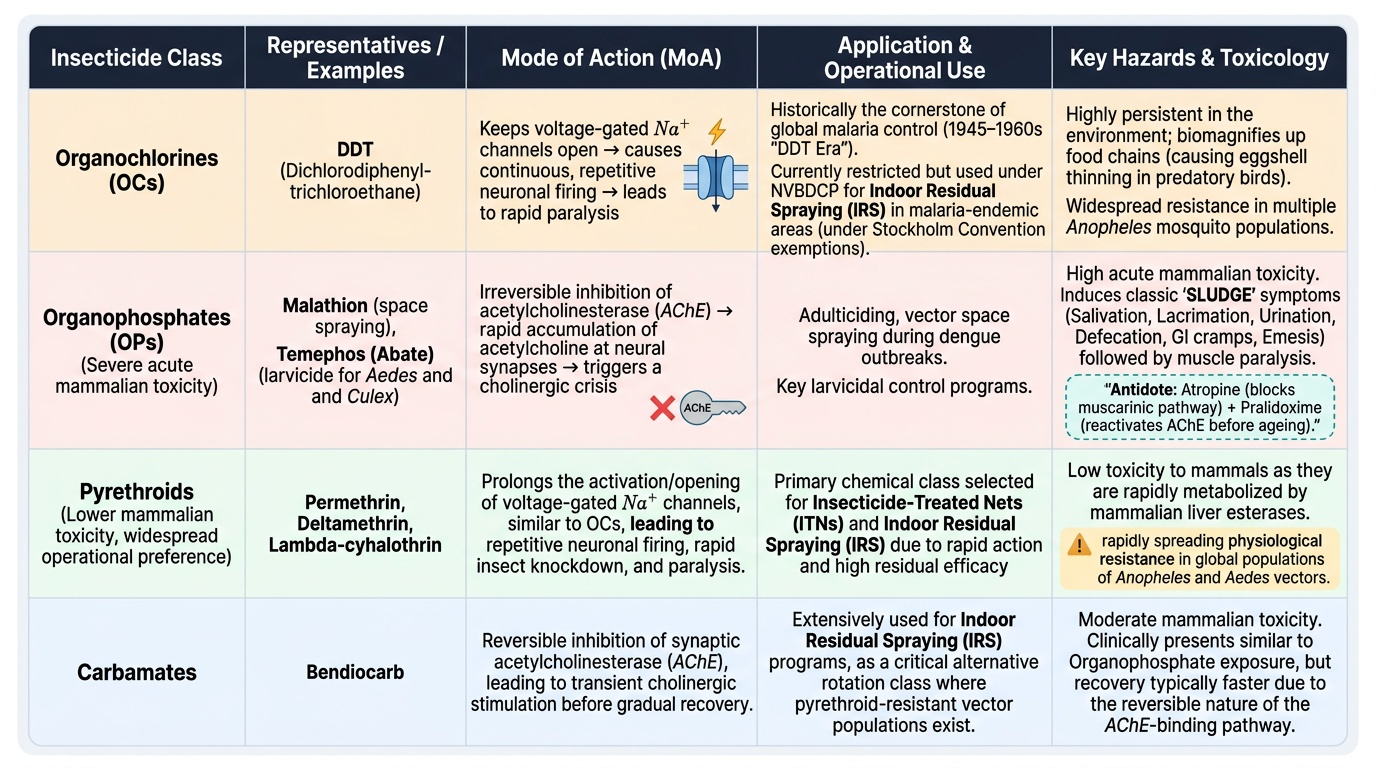
Chemical insecticides remain essential tools in vector control, particularly for rapid response to outbreaks and for reducing adult mosquito populations that cannot be controlled by larval management alone. Insecticides are classified by chemical class, each with a distinct mode of action:
Provided image
Organochlorines (OCs): Example: DDT (dichlorodiphenyltrichloroethane). Mode of action: keeps voltage-gated Na⁺ channels open → repetitive neuronal firing → paralysis. DDT was the most widely used insecticide for malaria control globally for decades (the 'DDT era' of malaria control, 1945-1960s). It was banned in India for agricultural use in 1989 but continues to be used for Indoor Residual Spraying (IRS) under NVBDCP in malaria-endemic areas, as an exemption under the Stockholm Convention on Persistent Organic Pollutants (POPs). Key hazards: persistent environmental accumulation, biomagnification up the food chain (eggshell thinning in raptors), and resistance in many Anopheles populations.
Organophosphates (OPs): Examples: malathion (adulticiding, space spraying for dengue control), temephos (abate) (larviciding for Aedes and Culex). Mode of action: irreversible inhibition of acetylcholinesterase (AChE) → accumulation of acetylcholine at synapses → cholinergic crisis (SLUDGE: salivation, lacrimation, urination, defecation, GI cramps, emesis; plus muscular fasciculations → paralysis). OPs are biodegradable (unlike OCs) but acutely toxic to mammals. Antidote for OP poisoning: atropine (blocks muscarinic effects) + pralidoxime (reactivates AChE if given early, before ageing).
Pyrethroids: Examples: permethrin, deltamethrin, lambda-cyhalothrin. Mode of action: similar to OCs—prolongs opening of voltage-gated Na⁺ channels → repetitive firing → paralysis. Pyrethroids are the preferred class for ITNs and IRS because of their low mammalian toxicity (mammals metabolise them rapidly via liver esterases), rapid knock-down effect, and residual activity. Widely used globally; resistance monitoring is essential because resistance in Anopheles and Aedes is spreading.
Carbamates: Example: bendiocarb. Mode of action: reversible inhibition of AChE (unlike OPs which are irreversible). Used as an alternative to pyrethroids for IRS when pyrethroid resistance is confirmed. Shorter duration of action than pyrethroids.
Application methods:
- Indoor Residual Spraying (IRS): spraying walls, ceilings, and furniture with a residual insecticide so that resting mosquitoes (which are endophilic—rest indoors) contact a lethal dose after blood-feeding. The standard technique for Anopheles malaria control and sandfly (kala-azar) control. Requires re-application every 3-6 months.
- Larval control (anti-larval operations): oil films (suffocate larvae), temephos, or Bti added to identified breeding sites.
- Space spraying (fogging): thermal or ultra-low volume (ULV) spray of insecticides (malathion, pyrethroids) to kill adult mosquitoes in the air. Used for rapid response to dengue outbreaks. Effectiveness is limited because it kills only mosquitoes in flight at the time of spraying and does not address resting mosquitoes or larvae.
Insecticide resistance management: rotating insecticide classes (e.g. pyrethroid one season, carbamate next) prevents the selection of a single resistance mechanism and prolongs the usefulness of each class. Resistance monitoring by susceptibility bioassay is an NVBDCP requirement.
Rodenticides control rat populations that serve as reservoirs for plague (Yersinia pestis) and as rat flea hosts. Commonly used rodenticides in public health: zinc phosphide (acute, single-dose bait—produces phosphine gas in the stomach, kills rapidly) and bromadiolone (second-generation anticoagulant—inhibits Vitamin K epoxide reductase → coagulopathy; anticoagulant rodenticides are hazardous to non-target predators; antidote is Vitamin K1).
National Vector Borne Disease Control Programme (NCVBDC/NVBDCP)
The National Vector Borne Disease Control Programme (NVBDCP) is the umbrella national programme for the prevention, control, and elimination of vector-borne diseases in India, under the Directorate of NVBDCP, Ministry of Health & Family Welfare. In 2021, it was reorganised as the National Centre for Vector Borne Diseases Control (NCVBDC).
The six diseases in scope are: malaria, dengue, chikungunya, kala-azar, lymphatic filariasis, and Japanese encephalitis.
Key programme strategies and elimination targets:
Malaria: India's National Framework for Malaria Elimination (NFME 2016-2030) targets zero indigenous malaria cases by 2027 in low-transmission states and nationwide by 2030. Strategies: universal access to Rapid Diagnostic Tests (RDTs) and artemisinin-based combination therapy (ACT) for P. falciparum; LLINs in high-burden areas; IRS with DDT/pyrethroids; intensified surveillance. Annual Parasite Incidence (API) is the key monitoring indicator—India's national API declined from >2 per 1000 in the 1990s to 0.17 per 1000 in 2023.
Kala-azar elimination: Target is <1 case per 10,000 population per year at block level by 2017 (revised to 2023 then 2030). Strategies: IRS with DDT/synthetic pyrethroid targeting sandfly Phlebotomus argentipes in the four endemic states; active case detection; treatment with liposomal amphotericin B (first line) or miltefosine.
Lymphatic filariasis: Target: elimination by 2030. Strategy: Mass Drug Administration (MDA) with DEC + albendazole (or in some states DEC + albendazole + ivermectin as triple therapy) annually to all eligible persons in 338 endemic districts. Vector control (anti-Culex measures) is a complementary strategy.
Dengue and chikungunya: No specific elimination target due to widespread Aedes presence; control is through integrated vector management (IVM) focused on domestic container breeding sites, community surveillance (larval surveys using House Index, Breteau Index, Container Index), and space spraying during outbreaks.
Japanese encephalitis: JE vaccine (single dose) is the primary prevention tool, included in the Universal Immunisation Programme in 12 states. Vector control (anti-Culex) and pig reservoir management are complementary.
SELF-CHECK
A district in Bihar has a reported kala-azar case load of 3 cases per 10,000 population per block (block A). The control team plans indoor residual spraying. Which vector, which insecticide class, and which elimination target apply?
A. Aedes aegypti; pyrethroid IRS; target is zero cases by 2025
B. Phlebotomus argentipes (sandfly); DDT or synthetic pyrethroid for IRS; elimination target is <1 case per 10,000 population per block per year
C. Culex quinquefasciatus; malathion space spraying; target is API <1 per 1000
D. Anopheles culicifacies; LLIN distribution; target is elimination by 2027
Reveal Answer
Answer: B. Phlebotomus argentipes (sandfly); DDT or synthetic pyrethroid for IRS; elimination target is <1 case per 10,000 population per block per year
Kala-azar (visceral leishmaniasis) is transmitted by the sandfly Phlebotomus argentipes, which is an endophilic peridomestic vector—it rests indoors on walls, making IRS with DDT (still used under Stockholm Convention exemption) or synthetic pyrethroids the primary vector control tool. The elimination target is <1 case per 10,000 population per block per year (revised target within the NCVBDC programme). Culex and Anopheles are malaria/filariasis/JE vectors, not kala-azar vectors. Aedes is the dengue/chikungunya vector. API <1 per 1000 is the malaria elimination indicator.