Page 14 of 25
CM1.7-8 | CM1.7-8 | Health Indicators and Demographic Profile — SDL Guide (Part 2)
India's Demographic Profile — Population, Structure, and Vital Rates
The demographic profile of a country describes the size, distribution, and composition of its population, as well as its vital rates (birth, death, fertility, migration). For India, the primary source remains the Census of India 2011 — the last completed decennial census — and the National Family Health Survey 5 (NFHS-5, 2019-21) for more recent health-linked demographic data.
Key Census 2011 figures:
- Total population: 1.21 billion (second largest in the world at that time)
- Decadal growth rate (2001-2011): 17.64% (declining from 21.54% in 1991-2001)
- Sex ratio: 940 females per 1,000 males (overall); child sex ratio (0-6 years): 914 — reflects son preference and sex-selective practices
- Literacy rate: 74.04% overall (male 82.14%, female 65.46%) — significant gender gap
- Urban population: 31.2% (rising rapidly with urbanisation)
Vital rates (recent estimates, SRS-based and NFHS-5):
- TFR: 2.0 per NFHS-5 (2019-21) — national average at or below replacement; Bihar, UP, Meghalaya still above replacement
- IMR: approximately 32-35 per 1,000 live births (declining, from 80 in 1990 to ~32 by 2019-21 per NFHS-5)
- MMR: 97 per 100,000 live births per SRS 2018-20 (Registrar General of India) — significant inter-state variation (Kerala ~19; Assam ~215)
- LEB at birth: approximately 70 years (male 68, female 71 — females outlive males)
India's demographic transition: The theory of demographic transition describes a universal pattern from high birth rate + high death rate (pre-transition, Stage I) through falling death rate + still-high birth rate (rapid population growth, Stage II) to falling birth rate + low death rate (slow growth, Stage III) to low birth rate + low death rate (stability, Stage IV). India is currently in late Stage II / early Stage III — mortality has fallen significantly, fertility is falling but with regional variation, and population growth continues (though decelerating). The national TFR crossing replacement level signals the approach of Stage III completion, but significant state-level heterogeneity means that interventions appropriate to late transition (NCD prevention, ageing) must coexist with interventions appropriate to early transition (maternal-child health, family planning) in different parts of the country.
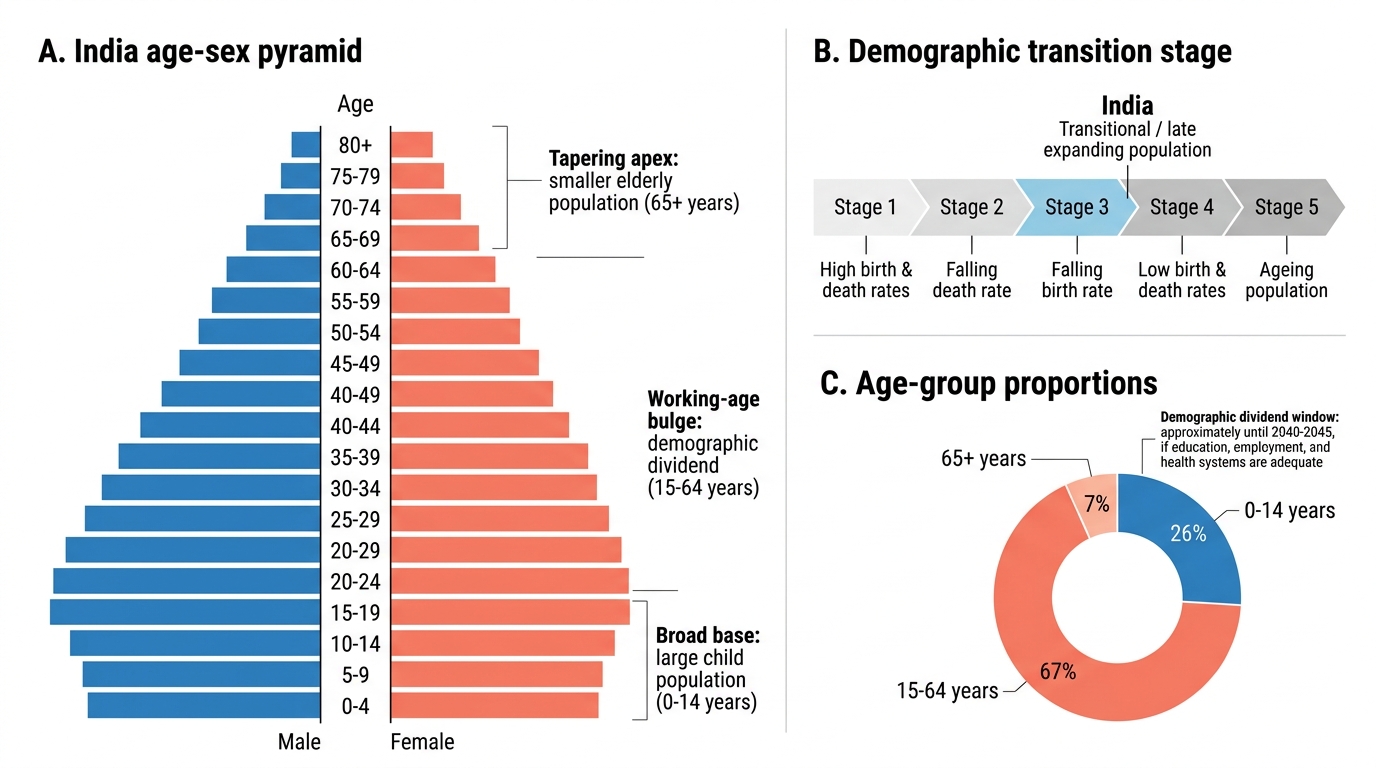
India Age-Sex Pyramid and Demographic Dividend
India's current age-sex structure shows a broad base (large proportion of young people aged 0-14) and a tapering apex (relatively small elderly proportion) — the classic 'expansive' pyramid of a transitional population. This structure creates the demographic dividend: a period during which the working-age population (15-64) is proportionally large relative to dependents (children + elderly), which — if education, employment, and health services are adequate — can accelerate economic growth. India's demographic dividend window is estimated to be open until approximately 2040-2045 after which the dependency ratio begins to rise as the population ages.
SELF-CHECK
India's Total Fertility Rate (TFR) per NFHS-5 (2019-21) is approximately 2.0. What does this mean for India's population?
A. India's population is currently declining
B. India has reached or crossed the replacement level fertility threshold nationally
C. Every Indian woman is having exactly 2 children
D. India's IMR has dropped to 2 per 1,000 live births
Reveal Answer
Answer: B. India has reached or crossed the replacement level fertility threshold nationally
A TFR of 2.0 means that at current age-specific fertility rates, the average Indian woman would have 2.0 children over her reproductive life — at or below the replacement level of approximately 2.1. This does not mean the population is currently declining (momentum from the large young cohort keeps births occurring), but the fertility transition is effectively complete at the national level. Significant state-level variation means some states remain above and others well below replacement.
Programmes and Interventions to Improve Key Indicators
National health programmes in India are explicitly designed around improving specific indicator targets, making the link between indicator measurement and programme design direct and operational.
Improving IMR and NMR: The Reproductive, Maternal, Newborn, Child, and Adolescent Health (RMNCH+A) strategy addresses the full continuum of care from adolescence through delivery and the neonatal period. Key interventions include skilled birth attendance (nurse/midwife or doctor at delivery), facility-based neonatal care (newborn care corners, Sick Newborn Care Units), immunisation (Universal Immunisation Programme), Integrated Management of Neonatal and Childhood Illness (IMNCI), and the ASHA (Accredited Social Health Activist) home-visit programme in the neonatal period.
Improving MMR: The Pradhan Mantri Surakshit Matritva Abhiyan (PMSMA) provides free antenatal care on the 9th of every month at PHC and CHC level, focusing on high-risk pregnancy identification. The LaQshya (Labour Room Quality Improvement Initiative) improves quality of intrapartum and immediate postpartum care in public facilities to reduce preventable maternal deaths. The emphasis on institutional delivery (promoted through the Janani Suraksha Yojana's conditional cash transfer scheme) has substantially increased the proportion of women delivering in facilities.
Improving TFR and sex ratio: The Mission Parivar Vikas programme targets high-fertility districts in 7 states with a comprehensive family planning package. The Beti Bachao Beti Padhao (BBBP) scheme addresses declining child sex ratio through community mobilisation, gender-sensitisation, and enforcement of the Pre-Conception and Pre-Natal Diagnostic Techniques (PCPNDT) Act.
SDG health targets related to these indicators (2030 goals): U5MR <25 per 1,000 live births; NMR <12 per 1,000 live births; MMR <70 per 100,000 live births. India's progress toward these targets is tracked through SRS and NFHS updates.
Monitoring India's Health Progress — Data Systems and Trends
Three complementary data systems provide the evidence base for monitoring India's health indicators over time, each with distinct strengths and appropriate uses.
Sample Registration System (SRS): A continuous dual-record system run by the Registrar General of India. Enumerators record births and deaths on a continuous basis in a sample of villages and urban blocks; a retrospective recall survey is then conducted to capture events missed. The reconciliation of the two records gives high-quality annual estimates of CBR, CDR, IMR, NMR, TFR, and LEB. SRS is the primary source for annual vital rate trends — it provides more frequent updates than NFHS but covers fewer health domains.
Census of India: Conducted once every 10 years, the Census provides a complete count of the population with detailed age-sex-literacy-occupation-housing data. It is the denominator anchor for all indicator calculations — all 'per-population' denominators are ultimately based on Census projections. The next census (delayed from 2021) will update denominators currently relying on 2011 projections.
National Family Health Survey (NFHS): A periodic household survey conducted roughly every 4-5 years (NFHS-1: 1992-93; NFHS-5: 2019-21) by the International Institute for Population Sciences (IIPS), Mumbai. It provides comprehensive data on reproductive health, child health, nutrition, domestic violence, alcohol use, non-communicable diseases, and health service coverage — domains not captured by SRS or Census. NFHS-5 was the first NFHS to cover all 707 districts of India, enabling district-level monitoring.
The demographic dividend is an economic opportunity created by India's current age structure. When the working-age cohort (15-64) is large and the dependency ratio (proportion of children + elderly relative to workers) is low, per-capita productivity can rise substantially — provided the working-age cohort is educated, healthy, and employed. India's dividend window is estimated to remain open until approximately 2040-2045. Health investment in this cohort — preventing NCDs, ensuring mental health, building occupational safety — is the highest-return public health investment India can make in the current period, and a core rationale for expanding the health system beyond maternal-child health toward working-age and elderly health.
SELF-CHECK
A district health officer wants to know the current neonatal mortality rate for her district for the current year. Which data source is MOST likely to provide this annually updated information?
A. NFHS-5 (2019-21)
B. Census of India 2011
C. Sample Registration System (SRS) annual report
D. District Level Household and Facility Survey (DLHS-4)
Reveal Answer
Answer: C. Sample Registration System (SRS) annual report
The Sample Registration System (SRS) provides annual estimates of vital rates including NMR, IMR, CBR, CDR, and TFR at state level (and for selected larger districts) through its continuous dual-record system. NFHS-5 provides these rates only periodically (every 4-5 years). Census 2011 provides population denominators but not vital rates. DLHS-4 is an older survey from 2012-13 and no longer current.