Page 2 of 18
FM2.13-15 | Autopsy: Principles, Types & Legal Requirements — SDL Guide (Part 2)
Aims and Objectives of the Medico-Legal Autopsy
The medico-legal autopsy is a structured investigation with specific, legally-mandated aims that go beyond the clinical curiosity of a hospital post-mortem. Understanding these aims is essential because every step of the examination — from external clothing inspection to viscera preservation — is designed to address one or more of them. Gaps in the examination translate directly into gaps in the post-mortem report, which prosecutors, defence counsel, and courts will scrutinise.
The principal aims of the medico-legal autopsy are:
- Establish the cause of death — the disease or injury responsible for the fatal sequence. This must be stated in three parts in Indian practice: immediate cause, antecedent cause, and underlying cause (following the ICD Death Certificate format).
- Determine the manner of death — the classification: natural, accidental, homicidal, suicidal, or undetermined. This determination carries the greatest legal weight and is the finding courts most frequently contest.
- Establish the mechanism of death — the physiological pathway through which the cause produced death (e.g. haemorrhagic shock from a stab wound; brainstem compression from a subdural haematoma).
- Estimate the time since death (post-mortem interval) — using rigor mortis, livor mortis, decomposition, stomach contents, and entomological evidence.
- Identify the deceased if unknown — through anthropometric features, dentition, fingerprints, DNA, tattoos, and unique identifying marks.
- Detect and document injuries — their type, pattern, mechanism, direction, age, and medicolegal significance (see wound classification in later FMmodules).
- Preserve evidence — biological specimens (blood, urine, bile, vitreous humour, gastric contents) and trace evidence for chemical analysis, toxicology, and DNA profiling.
- Provide documentation for court — a comprehensive PM report that will withstand cross-examination.
Each of these aims requires specific examination steps; the forensic physician must hold all eight simultaneously throughout the procedure.
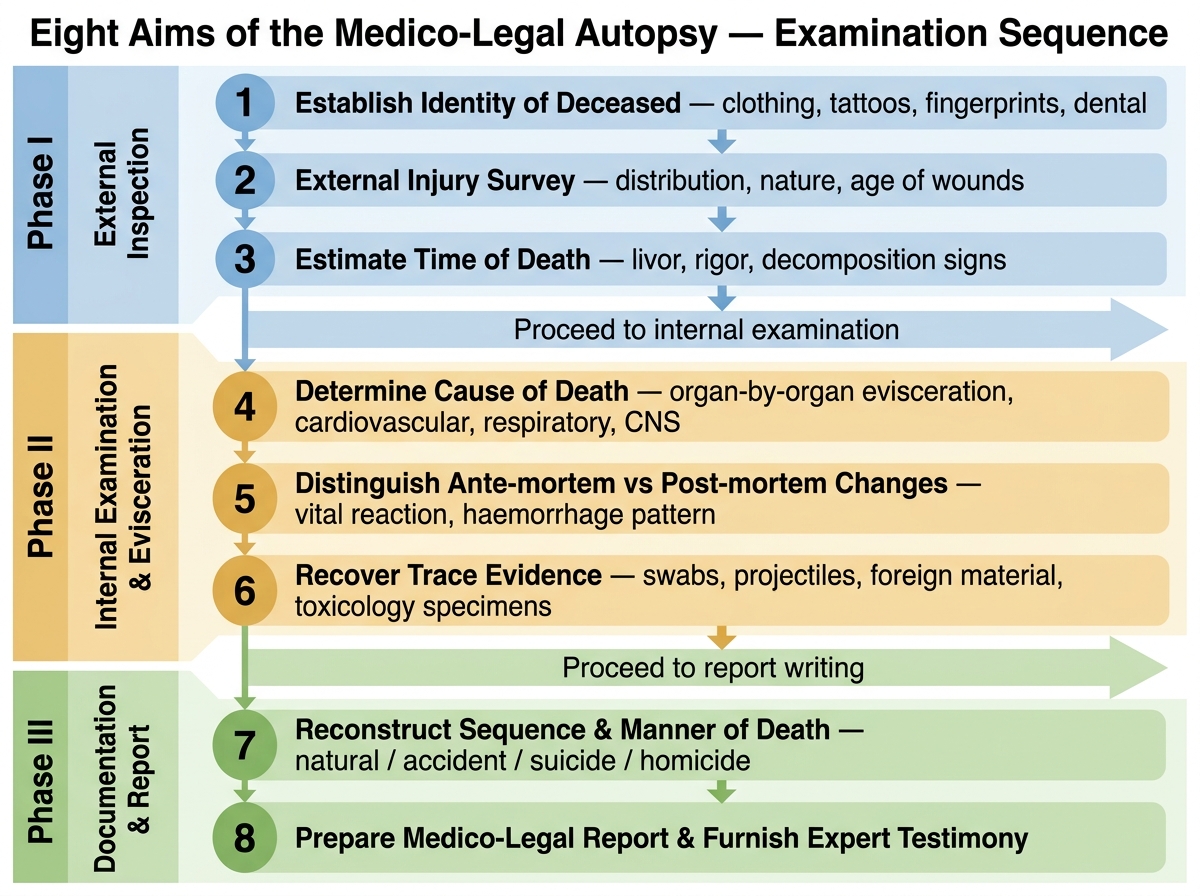
Fig. 1 — Eight Aims of the Medico-Legal Autopsy: Examination Sequence
Legal Requirements for PM Examination in India
In India, the legal framework for medico-legal post-mortem examination is governed primarily by the Code of Criminal Procedure (CRPC) 1973, supplemented by state police manuals, the Indian Evidence Act, and specific institutional guidelines. The two central provisions are Section 174 and Section 176 of the CRPC.
CRPC Section 174 empowers a police sub-inspector (or higher-ranking officer) to hold an inquest and request a post-mortem examination in cases of: (1) suicide; (2) accidental or unusual deaths; (3) deaths in suspicious circumstances; (4) deaths of a person in police custody; or (5) deaths caused by another's act. The officer's written order (inquest form, also called the Panchnama) is the legal authority for the PM. A police inquest is a preliminary investigation, not a judicial proceeding.
CRPC Section 176 mandates a magistrate inquest (instead of or in addition to the police inquest) in specific circumstances that require heightened legal scrutiny: (a) deaths in police custody or jail; (b) deaths of women within seven years of marriage in circumstances suggesting dowry harassment or unnatural causes; (c) deaths in a psychiatric institution; and (d) any case the magistrate deems requires personal inquiry. A magistrate inquest under Section 176 is a judicial proceeding, carries greater evidentiary weight, and must be preferred whenever custodial or suspicious domestic deaths are involved.
For the performing physician, the legal requirements include:
- Receiving the written order (inquest form or magistrate's order) before commencing — never perform a ML autopsy without documentary authority
- Completing the PM report on the prescribed government form, counter-signed by a second doctor where required (per state practice)
- Preserving viscera per the standard viscera preservation protocol (relevant to FM2.16, examined separately)
- Handing over exhibits (viscera, biological specimens, clothing, trace evidence) under proper chain-of-custody documentation
- Being prepared to appear in court as an expert witness
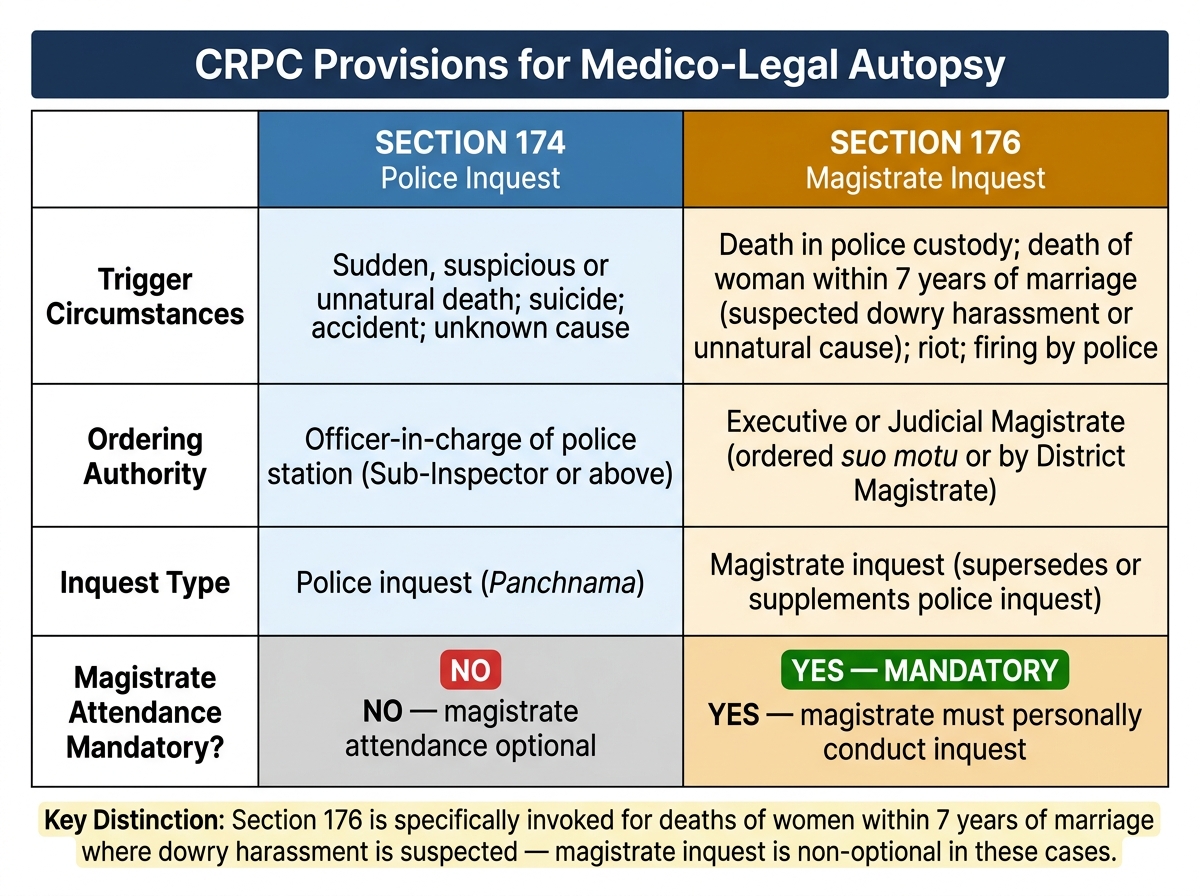
CRPC Sections 174 vs 176 — Medico-Legal Inquest Provisions
SELF-CHECK
A 24-year-old woman dies at home, having been married 3 years ago. Her parents suspect dowry harassment. Which provision of the CRPC mandates a magistrate inquest rather than a police inquest alone?
A. CRPC Section 174
B. CRPC Section 176
C. CRPC Section 302
D. CRPC Section 498A
Reveal Answer
Answer: B. CRPC Section 176
CRPC Section 176 mandates a magistrate inquest specifically for deaths of women within seven years of marriage where dowry harassment or unnatural causes are suspected. Section 174 covers police inquests generally; Section 302 is an IPC section (murder); Section 498A is an IPC section (cruelty to wife by husband/relatives).
Obscure Autopsy and Virtopsy
Forensic practice occasionally encounters cases where a first, properly-conducted post-mortem examination fails to establish a definitive cause of death despite complete examination and ancillary investigations. This situation — more common than often appreciated — necessitates a specific legal and procedural response.
An obscure autopsy (also termed a 'second PM' or 'second post-mortem') is ordered by a magistrate when the findings of the first examination are inconclusive or contested. Common scenarios include: (1) deaths where decomposition was advanced at the time of the first PM; (2) deaths attributed to natural disease but where a party contests this conclusion; (3) suspicious findings emerging after the first PM (e.g. new witnesses, new evidence); and (4) cases involving high-profile or sensitive medicolegal disputes. The legal authority must come from a magistrate's order — an obscure autopsy cannot be performed on a police officer's authority alone. The second examination is ideally performed by a different doctor (to prevent confirmation bias) and the first PM report must be made available to the second examiner.
Virtopsy (from 'virtual autopsy') is a non-invasive, imaging-based approach to post-mortem examination that uses computed tomography (CT) and/or magnetic resonance imaging (MRI) to produce three-dimensional reconstructions of the body's internal structures without traditional surgical dissection. Developed primarily at the University of Bern (Switzerland) by Dirnhofer and colleagues, Virtopsy can identify skeletal injuries, gas embolism, projectile tracks, organ haemorrhage, and vascular pathology with high precision. It is particularly valuable when: (a) traditional autopsy is religiously or culturally objectionable; (b) infection risk (e.g. viral haemorrhagic fever, HIV, COVID-19) makes invasive examination hazardous; (c) rapid victim identification in mass disasters requires parallel processing; or (d) defence counsel contests destructive examination findings.
However, Virtopsy is not a complete substitute for conventional autopsy: it cannot detect subtle soft-tissue findings (e.g. petechiae, fine cutaneous bruising), cannot sample for histology or toxicology directly, and is limited by cost and scanner availability. In current Indian forensic practice, Virtopsy is used as a supplementary tool, not a replacement.
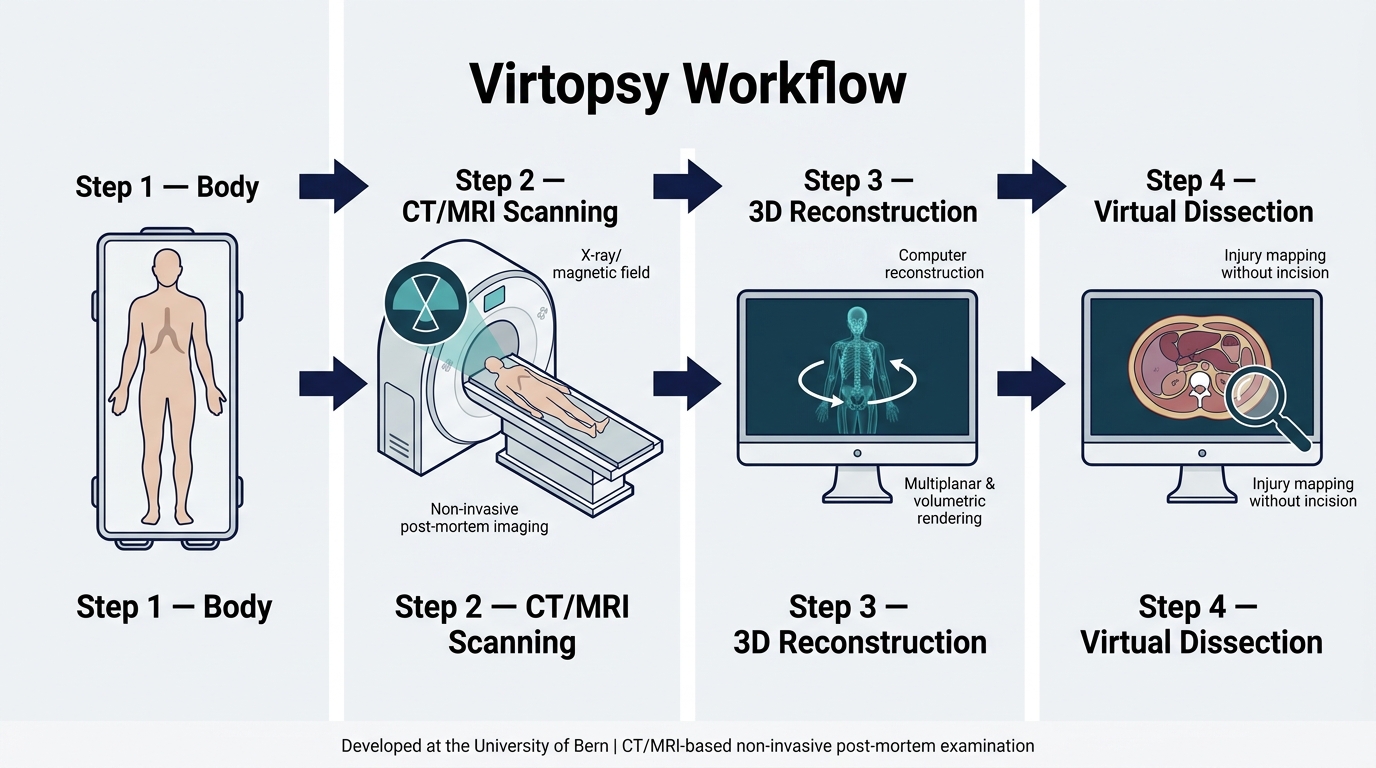
Virtopsy Workflow: From Body to Virtual Dissection
CLINICAL PEARL
Pearl: Never conflate Virtopsy with 'digital autopsy' generically. Virtopsy is specifically CT/MRI-based post-mortem imaging with 3D reconstruction — a defined technique developed at the University of Bern. The term 'virtual autopsy' in FM examinations and viva questions refers to this specific imaging-based method, not to any digital record-keeping or video-recording during autopsy. A common examination trap asks to 'define Virtopsy' — always anchor your definition to CT/MRI-based non-invasive imaging, and always note its limitations (cannot replace histology, toxicology, and soft-tissue tactile examination).
SELF-CHECK
Virtopsy differs from a conventional medico-legal autopsy primarily in that it:
A. Is performed by a radiologist rather than a forensic pathologist
B. Uses CT and/or MRI imaging to examine the body without surgical dissection
C. Does not require any legal authority or magistrate order
D. Can fully replace histological and toxicological sampling
Reveal Answer
Answer: B. Uses CT and/or MRI imaging to examine the body without surgical dissection
Virtopsy is defined by its use of CT/MRI-based imaging to conduct a non-invasive post-mortem examination without traditional surgical dissection. It still requires legal authority; a forensic physician interprets the findings; and it cannot replace histology or toxicology sampling — these are fundamental limitations.