Page 4 of 14
FM1.5-7 | Medical Evidence & Conduct in Court — SDL Guide (Part 2)
Perjury and Court Strictures Against Medical Officers
The obligation to tell the truth under oath is not merely an ethical principle — it is a statutory duty, the breach of which constitutes one of the most serious offences a professional person can commit. Perjury is defined as giving false evidence on oath or affirmation in a judicial proceeding. Under the Bharatiya Nyaya Sanhita (BNS) 2023 — which replaced the IPC 1860 for this offence — perjury is punishable with imprisonment for a term that may extend to seven years, along with a fine. The same punishment applies to fabricating false evidence, to making a false statement in a document that is likely to be used as evidence, and to using evidence known to be false.
For a medical officer, perjury can arise in several specific ways:
- False certification — certifying in a post-mortem report, wound certificate, or injury report that findings were made when they were not, or that injuries were of a character different from what was actually observed. This is perhaps the most common form of perjury in forensic medicine practice.
- Suppression of findings — omitting from testimony findings that were made and recorded, if the omission is deliberate and material. Accidental omission is a different matter and may be corrected; deliberate suppression is perjury.
- Fabrication of expert opinion — giving an expert opinion that the doctor does not genuinely hold, or that is not scientifically supportable, in order to secure a particular outcome for one party.
- False attribution — claiming to have personally performed an examination or procedure that was actually performed by another person.
Beyond the specific offence of perjury, courts have the power to make strictures against medical officers — formal adverse judicial comments recorded in the judgement. Strictures do not carry criminal punishment but have serious professional consequences. A stricture from a High Court or Sessions Court judge, questioning the reliability of a doctor's evidence or their professional conduct in the witness box, will be considered by the National Medical Commission (NMC) in any subsequent disciplinary proceeding under the NMC Act 2020. Repeated strictures can lead to suspension or removal of a doctor's licence to practise.
The NMC Act 2020 and the Indian Medical Council (Professional Conduct, Etiquette and Ethics) Regulations 2002 require that a doctor's professional conduct be of the highest standard in all settings, including in legal proceedings. A doctor who gives evidence in a manner that brings the medical profession into disrepute — whether through carelessness, partiality, or dishonesty — is accountable to the NMC as well as to the court.
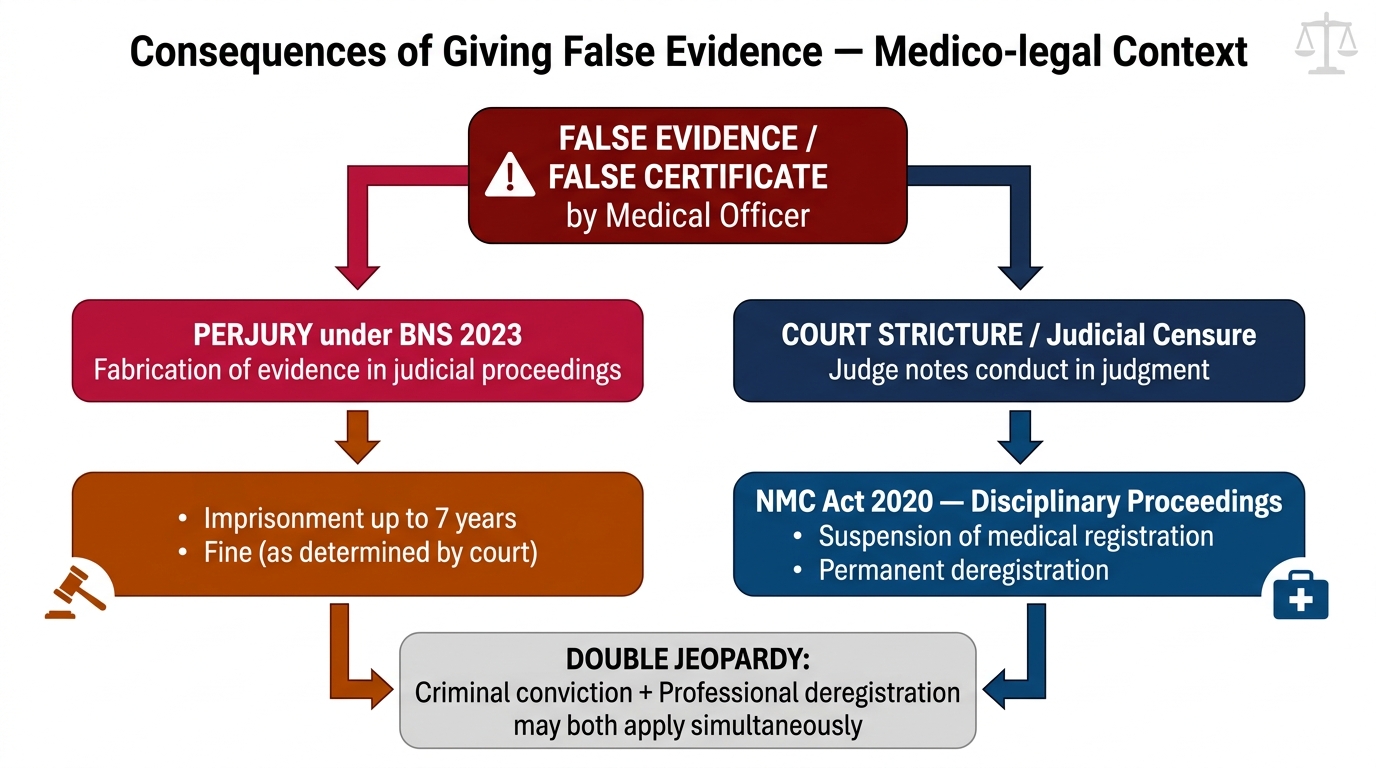
Consequences of False Evidence by a Medical Officer: Criminal and Professional Pathways
SELF-CHECK
A medical officer certifies in a wound certificate that injuries were 'simple hurt' when the documented findings were consistent with 'grievous hurt,' allegedly to help a relative of the accused. Under BNS 2023, this constitutes:
A. A minor professional lapse correctable by a warning
B. Perjury, punishable with imprisonment up to seven years
C. Negligence under the Consumer Protection Act 2019
D. A contempt of court offence only
Reveal Answer
Answer: B. Perjury, punishable with imprisonment up to seven years
Issuing a false certificate about the nature of injuries is perjury (fabrication of evidence used in judicial proceedings) under BNS 2023, punishable with imprisonment up to seven years. It is not merely a professional lapse — it is a criminal offence. It may additionally constitute professional misconduct under NMC Act 2020 and could result in deregistration. It is distinct from negligence, which involves an unintentional failure of standard of care.
Dying Declaration and Dying Deposition
Among the most medically significant types of evidence in the Indian legal system are the dying declaration and the dying deposition — statements made by a person who believes they are about to die. Both are treated as specially credible forms of evidence under the legal principle that a person facing imminent death has no reason to lie — though this principle is a presumption, not an absolute rule, and courts weigh these statements carefully.
Understanding the exact legal conditions for each type is critical because the doctor is often the person present when such statements are made, and any deficiency in the recording or attestation of the statement — however minor — can render it inadmissible and potentially destroy the evidentiary foundation of the case.
Dying Declaration
A dying declaration is a statement made by a person who is in a state of danger of death, about the cause or circumstances of the danger they are in or of any other transaction relevant to their death. Under the Bharatiya Sakshya Adhiniyam (BSA) 2023 (formerly Section 32(1) of the Indian Evidence Act 1872), a dying declaration is admissible in evidence as a statement of a deceased person — despite being hearsay — because the law treats the imminence of death as a substitute for the solemnity of an oath.
The conditions for a valid dying declaration are:
- The declarant must believe they are about to die — they need not actually die for the declaration to be admissible, but they must have a genuine expectation of impending death at the time of making the statement. A statement made by a person who expects to recover has no special evidentiary status.
- The declarant must be mentally competent at the time of making the statement — they must be conscious, oriented, and capable of understanding what they are saying. The doctor's role is to certify the declarant's fitness of mind — specifically, that the patient was conscious, oriented, and able to communicate meaningfully at the time the declaration was recorded. This certification is separate from and in addition to the declaration itself, and must be made in writing.
- The statement must relate to the cause or circumstances of the declarant's imminent death — a statement about unrelated matters does not qualify.
- Attestation: The dying declaration is ideally recorded by a Judicial Magistrate (First Class). If a Judicial Magistrate is not available in time, the declaration may be recorded by an Executive Magistrate. If no magistrate is available and the patient's condition is so critical that waiting for a magistrate would result in the statement being lost, the doctor may record the declaration — in which case the doctor must personally attest the statement and certify the declarant's mental fitness. A declaration recorded only by police without medical certification of fitness is of diminished evidentiary value.
- No oath is required — unlike a dying deposition, a dying declaration does not require the declarant to be sworn in. This means it can be recorded even from a person who is barely conscious, as long as they are mentally competent.
Dying Deposition
A dying deposition is a statement recorded from a person who is critically ill or dying but is recorded on oath before a Judicial Magistrate as formal evidence — in effect, the recording of testimony as though in court, in the patient's home, hospital, or wherever they are. A dying deposition is governed by the BNSS 2023 provisions for recording evidence where a witness may not survive to testify at trial.
The key differences between a dying declaration and a dying deposition are:
- A dying deposition requires the presence of a Judicial Magistrate — unlike the dying declaration, it cannot be recorded by a doctor alone.
- A dying deposition requires oath or affirmation by the declarant.
- A dying deposition is recorded as formal evidence on commission under BNSS provisions — it is treated as if it were testimony given in court.
- The accused (or their legal representative) has the right to cross-examine the person giving a dying deposition.
- Because the dying deposition is recorded on oath with an opportunity for cross-examination, it generally carries greater evidentiary weight than a dying declaration, though both are admissible.
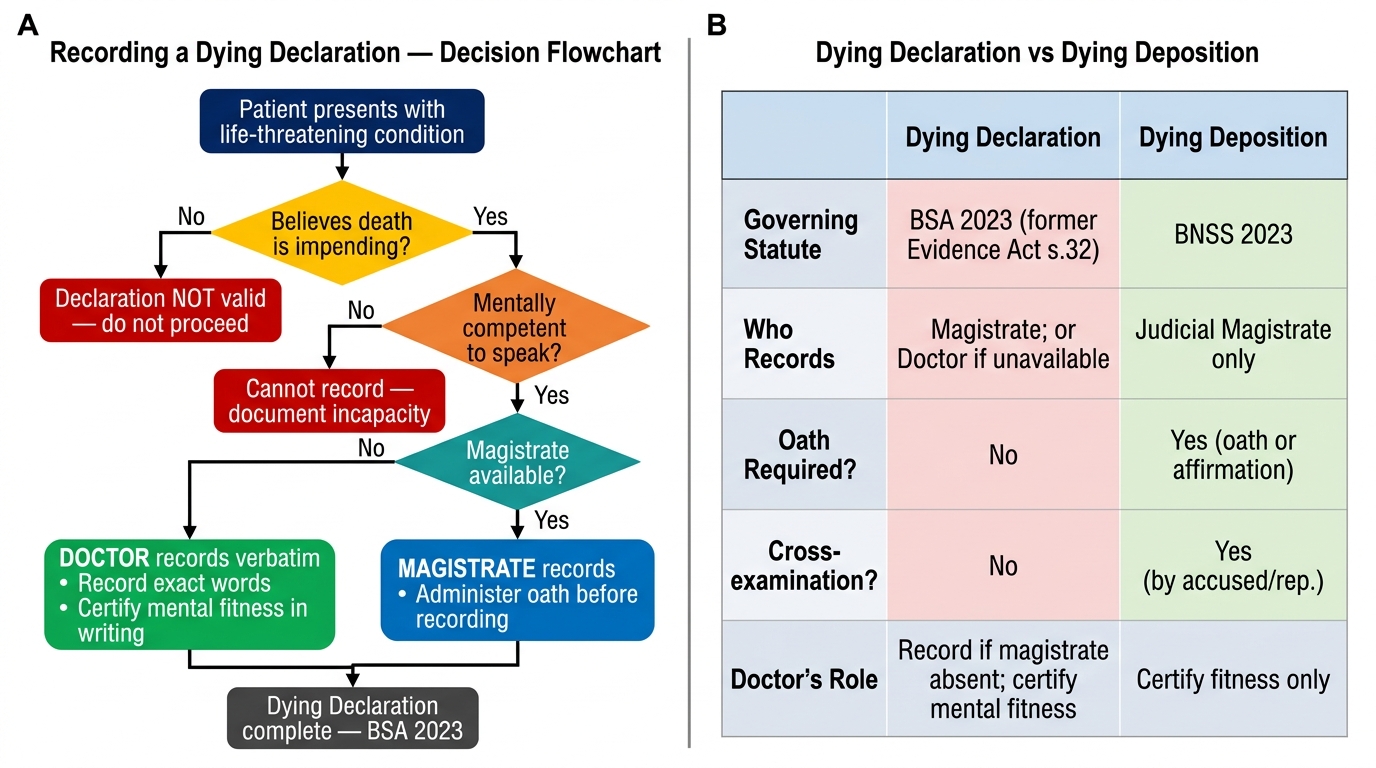
Dying Declaration: Decision Flowchart and Comparison with Dying Deposition (BSA 2023)
| Feature | Dying Declaration | Dying Deposition |
|---|---|---|
| Governing statute | BSA 2023 (former Evidence Act s.32) | BNSS 2023 (evidence on commission) |
| Who records | Magistrate; or doctor if magistrate unavailable | Judicial Magistrate only |
| Oath required? | No | Yes (oath or affirmation) |
| Cross-examination? | No | Yes (by accused or representative) |
| Doctor's role | Record if magistrate unavailable; certify mental fitness | Certify fitness; may not record |
| Evidentiary weight | Admissible as statement of deceased person | Higher — treated as sworn court evidence |
| Declarant's belief | Must believe death is imminent | Must be critically ill/unlikely to survive to trial |
SELF-CHECK
A critically ill burns patient with 85% body surface burns is conscious and wants to name their attacker. No magistrate is available for at least two hours. The doctor records the statement in the patient's own words, attests it, and certifies the patient's mental fitness in writing. What has the doctor recorded, and is it legally valid?
A. A dying deposition — valid as long as the doctor's qualification is stated
B. A dying declaration — valid under BSA 2023 when the doctor records and attests in the absence of a magistrate, provided mental fitness is certified
C. A police statement — only the police have authority to record such statements
D. An informal clinical note — not legally admissible unless countersigned by a magistrate later
Reveal Answer
Answer: B. A dying declaration — valid under BSA 2023 when the doctor records and attests in the absence of a magistrate, provided mental fitness is certified
A dying declaration recorded by a doctor in the absence of a magistrate, with attestation and written certification of the patient's mental fitness, is legally valid under BSA 2023. The law recognises that emergencies may prevent magistrate attendance; the doctor's role in this scenario is precisely defined. A dying deposition, by contrast, requires a magistrate to be present and the declarant to be sworn in — conditions that cannot be met here. A police statement and an informal clinical note are not dying declarations.
CLINICAL PEARL
When recording a dying declaration, use the patient's exact words — do not paraphrase or translate into legal or medical language. If the patient speaks in a regional language, write the statement phonetically in that language and provide a translation below, noting that you have translated it. Immediately after recording the statement, write a separate, clearly headed note certifying: 'I, [name], [designation], [hospital], hereby certify that at [date and time], the above-named patient was conscious, oriented, able to understand questions, and gave the above statement voluntarily. I am satisfied that the patient believed at the time of making this statement that they would not survive.' Sign, date, and affix your hospital stamp. This contemporaneous certification is what makes the dying declaration court-proof.