Page 17 of 23
FM10.22-23 | Medical Oaths & the Declaration of Geneva — SDL Guide
Learning Objectives
- Describe the key provisions of the Hippocratic Oath, the Charaka Samhita oath, and the Sushruta oath, and explain their historical significance
- Explain the procedure for administration of medical oaths at Indian graduation ceremonies
- Describe the Declaration of Geneva (WMA 2017) — its origins, key clauses, and the significance of its 2017 revision
- Reflect on the relevance of oath-taking to contemporary medical conduct and professional identity
INSTRUCTIONS
The medical oath is one of the most ancient and universal features of the physician's role — the moment when acquired knowledge is joined to a formal ethical commitment. This module traces the history of medical oaths from their ancient origins in Greek and Indian traditions to the current Declaration of Geneva (revised 2017), which is the basis for the oath taken by Indian medical graduates today. Understanding the content, history, and relevance of these oaths is not merely historical knowledge — it is the foundation for understanding the ethical identity of a physician.
References
- KSN Reddy — Essentials of Forensic Medicine & Toxicology (textbook)
- BV Subrahmanyam — Modi's Medical Jurisprudence and Toxicology (textbook)
Version 2.0 | NMC CBUC 2024
CLINICAL SCENARIO
On a warm afternoon in the examination hall, a few months from now, you will stand with your graduating class and speak words that connect you — however briefly — to a tradition stretching back over two thousand years. A physician in ancient Greece swore by Apollo and Aesculapius. A physician in ancient India, completing the Ayurvedic gurukul, made a formal promise to the guru and to the welfare of all patients. A doctor in 1948, in the aftermath of the Nuremberg trials and the Holocaust, signed a declaration that committed them to humanity above all other loyalties. What you will say at your graduation is the contemporary descendant of all three. Understanding what those words mean — where they came from, what they replaced, and what they still demand — is what this final module in the ethics cluster is about.
WHY THIS MATTERS
The medical oath is often treated as a ceremonial formality — recited once and then placed on a shelf. But its content matters. The Declaration of Geneva, which Indian graduates take, contains specific commitments that are directly relevant to clinical practice: to put the patient's health first, to respect secrets confided by patients, to maintain the honour and traditions of the medical profession, to give colleagues the respect and gratitude they deserve, to practise with conscience and dignity, and — in the 2017 revision — to attend to one's own health and wellbeing, and never to use medical knowledge to violate human rights. These are not platitudes. Understanding the historical basis for these commitments, and reflecting on what they mean for your own practice, is part of medical education.
RECALL
Before we begin:
- In me1 (History of Medical Ethics), you learned that Indian medical graduates do NOT take the Hippocratic Oath. What oath DO they take?
- In me1, we discussed the Declaration of Geneva's 2017 revision. Can you recall which two clauses were added in 2017 that were not present in earlier versions?
- The Charaka Samhita and the Sushruta Samhita are foundational texts of Ayurvedic medicine. What ethical themes do they share with the Hippocratic tradition?
Legal and Professional Context: Medical Oaths as Ethical Foundations
Medical oaths serve a function that extends beyond their ceremonial role at graduation. They represent the formal expression of the social contract between medicine and society — the public commitment by a new physician that their knowledge and skill will be directed to human welfare, constrained by ethical principles, and subject to the oversight of the profession and the law.
From a legal and regulatory perspective, the oath is directly connected to the regulatory framework. The National Medical Commission (under the NMC Act 2020) specifies that Indian medical graduates take a formal oath at graduation, modelled on the Declaration of Geneva. This oath is not merely symbolic — it is the formal expression of the practitioner's acceptance of the professional obligations that accompany registration. A registered practitioner who subsequently violates the principles they pledged at graduation may face disciplinary proceedings under the NMC Code of Medical Ethics.
Historically, medical oaths served several functions:
1. Socialisation into the professional role — the oath marks the transition from student to practitioner and communicates the values of the profession
2. Public accountability — the oath is typically administered in a public ceremony; it signals the physician's commitment to the community they will serve
3. Normative standard — the content of the oath articulates the core ethical obligations; it can be used as a reference point in disciplinary proceedings ('did the practitioner's conduct accord with the commitments they made?')
4. Professional identity — identifying oneself as a physician implies the values embedded in the oath; these values are part of what distinguishes a profession from a trade
It is worth noting that taking an oath does not guarantee ethical conduct — the Nazi physicians who committed the crimes that prompted the Declaration of Geneva had also taken oaths. The oath is a necessary but not sufficient condition for ethical practice; it must be supported by ongoing education, reflective practice, and institutional structures that reinforce ethical behaviour.
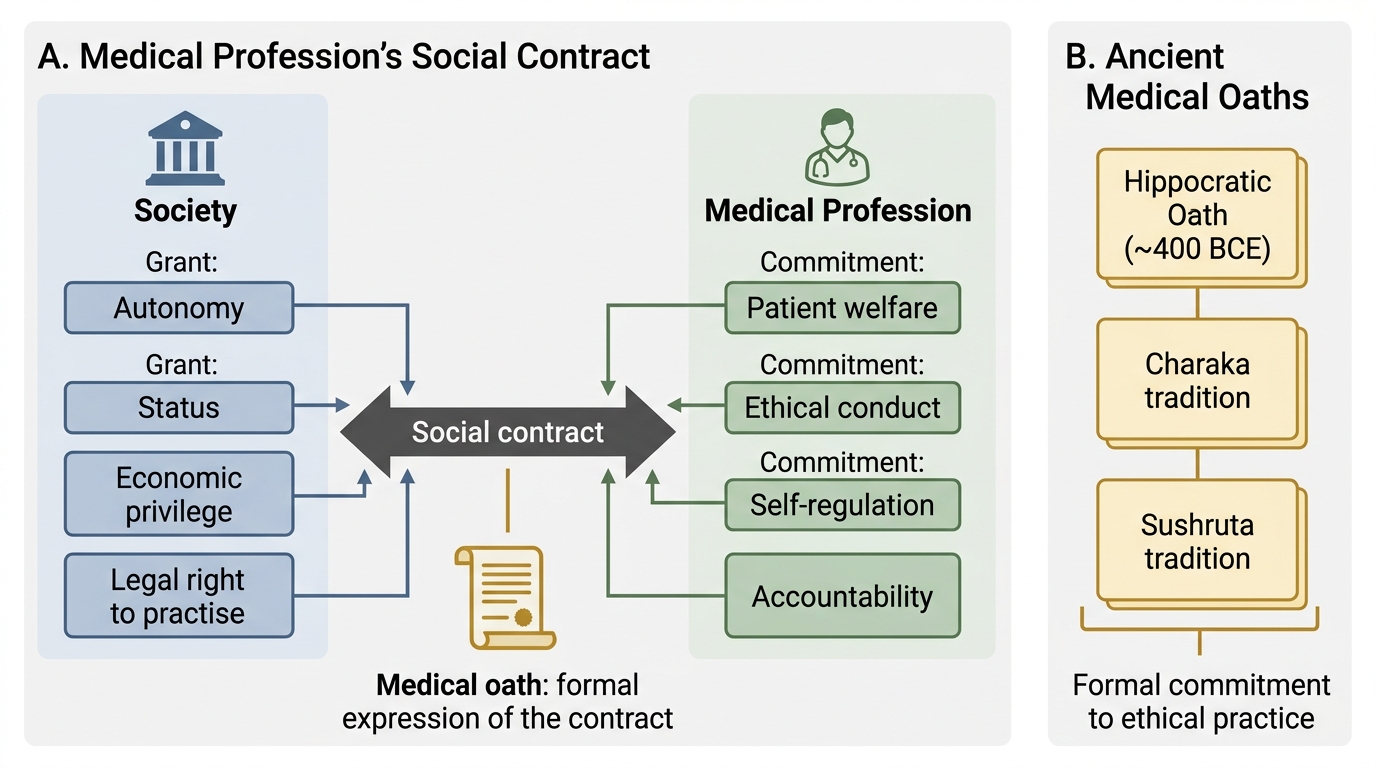
Medical Profession's Social Contract and Oaths
Ancient Medical Oaths: Hippocrates, Charaka and Sushruta
Across independent medical traditions, the act of taking a formal commitment to ethical practice appears as a near-universal feature. Three ancient traditions are specifically covered in the FM curriculum: the Greek Hippocratic tradition and the Indian Ayurvedic traditions of Charaka and Sushruta.
The Hippocratic Oath (~400 BCE)
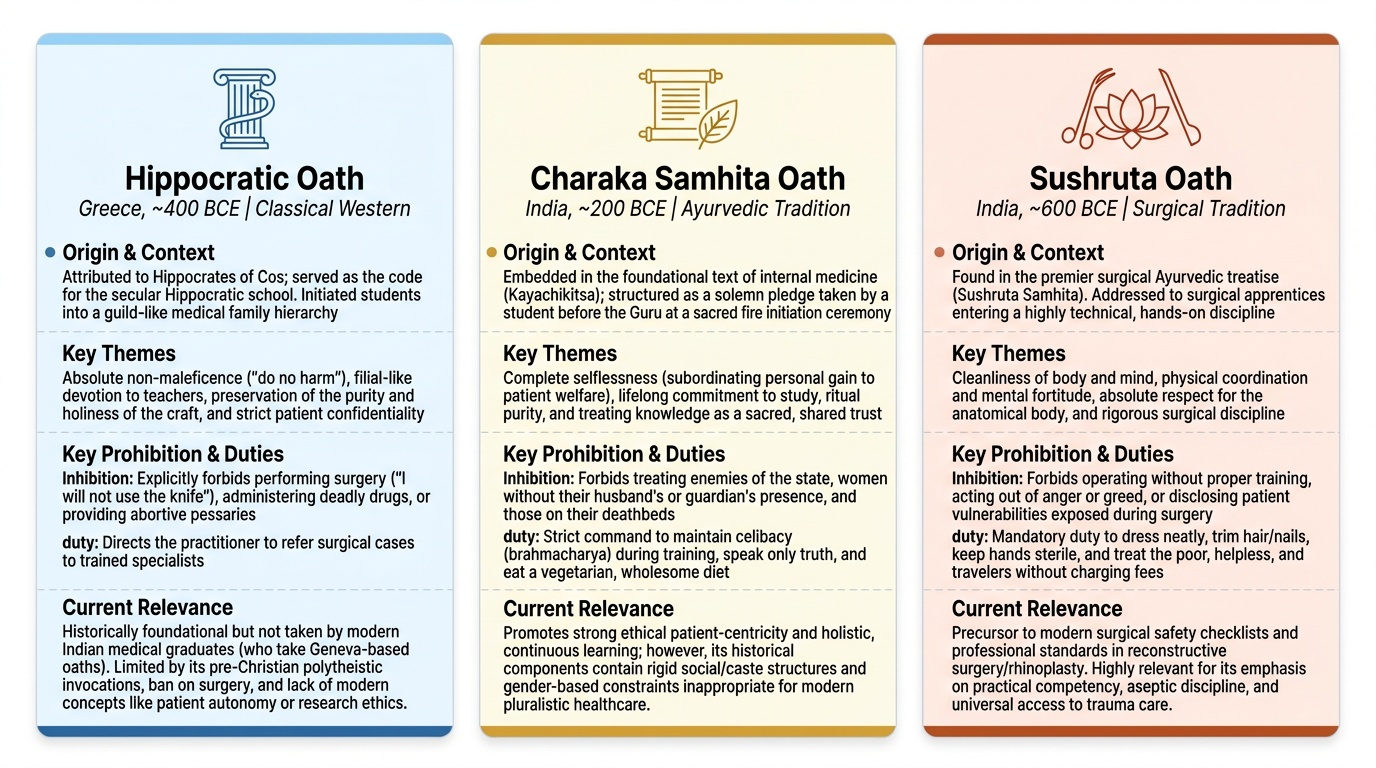
The Hippocratic Oath is attributed to Hippocrates of Cos (ca. 460–370 BCE) and is the most widely referenced medical ethical text in Western history. The classical oath invokes Greek gods — Apollo, Aesculapius, Hygieia, and Panacea — and makes the following principal commitments:
- To treat the teacher as a parent and to share knowledge with fellow students
- To use treatment to help the sick, and never to harm them
- Not to give 'a deadly drug' even if asked
- Not to give a pessary for abortion
- To practise surgery only if trained, referring otherwise
- To maintain confidentiality of all patient disclosures
- To abstain from sexual relations with patients and their households
- To maintain purity and holiness in conduct
Key limitations of the Hippocratic Oath for modern practice:
- It invokes pre-Christian Greek gods — not appropriate for a multi-religious modern India
- It specifically prohibits surgery ('I will not use the knife') — surgery has been an essential part of medicine for centuries
- It does not address research ethics, informed consent, or patient autonomy as understood today
- It was the ethical code of one school (the Hippocratic school on Cos) — not a universally adopted document in ancient Greece
CRITICAL POINT: Indian medical graduates do NOT take the Hippocratic Oath. They take a Declaration of Geneva-based oath.
The Charaka Samhita Oath (ca. 200 BCE)
The Charaka Samhita is one of the two foundational classical Ayurvedic texts. It describes an initiation ceremony in which the student, upon completing training with the guru, takes a formal ethical pledge. The key commitments in the Charaka oath include:
- Dedication to the welfare of patients — subordinating all personal interests to the patient's welfare
- Pledge to live a pure and disciplined life, with celibacy implied during the training period
- Commitment to continue learning throughout the professional life
- Promise to share knowledge freely with those who deserve it
- Commitment to treat all patients regardless of social status or ability to pay
- Maintenance of confidentiality — not to disclose patient information outside the clinical context
The Charaka oath is notable for its emphasis on the physician's character — the ethical requirement that the doctor be a good person, not merely technically competent. It also includes a striking egalitarian commitment to treat all patients, which resonates with modern justice principles.
Sushruta's Ethical Guidelines
The Sushruta Samhita is the foundational text of Indian surgery, attributed to Sushruta (~600 BCE, though the text was compiled later). Sushruta's ethical framework for surgeons emphasises:
- Purity of motive and action
- Patient welfare as the primary goal
- The obligation to continue learning and to acknowledge the limits of one's knowledge
- Respect for the patient's person
- Compassion as an essential quality of the practitioner
While Sushruta's text does not contain a single formal oath, the ethical guidelines woven through it establish a vision of the ethical surgeon that parallels — and predates — many modern principles.
Provided image
SELF-CHECK
Which of the following is a correct statement about the Hippocratic Oath in the context of modern Indian medical practice?
A. The Hippocratic Oath is administered to all Indian medical graduates at graduation and is the basis for the NMC's professional standards
B. The Hippocratic Oath is historically significant but is NOT administered to modern Indian medical graduates; they take a Declaration of Geneva-based oath
C. The Hippocratic Oath has been adopted by the NMC with modifications to remove the references to Greek gods
D. The Hippocratic Oath and the Declaration of Geneva are identical in content; the names are used interchangeably
Reveal Answer
Answer: B. The Hippocratic Oath is historically significant but is NOT administered to modern Indian medical graduates; they take a Declaration of Geneva-based oath
The Hippocratic Oath is historically foundational but is NOT administered to modern Indian medical graduates. The NMC specifies a Declaration of Geneva-based oath at graduation. The Hippocratic Oath is clinically and practically unsuitable for modern use — it invokes Greek pagan gods, explicitly prohibits surgery, and does not address informed consent or patient autonomy. The Declaration of Geneva is a separate, modern document with different content.
The Declaration of Geneva: Modern Medical Pledge
The Declaration of Geneva is the modern successor to the Hippocratic tradition as the operative medical pledge. It was adopted by the World Medical Association (WMA) at its second General Assembly in Geneva in September 1948 — deliberately timed as a response to the atrocities committed by physicians in Nazi Germany, and as a reaffirmation of medicine's fundamental commitment to human welfare.
The Declaration has been revised multiple times since 1948 to reflect evolving ethical understanding. The current version is the 2017 revision — the most recent and the version that must be cited in Indian FM examinations when asked about the 'current Declaration of Geneva.'
Key commitments in the 2017 Declaration of Geneva:
- I will put the health and wellbeing of my patient first.
- I will respect the autonomy and dignity of my patient.
- I will maintain the utmost respect for human life.
- I will not permit considerations of age, disease or disability, creed, ethnic origin, gender, nationality, political affiliation, race, sexual orientation, social standing, or any other factor to intervene between my duty and my patient.
- I will respect the secrets that are confided in me, even after the patient has died.
- I will maintain, by all the means in my power, the honour and the noble traditions of the medical profession.
- I will give to my teachers, colleagues and students the respect and gratitude that is their due.
- I will practise my profession with conscience and dignity and in accordance with good medical practice.
- NEW in 2017: I will attend to my own health, wellbeing and abilities in order to provide care of the highest standard.
- NEW in 2017: I will not use my medical knowledge to violate human rights and civil liberties, even under threat.
The two 2017 additions are examination-relevant:
- Physician health clause — the recognition that a doctor's own health is a professional responsibility, not merely a personal matter. A physician who is impaired by illness, burnout, substance use, or mental health challenges cannot provide care of the highest standard; attending to one's own health is therefore an ethical duty to patients.
- Human rights clause — a direct response to documented cases of physicians participating in torture, non-consensual experimentation, or the medical oversight of abuse in conflict zones and authoritarian contexts. The phrase 'even under threat' is significant — it acknowledges that doctors may face coercion or intimidation and explicitly states that the ethical obligation does not yield to such pressure.
| Version | Year | Key Additions/Changes from Previous Version | Notes |
|---|---|---|---|
| Original | 1948 | First adoption post-WWII; response to Nuremberg; replaced Hippocratic Oath | Foundational modern pledge |
| Second revision | 1983 | Added provisions related to torture and inhumane treatment | Response to Cold War documentation of physician participation in torture |
| Third revision | 1994 | Minor language updates | — |
| Fourth revision | 2005 | Added explicit duty to patients over personal interests | — |
| Fifth revision | 2017 | Added physician health clause and human rights clause | Current version; cite for examinations |