Page 6 of 23
FM10.2-3 | NMC & State Medical Councils: Registration & Functions — SDL Guide (Part 2)
State Medical Councils: Functions and Relationship with NMC
State Medical Councils are established under respective state legislation and function as the primary point of contact for most registered practitioners in India. While the NMC sets national standards and maintains the central IMR, the State Medical Councils handle a large proportion of the practical registration and regulatory work.
The functions of State Medical Councils include:
- Registration: receiving and processing applications for registration from MBBS graduates of colleges within their jurisdiction
- Maintaining the State Medical Register: the state-level counterpart to the IMR
- Disciplinary proceedings: investigating and adjudicating complaints of professional misconduct at the state level; findings are referred to the NMC's EMRB for national-level action (erasure from IMR)
- Renewal: in some states, periodic renewal of registration
- Transfer: facilitating transfer of registration between states (when a practitioner moves to practise in a different state)
The relationship between NMC and State Medical Councils is hierarchical but coordinated: the NMC sets standards and has appellate authority; the State Councils are the first-instance regulators. In disciplinary matters, a practitioner may appeal a State Council decision to the NMC's EMRB.
| Feature | NMC (National Medical Commission) | State Medical Council |
|---|---|---|
| Governing legislation | NMC Act 2020 | State legislation |
| Geographic scope | National | State-specific |
| Register maintained | Indian Medical Register (IMR) | State Medical Register |
| Registration type | Permanent (via EMRB) | Provisional + Permanent |
| Disciplinary power | Ultimate authority; penal erasure from IMR | First-instance; findings referred to NMC |
| Standards-setting | Yes (curriculum, accreditation, conduct) | Implements NMC standards |
A practitioner who has been erased from a State Medical Register is also erased from the IMR and may not practise anywhere in India. Conversely, restoration on appeal to the NMC restores the registration nationally.
Medical Registration in Practice: Provisional, Permanent and Transfer
Understanding the registration process is essential for every newly qualifying doctor. The process involves two stages: provisional registration (enabling the internship) and permanent registration (enabling independent practice).
Provisional Registration is granted by the State Medical Council to MBBS graduates who have completed their final professional examination and are proceeding to the compulsory one-year rotating internship. The provisional registration:
- Is time-limited (valid for the duration of the internship)
- Permits the graduate to practise medicine only under supervision in an accredited internship setting
- Does NOT permit independent practice
- Is granted by the State Medical Council of the state in which the internship will be served
Permanent Registration is granted after successful completion of the internship:
- The candidate submits the internship completion certificate to the State Medical Council
- The Council verifies the certificate and adds the practitioner's name to the State Medical Register
- The registration is simultaneously reflected in the Indian Medical Register
- Permanent registration permits independent practice anywhere in India
Transfer of Registration: If a practitioner registered in one state wishes to practise in another, they may transfer their registration. The process involves obtaining a 'No Objection Certificate' from the original State Medical Council and registering with the new state's Council. The NMC has been working towards a system where a single national registration (via the IMR) would suffice for practice anywhere in India, which was a key motivation for the NMC Act 2020.
Registration of Foreign Medical Graduates (FMGs): Indian citizens who have obtained a medical degree from a foreign university must pass the Foreign Medical Graduate Examination (FMGE) — or, when implemented, the National Exit Test (NExT) — before they can be registered in India.
Steps for a newly qualified MBBS graduate to obtain registration:
1. Receive final professional examination marksheet and degree/provisional certificate from the medical university
2. Apply to the State Medical Council for provisional registration with required documents (application form, fee, marksheet, identity proof, internship placement confirmation)
3. Receive provisional registration certificate; commence internship
4. Complete one-year internship; obtain completion certificate signed by the Medical Superintendent and Principal
5. Submit internship completion certificate to the State Medical Council
6. Receive permanent registration certificate with registration number
7. Registration reflected in Indian Medical Register — practitioner is now legally authorised to practise medicine in India
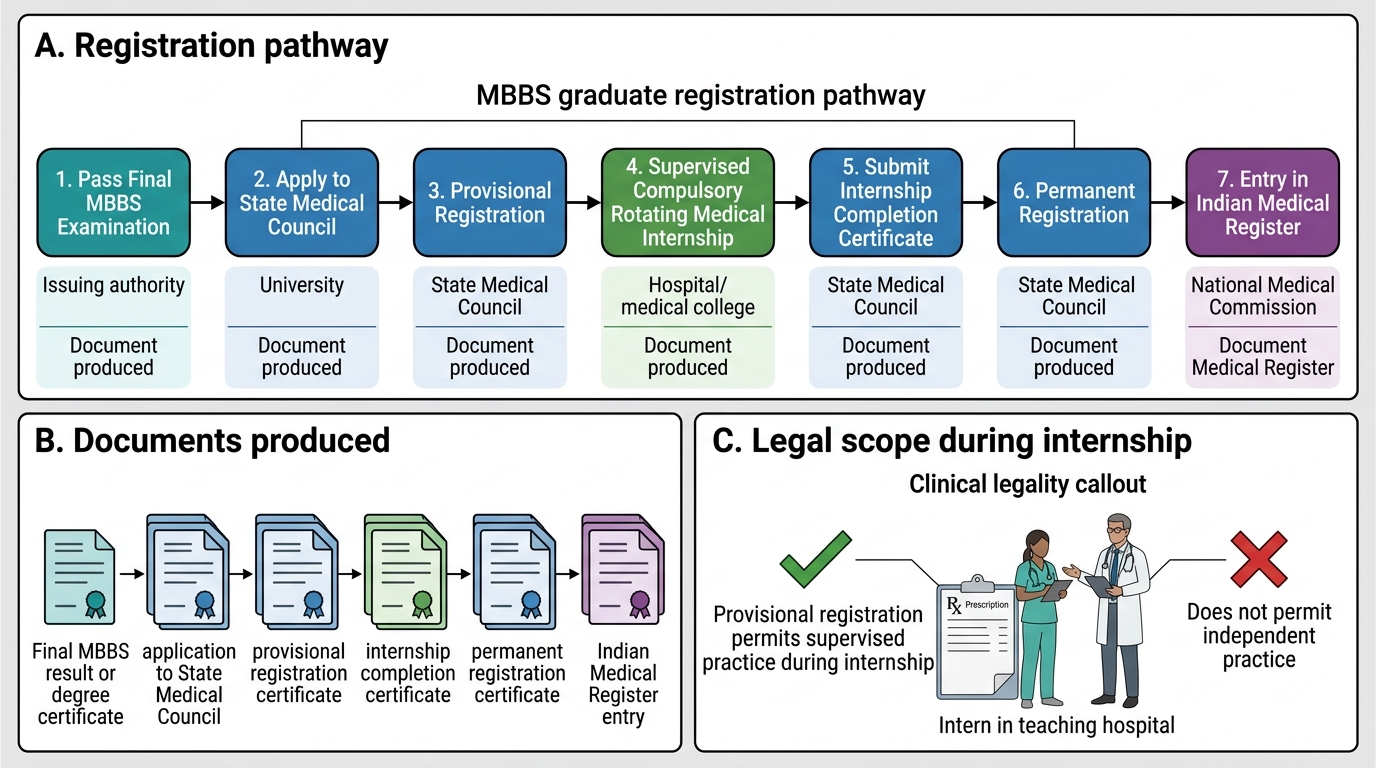
MBBS Graduate Registration Pathway in India
SELF-CHECK
A newly qualified MBBS graduate is working as an intern in a teaching hospital. She prescribes a medication for an inpatient and the prescription is challenged — the patient's family claims she is not 'a real doctor.' What is the correct legal position regarding her practice?
A. She cannot practise medicine at all until she has permanent registration
B. Her MBBS degree alone authorises her to prescribe during internship
C. She holds a provisional registration that authorises supervised practice during internship, but not independent practice
D. She is practising illegally as only permanent registration permits any prescription writing
Reveal Answer
Answer: C. She holds a provisional registration that authorises supervised practice during internship, but not independent practice
An MBBS graduate who has been granted provisional registration by the State Medical Council is legally authorised to practise medicine under supervision during the compulsory internship period. The provisional registration is time-limited and scope-limited — it does not permit independent practice outside the supervised internship setting. The MBBS degree alone, without registration, does not authorise practice.
CLINICAL PEARL
Always quote the NMC Act 2020, never the IMC Act 1956. In examinations and in practice, citing the MCI or the IMC Act as the current authority for medical registration is a factual error. The NMC Act 2020 came into force in September 2020. The NMC was constituted and the MCI was dissolved. Any reference to current registration requirements, disciplinary procedures, or the Indian Medical Register must cite the NMC Act 2020 and the NMC. This distinction is specifically flagged in the FM examination curriculum (FM10.2, FM10.3) because it is a common error.