Page 11 of 23
FM10.{6,24} | Rights & Duties of a Registered Medical Practitioner — SDL Guide
Learning Objectives
- Enumerate the rights and privileges of a registered medical practitioner in India
- Describe the duties of a registered medical practitioner towards patients, colleagues, and society
- Define professional secrecy and privileged communication and explain their scope and exceptions
- Apply the rights-duties framework to clinical scenarios involving disclosure, refusal, and reporting
INSTRUCTIONS
Registration as a medical practitioner confers specific rights — and imposes specific duties. Understanding both is essential to practising medicine legally and ethically. This module examines what rights a registered practitioner holds, what duties are owed to patients, colleagues, and society, and how the doctor-patient relationship generates special obligations around professional secrecy and privileged communication. These obligations have both ethical and legal dimensions under Indian law.
References
- KSN Reddy — Essentials of Forensic Medicine & Toxicology (textbook)
- BV Subrahmanyam — Modi's Medical Jurisprudence and Toxicology (textbook)
Version 2.0 | NMC CBUC 2024
CLINICAL SCENARIO
A 42-year-old man consults his physician for a persistent cough. During the examination, he confides that he uses injectable drugs and shares needles. He tests positive for HIV. He is in a relationship and has not told his partner. He begs the doctor to keep this information confidential. The doctor faces a direct conflict: the principle of professional secrecy says the patient's information must be protected; the principle of public health (and the partner's right to know they are at risk) suggests disclosure. Then a week later, the police arrive and ask the doctor whether the man has visited the clinic, because he is suspected of involvement in a robbery. Are you obligated to tell them? This module equips you to navigate these questions — by understanding the rights and duties of a registered medical practitioner, and the specific rules around professional secrecy.
WHY THIS MATTERS
Rights and duties are not abstract concepts for a medical practitioner — they are the daily currency of clinical practice. Every prescription you write, every conversation you have with a patient about their diagnosis, every decision about whether to refer or continue managing a case — these are exercises of your rights and duties as a registered practitioner. Understanding the legal basis for those rights (and the legal consequences of breaching those duties) is not optional. The Consumer Protection Act 2019 brings medical services within the reach of consumer courts; the NMC Code imposes professional obligations; the Indian Penal Code creates criminal liability for specified violations. A doctor who does not understand this framework is professionally vulnerable.
RECALL
Before we begin:
- From the previous modules, you know that the NMC Code of Medical Ethics imposes duties on practitioners. Can you name three positive duties (things the Code requires you to DO) that you learned in me4?
- You have heard the term 'doctor-patient privilege' — what do you understand by it? Is this a legal or ethical concept, or both?
- In the opening scenario, what factors would you weigh in deciding whether to disclose the patient's HIV status to his partner? What factors would you weigh in deciding whether to respond to the police inquiry?
Legal and Professional Context: The Rights-Duties Balance in Medical Practice
The rights and duties of a registered medical practitioner are derived from multiple sources that operate simultaneously: the ethical obligations of the profession (codified in the NMC Code of Medical Ethics Regulations 2002), the statutory framework under the NMC Act 2020 and other applicable legislation, the common law of contract and tort, and the evolving body of Indian case law that has progressively defined the legal contours of the doctor-patient relationship.
The concept of rights in this context refers to the entitlements that registration confers — the legal authorisation to practise medicine, to charge fees, to maintain confidentiality without being compelled to disclose, and to decline certain patients or procedures in defined circumstances. The concept of duties refers to the obligations that registration imposes — the affirmative obligations to provide care, to inform, to refer, and to report, as well as the negative obligations to refrain from harmful or unethical conduct.
The legal landscape governing medical practice in India is multi-layered:
- NMC Act 2020 and Code of Medical Ethics 2002: Professional rights and duties; disciplinary consequences for breach
- Consumer Protection Act 2019: Medical services fall within the definition of 'service'; patients can approach Consumer Disputes Redressal Commissions for deficiency of service. The landmark case Indian Medical Association vs V.P. Shantha (1995) established medical services as 'services' under the 1986 Act; this principle continues under the 2019 Act.
- Indian Penal Code: IPC 304A (causing death by negligent act), IPC 375 (sexual assault — applies to violations of patient dignity), IPC 499 (defamation), and other provisions
- Indian Evidence Act 1872: Section 126 creates a bar on professional communications — a legal advisor cannot be compelled to disclose communications received in professional capacity; the position for medical practitioners is more complex and discussed below
The rights-duties framework thus operates at both the professional/regulatory level and the legal/statutory level. A breach may be a disciplinary matter (leading to a warning or erasure) or a legal matter (leading to civil liability or criminal prosecution), or both.
Rights of a Registered Medical Practitioner
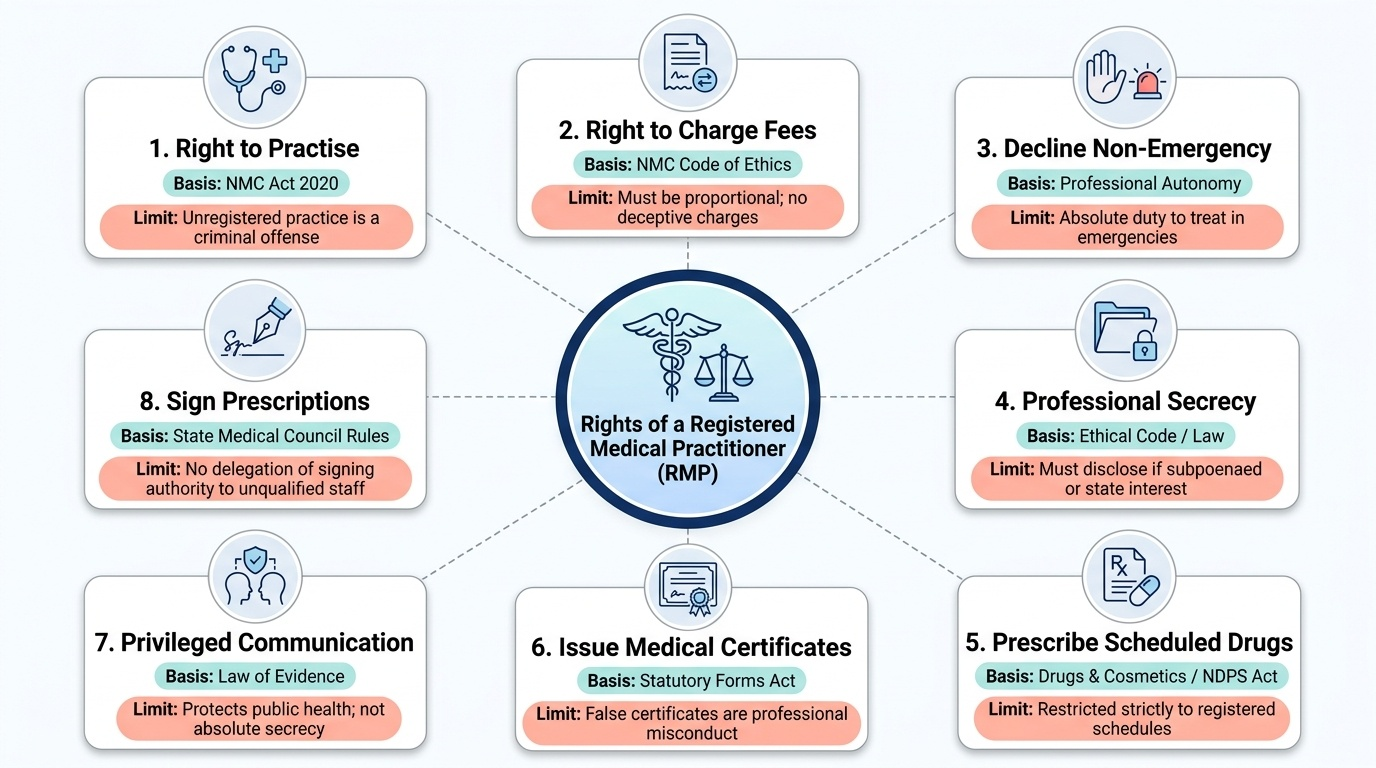
Registration as a medical practitioner confers specific rights that non-registered persons do not hold. Understanding these rights protects the practitioner from inappropriate demands and helps define the boundaries of the professional role.
1. The right to practise medicine. The most fundamental right — the legal authorisation to diagnose, treat, prescribe, and certify. This right is exclusive to registered medical practitioners; practising without registration is an offence under the NMC Act 2020.
2. The right to charge professional fees. A registered practitioner is entitled to charge for professional services. The Code does not fix a fee schedule but requires that fees be in proportion to the services rendered and that no deceptive practices be used in fee collection.
3. The right to decline to treat (non-emergency). A registered practitioner has the right to decline to provide services to a patient in non-emergency situations — for example, if there is a breakdown in the doctor-patient relationship, if the requested treatment is outside the practitioner's competence or specialty, or if the practitioner has a conscientious objection to a procedure. This right does NOT extend to emergency situations — in a medical emergency, every registered practitioner has a duty to provide immediate care to stabilise the patient, regardless of whether payment is available or the patient is unregistered.
4. The right to maintain professional secrecy. A practitioner has a right (and a duty) to maintain confidentiality of patient information and may decline to disclose it except in defined circumstances. This is both an ethical right (the patient's information is held in trust) and, in some limited circumstances, a legal protection.
5. The right to prescribe. Only registered medical practitioners are legally authorised to prescribe scheduled drugs, including Schedule H (hospital and prescription-only) and Schedule X (psychotropic) substances under the Drugs and Cosmetics Act 1940 and NDPS Act 1985.
6. The right to issue medical certificates. Only registered practitioners are legally authorised to issue medico-legal documents: cause of death certificates, fitness certificates, injury certificates, disability certificates, and other statutory certifications.
7. The right to privileged communication. Information disclosed to a doctor in a professional context is 'privileged' — it is understood to be confidential and the doctor cannot be required to disclose it except by court order. This is discussed in detail under the professional secrecy section below.
8. The right to sign prescriptions with the NMC registration number. All prescriptions must include the prescriber's name, qualification, and NMC registration number, and must be written legibly.
Provided image
SELF-CHECK
A patient in a private clinic has a stable, non-emergency hernia and requests surgery. The general surgeon she consults declines to operate because he has just returned from personal leave and has not performed this procedure for six months. He refers her to a colleague. Under the NMC Code, is the surgeon's refusal permissible?
A. No — registered practitioners must treat any patient who requests their services
B. Yes — a practitioner may decline non-emergency treatment, particularly when competence concerns are present, provided they refer appropriately
C. No — declining to treat is only permissible when the patient cannot pay
D. Yes — but only if the patient gives written consent to the refusal of treatment
Reveal Answer
Answer: B. Yes — a practitioner may decline non-emergency treatment, particularly when competence concerns are present, provided they refer appropriately
A registered practitioner may decline to treat a non-emergency patient, particularly when the request is outside their current competence or when there is a legitimate clinical reason to refer. The NMC Code does not require a practitioner to perform procedures they are not currently competent to perform safely. The duty to treat without exception applies only in genuine emergencies. Referring to a qualified colleague is the appropriate professional response.
Duties of a Registered Medical Practitioner
Registration as a medical practitioner imposes positive obligations that form the core of professional practice. These duties are drawn from the NMC Code of Medical Ethics 2002, the NMC Act 2020, and from other applicable legislation and case law.
Duties towards patients:
- Duty of care: The primary obligation — to provide competent, appropriate medical care to the patients under the practitioner's care, meeting the standard of a reasonably skilled practitioner in that specialty (Bolam test as adapted in Indian case law)
- Duty of informed consent: To provide adequate, accurate, and comprehensible information about diagnosis, treatment options, risks, and alternatives before obtaining consent; to ensure the patient has decision-making capacity
- Duty of confidentiality: To protect patient information from unauthorised disclosure; this duty survives the end of the clinical relationship and extends even after the patient's death in most circumstances
- Duty of referral: To refer a patient whose condition is beyond the practitioner's competence, or when specialist input would benefit the patient
- Duty of emergency care: To provide immediate life-saving care in an emergency, regardless of the ability to pay or the existence of a pre-existing doctor-patient relationship
- Duty of accurate documentation: To maintain complete and accurate clinical records; these are both a clinical tool and a legal document
Duties towards society:
- Duty of statutory notification: To report notifiable diseases (TB, cholera, plague, typhoid, smallpox/vaccination complications, malaria in endemic areas, etc.) to the appropriate public health authority as required under the Epidemic Diseases Act 1897, PCPNDT Act 1994 for sex-selective abortions, and state public health legislation
- Duty to report court-ordered examinations: When ordered by a court to conduct a medical examination, the practitioner must do so and submit a report
- Duty to report injuries from certain causes: Under specific circumstances (e.g. injuries likely resulting from criminal violence, IPC 304A deaths), there may be obligations to report to police or a magistrate
- Duty of professional competence: To maintain current clinical competence through continuing medical education; not to practise beyond the limits of current skill and knowledge
| Duty Category | Specific Duty | Statutory/Code Basis | Consequence of Breach |
|---|---|---|---|
| Towards patients | Duty of care | NMC Code + negligence law | Civil liability (IMA vs V.P. Shantha); disciplinary action |
| Towards patients | Informed consent | NMC Code + Consumer Protection Act 2019 | Consumer dispute; disciplinary action |
| Towards patients | Confidentiality | NMC Code | Disciplinary action; possible tort liability |
| Towards patients | Emergency care | NMC Code | Disciplinary action |
| Towards society | Notifiable disease reporting | Epidemic Diseases Act 1897; state public health acts | Possible criminal liability for non-reporting |
| Towards society | Court-ordered examinations | Courts — binding order | Contempt of court |
| Towards profession | Maintain competence | NMC Code | Disciplinary action if practice falls below standard |