Page 10 of 20
FM5.6,FM14.10 | Weapons of Medico-legal Importance — SDL Guide
Learning Objectives
- Classify weapons of medico-legal importance by type and describe the characteristic wound pattern produced by each class
- Identify and describe all 11 named weapons in FM14.10 (lathi, knife, kripan, axe, gandasa, gupti, farsha, dagger, bhalla, razor, stick) with their key identifying features and wound-type associations
- Describe the systematic examination protocol for a weapon submitted as a medico-legal exhibit, including chain of custody requirements
- Prepare a weapon report and formulate a medico-legal opinion connecting weapon characteristics to injury findings
INSTRUCTIONS
When the police present a weapon as evidence in an assault or homicide case, the forensic physician is asked to perform two tasks: describe the weapon systematically and give an opinion connecting it to the injuries found on the victim or at the scene. This is a skill as much as a knowledge task — the weapon must be examined like a clinical specimen, with a systematic protocol, careful documentation, and strict chain-of-custody procedures. This module covers the classification of weapons encountered in Indian medico-legal practice, with specific attention to the 11 named weapons in the NMC FM14.10 competency, and the forensic examination and reporting procedure for weapon exhibits.
References
- KSN Reddy — Essentials of Forensic Medicine & Toxicology (textbook)
- BV Subrahmanyam — Modi's Medical Jurisprudence and Toxicology (textbook)
Version 2.0 | NMC CBUC 2024
CLINICAL SCENARIO
The investigating officer presents a 35 cm long, slightly curved, single-edged blade with a wooden handle and visible brownish staining on the blade. The victim has a stab wound 3 cm long, 9 cm deep into the left chest, with one sharply tapered end and one end showing a small abrasion collar consistent with the blunt spine of the blade. The defence counsel claims the weapon was 'a religious artefact of cultural significance, not a weapon.' You are asked: what type of weapon is this, is it capable of producing the injury described, what does the abrasion collar at one end of the stab wound indicate about the blade's cross-section, and how does this weapon connect to the injury in a medico-legal opinion?
WHY THIS MATTERS
The identification of weapons in medico-legal practice is a bidirectional skill. From the wound, one works forward to the likely weapon class; from a submitted weapon exhibit, one works backward to the wound pattern it could have produced. Both directions are required in forensic practice. In courts, defence counsel frequently challenge weapon-wound connections — claiming a wound could have been caused by a different weapon, that the weapon lacks the capacity to cause the described injury, or that the weapon is a cultural or ceremonial object rather than a dangerous weapon. The forensic physician who can systematically examine a weapon, describe it with precision, and articulate the biological mechanism connecting it to specific wound features provides the court with expert testimony that withstands cross-examination. The FM14.10 competency specifically enumerates 11 weapons commonly encountered in Indian medico-legal practice, reflecting regional patterns of violence and cultural weapons with known forensic profiles.
RECALL
From the wound classification module (FM5.1), recall the defining features that allow weapon class inference: tissue bridges indicate blunt force, incised wounds (length > depth, clean margins, no tissue bridges) indicate a sharp edge, stab wounds (depth > length) indicate a sharp point, and chop wounds (bone notching, combined incised/lacerated) indicate a heavy sharp weapon. From general anatomy, recall that the cross-sectional geometry of a weapon's blade determines the wound shape — a single-edged blade with a sharp edge and a blunt spine produces a wound with one tapered end and one squared/notched end; a double-edged blade produces a wound with two tapering ends. These wound-geometry relationships are the basis for the weapon-wound connection opinion.
From Injury to Weapon: The Reconstruction Challenge
The forensic physician occupies a unique position in the criminal justice chain: they are the expert who connects the biological evidence — the wound on the victim's body — with the physical evidence — the weapon submitted by the police. This reconstruction is more complex than it appears. A single wound type can be produced by several different weapons within the same class, and conversely, a single weapon can produce different wound types depending on how it is used (a knife drawn along the skin produces an incised wound; the same knife thrust produces a stab wound).
The legal context is particularly important because certain weapons under the Arms Act 1959 are licensed, restricted, or prohibited. The possession of certain weapons — particularly firearms and specified categories of sharp and prohibited weapons — without a valid licence is itself an offence. The forensic physician's description of a weapon exhibit may therefore have dual legal significance: it is relevant both to the injury charges and to the weapons-possession charges. In the scenario above, the question of whether the curved single-edged blade is a 'kripan' (a traditional Sikh ceremonial weapon, which has specific legal protections under the Constitution of India and is exempted from Arms Act provisions for Sikhs) or a general-purpose sharp weapon is medico-legally relevant — but the forensic physician's opinion should focus on the weapon's physical characteristics and capacity to cause the described injury, not on its cultural status, which is for the court to determine.
The professional responsibility here is significant: the weapon report must be objective, reproducible, and based solely on what can be observed and measured. An opinion that overstates or understates the weapon's capacity to cause the injury — whether because of bias, pressure, or inadequate examination — compromises the integrity of the entire medico-legal process.
Classification of Weapons of Medico-legal Importance
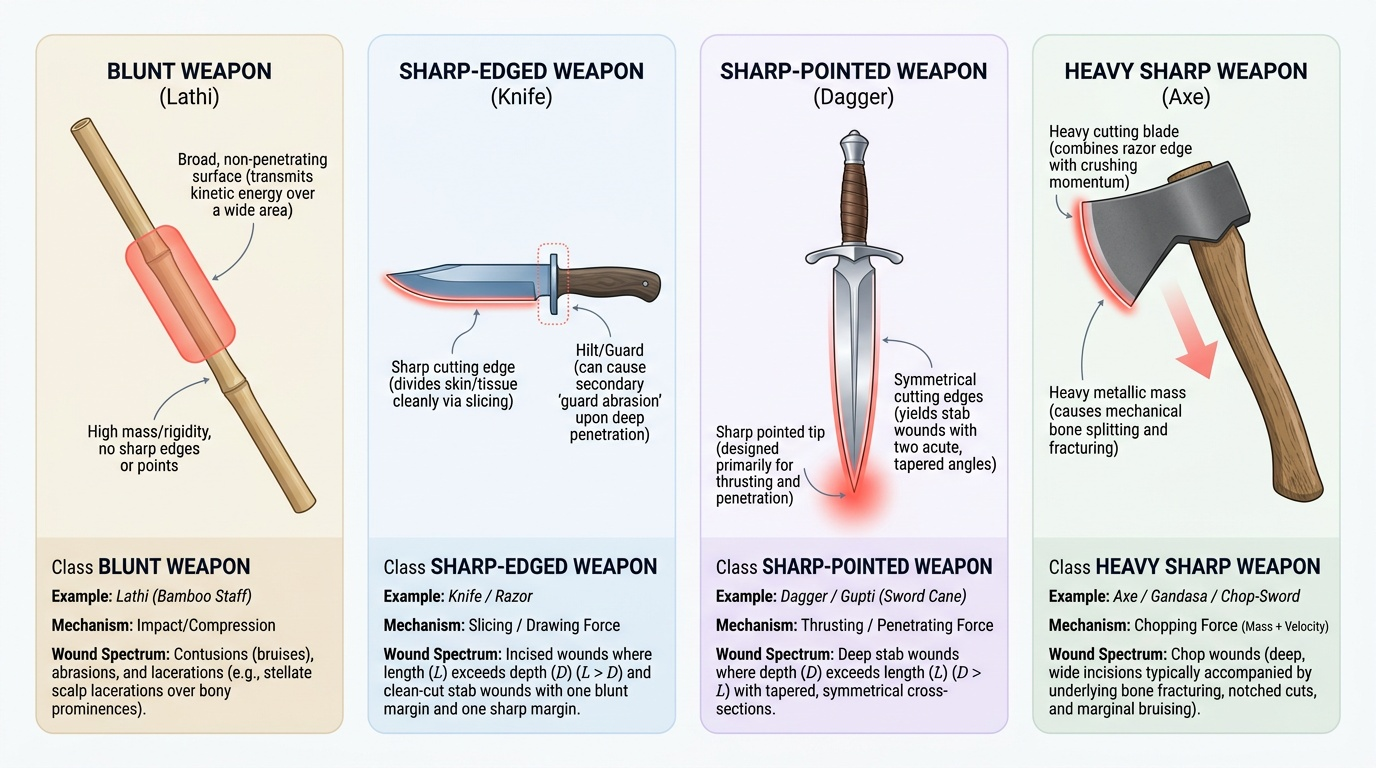
Weapons of medico-legal importance are classified primarily by their construction and the mechanism by which they injure, which directly determines the wound type they produce. A working classification for forensic purposes divides weapons into four main categories based on the nature of the injuring surface.
Blunt weapons have no sharp edge or point — they injure by transmitting force over a broad contact area, producing contusions, abrasions, and lacerations (via tearing/bursting). Examples include the lathi (bamboo or wooden staff), danda (stick), stones, hammers, and bricks. A lathi strike to the scalp typically produces a stellate laceration over the parietal or occipital bone, where the skin bursts between the blunt weapon and the underlying bone. Blunt weapons may also fracture underlying bones, particularly over the skull, ribs, and long bones.
Sharp-edged weapons have at least one sharpened cutting edge and injure primarily by dividing tissue, producing incised wounds when drawn across the skin and stab wounds when thrust into tissue. Examples include the knife, razor, kripan, farsha (when the edge, not the mass, is the injuring surface), and glass. Sharp-edged weapons typically have a hilt, guard, or handle that leaves a guard abrasion or collar mark at the wound entry when the weapon is fully plunged to the hilt.
Sharp-pointed weapons have a sharp tip designed for thrusting rather than cutting, producing stab wounds. The dagger (double-edged) and gupti (a sword cane with a concealed blade) are the primary examples. The double-edged dagger produces a characteristic stab wound with both ends tapering — distinguishing it from a single-edged knife wound where one end is tapered and the other shows a squared or notched appearance from the blunt spine.
Heavy sharp weapons combine mass (enabling force) with a sharpened blade, producing chop wounds with features of both incised and lacerated wounds, often with bone notching or fracture. The axe, gandasa (a large single-edged agricultural chopper), farsha (a large double-edged axe-like weapon used historically), and bhalla (a spear, used as a thrust weapon) fall into this category when mass delivery is the primary mode.
Provided image
SELF-CHECK
A stab wound is found on the left chest wall measuring 3 cm on the skin surface. Examination of the wound shows BOTH ends of the wound are sharply tapered. What type of weapon most likely produced this wound?
A. A single-edged kitchen knife
B. A lathi
C. A double-edged dagger
D. A razor
Reveal Answer
Answer: C. A double-edged dagger
Both ends of the stab wound tapering indicates that the weapon has two sharp edges converging at the tip — this is the characteristic of a double-edged blade such as a dagger. A single-edged knife produces a stab wound with ONE tapered end (from the sharp edge) and one squared or notched end (from the blunt spine). A lathi produces a laceration, not a stab wound. A razor produces incised wounds (length > depth), not stab wounds.
Named Weapons Under FM14.10: Features and Wound Patterns
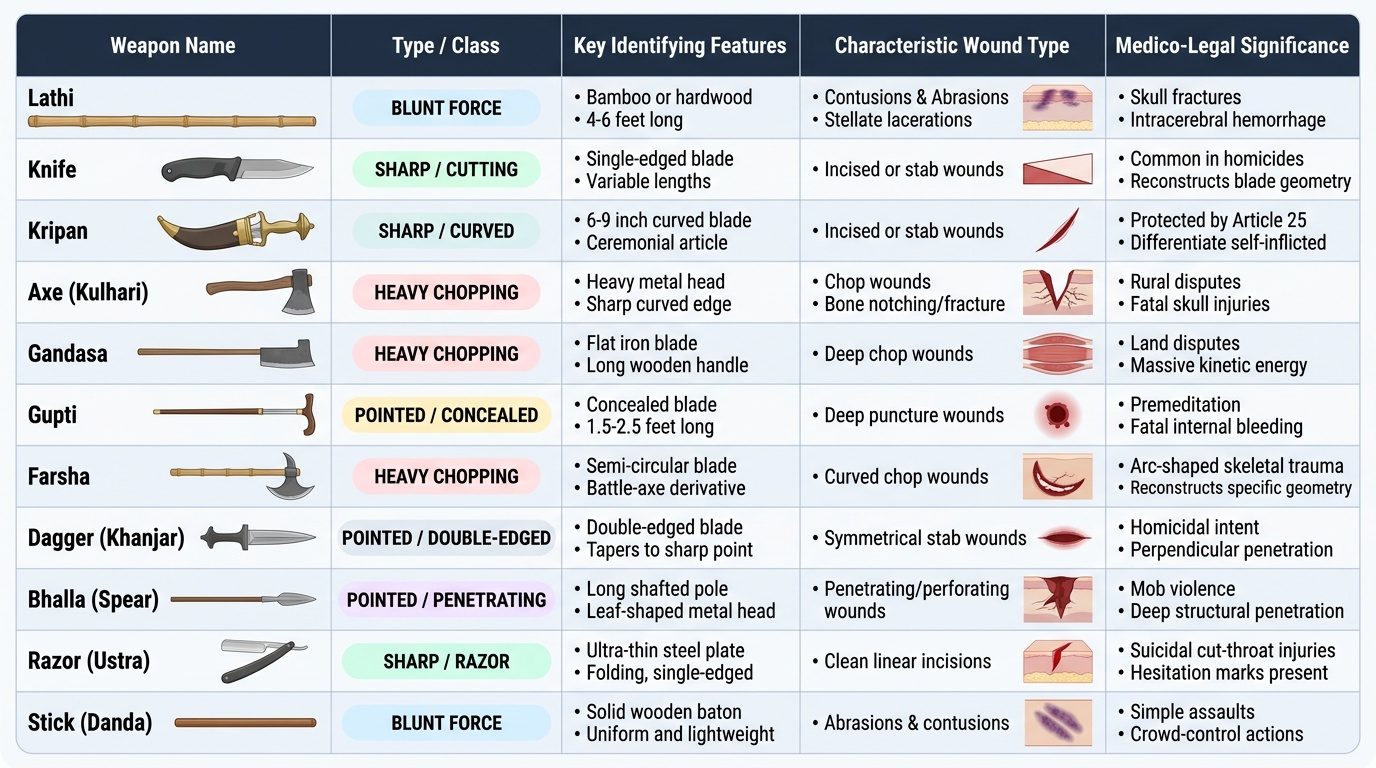
The NMC FM14.10 competency identifies eleven specific weapons that are of established medico-legal importance in Indian forensic practice, reflecting the weapons most commonly encountered in courts, post-mortems, and injury examinations across the subcontinent. Each weapon has characteristic physical features and a characteristic wound pattern that the forensic physician must be able to identify and describe.
Lathi: A bamboo or hardwood rod, typically 4–6 feet long. A blunt weapon producing contusions, abrasions, and lacerations with stellate or linear patterns over the scalp, and long-bone fractures. A hard blow with a lathi to the head can be fatal via intracerebral haemorrhage.
Knife: A single-edged blade with a handle. Available in a wide size range (pen knife to bread knife). Produces incised wounds (drawn) or stab wounds (thrust), with one tapered end and one squared end in the wound. One of the most common sharp weapons in Indian forensic practice.
Kripan: A traditional curved single-edged blade carried by Sikhs as one of the five Ks (Panj Kakars); constitutionally protected for Sikhs under Article 25. Typically 6–9 inches in blade length, slightly curved. Produces incised or stab wounds depending on mode of use, distinguishable from a standard knife by the curvature.
Axe: A heavy metal blade mounted on a wooden handle. Produces chop wounds with bone notching or frank fracture of the underlying bone. The wound margins are partially clean (from the edge) and partially lacerated (from the mass and force), with crushing of the wound floor. Fatal axe injuries to the skull are common in homicide cases in agricultural communities.
Gandasa: A large agricultural chopper with a heavy broad blade, common in Punjab and Haryana. Similar to an axe in wound production — chop wounds, severe skeletal damage, and limb amputation are possible. The blade is typically broader and heavier than a standard axe.
Gupti: A sword cane — a walking stick that conceals a sharp blade inside, which can be drawn rapidly. The outer appearance is that of a walking stick. The concealed blade (single or double-edged) produces incised or stab wounds. Forensically significant because the perpetrator carries it without arousing suspicion.
Farsha: A large double-edged axe-like weapon with a broad blade, used both as a sharp and heavy weapon. Produces chop wounds when the mass and force of the swing delivers energy through the blade, with bilateral clean wound margins (due to double edge) but crushing at the base.
Dagger: A double-edged pointed blade designed for thrusting, with both edges sharpened. Stab wounds produced have two tapering ends. May have a central ridge (fuller). Distinguished from a knife by the double-edged construction and the wound geometry.
Bhalla: A spear or lance — a long shaft with a metal point, used for thrusting. Produces penetrating stab-type wounds, typically in the trunk or thigh. The wound entry may be round or oval, with depth greatly exceeding length. In historical and regional contexts, also refers to a broad-headed spear variant.
Razor: A thin flexible single-edged blade (safety or straight razor). Produces very fine, shallow incised wounds. Commonly encountered in suicidal wounds on the anterior wrist and neck; also in occupational injuries. The wound is typically superficial, finely incised, and bleeds freely.
Stick: A general term for a shorter, lighter blunt wooden or metal rod. Produces contusions, abrasions, and lacerations similar to the lathi but with smaller force and lesser skeletal injury. Patterned contusions may reproduce the stick's shape.
Provided image
CLINICAL PEARL
When examining a stab wound, the guard abrasion (an abrasion or contusion around the entry wound when the blade is fully plunged to the hilt, caused by the handle guard impacting the skin) is a critical forensic finding. Its presence establishes that the blade was inserted to its full depth — which informs the minimum blade length. Its shape may even reproduce the guard's profile. Always note the presence, shape, and dimensions of a guard mark, and correlate it with the submitted weapon's hilt dimensions when available.