Page 11 of 17
FM8.10 | PC&PNDT & Domestic Violence Acts — SDL Guide
Learning Objectives
- State the purpose and key provisions of the Pre-Conception and Pre-Natal Diagnostic Techniques (PC&PNDT) Act 1994 and its amendments
- Describe the registration requirements, prohibited practices, and penalties under the PC&PNDT Act
- Explain the mandatory Form F (antenatal ultrasound record) and its legal significance
- State the key provisions of the Protection of Women from Domestic Violence Act 2005 and the types of domestic violence it covers
- Identify the doctor's duties under each Act and the consequences of non-compliance
INSTRUCTIONS
The PC&PNDT Act 1994 addresses one of India's most persistent public health challenges — sex-selective foeticide — by regulating who may perform prenatal diagnostics, for what purpose, and with what documentation. The Domestic Violence Act 2005 addresses a different dimension of reproductive and family harm by providing civil protection to women in abusive relationships. Both Acts place specific obligations on doctors — understanding them is not optional for any MBBS graduate.
References
- KSN Reddy — Essentials of Forensic Medicine & Toxicology (textbook)
- BV Subrahmanyam — Modi's Medical Jurisprudence and Toxicology (textbook)
Version 2.0 | NMC CBUC 2024
CLINICAL SCENARIO
A radiologist performing routine antenatal ultrasounds is visited by a government inspector. The inspector finds that Form F (the mandatory consent and record form) has not been filled for 15 ultrasounds performed that day, and that the machine is not registered under the PC&PNDT Act. The radiologist says, 'I only report findings — I never disclose sex.' Across the city, a woman arrives at the emergency department with bruising consistent with repeated blunt trauma. She says her husband beats her regularly but does not wish to file a police complaint. The intern asks: 'What is my legal obligation here?' Both scenarios require knowledge of two specific Acts.
WHY THIS MATTERS
India's sex ratio at birth was severely skewed for decades due to sex-selective abortion, despite being illegal under the MTP Act. The PC&PNDT Act 1994 (amended 2002 to cover pre-conception techniques) represents the legislative response — creating a registration and documentation framework designed to enable enforcement action even when no explicit sex disclosure is witnessed. The Domestic Violence Act 2005 created India's first comprehensive civil protection mechanism for women in abusive relationships, covering physical, emotional, economic, and sexual violence. Every doctor who manages antenatal care or treats injured women must be familiar with both.
RECALL
From public health: recall India's declining child sex ratio (historically below 950 girls per 1000 boys in many states) and its demographic drivers. From MTP SDL (so10): termination of pregnancy for sex selection is illegal under the MTP Act regardless of gestational age. From FM8.1 SDL: BNSS Section 52 mandates information to police when a victim of an offence presents — this applies to domestic violence injuries.
PC&PNDT Act 1994: Purpose, Scope, and Amendments
The Pre-Conception and Pre-Natal Diagnostic Techniques (Prohibition of Sex Selection) Act was enacted in 1994 and significantly amended in 2002 to extend its scope to pre-conception sex selection techniques (not just prenatal diagnostics). The 2002 amendment also tightened registration requirements and penalties. The Act is referred to as PC&PNDT post-2002 (previously PNDT Act).
Purpose: The Act prohibits the use of any technique — prenatal or pre-conception — for the purpose of sex determination or sex selection. It regulates all facilities that conduct prenatal diagnostic procedures to ensure they are not misused for sex selection, while permitting their use for legitimate medical indications (detection of chromosomal abnormalities, genetic disorders, metabolic disorders, haemoglobinopathies, and sex-linked disorders).
Scope: The Act covers:
- All genetic counselling centres, genetic laboratories, and genetic clinics — including ultrasound facilities used for antenatal purposes
- All pre-natal diagnostic techniques — ultrasound, amniocentesis, chorionic villus sampling (CVS), foetoscopy, and sex chromatin analysis
- All pre-conception techniques — any method used to select the sex of the child before conception
Key provisions:
- Registration: every genetic clinic, laboratory, or counselling centre must be registered with the Appropriate Authority (typically District CMO) — registration is not optional and is facility- and machine-specific.
- Permitted indications: prenatal diagnostics may only be conducted for listed medical indications (chromosomal abnormalities, fetal anomalies, metabolic disorders, haemoglobinopathies); not for routine sex determination.
- Prohibition: determining the sex of the foetus and communicating it is absolutely prohibited; even indirect communication (e.g., gestures, codes on forms) is an offence.
- Form F: every pregnant woman undergoing an antenatal ultrasound must complete Form F — a prescribed consent and record form. The doctor must complete it for every scan, and the facility must maintain Form F records for two years. Failure to fill Form F is an offence under the Act, independent of whether sex was disclosed.
- Penalty: suspension and cancellation of registration; imprisonment up to 3 years and fine up to ₹10,000 (first offence); enhanced for subsequent offences.
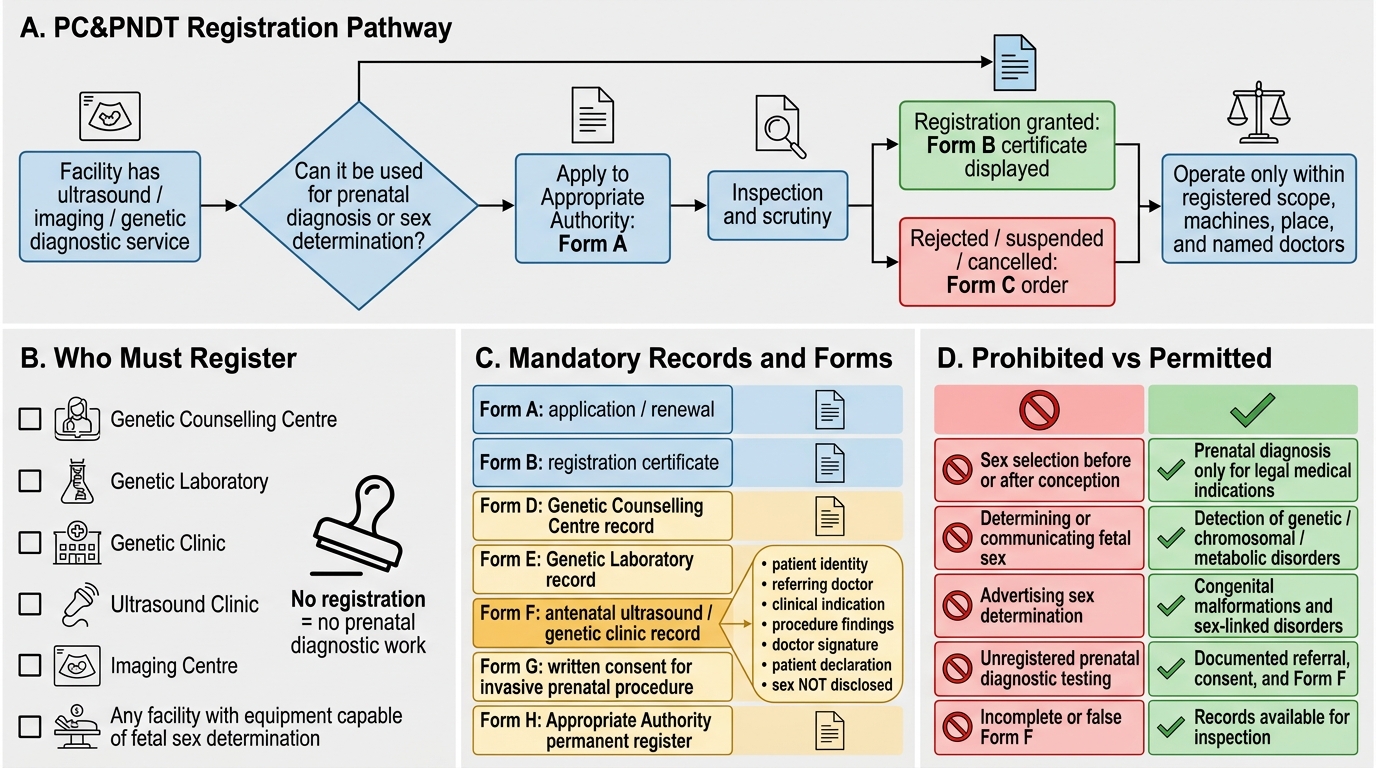
PC&PNDT Act: Registration, Records, and Prohibitions
SELF-CHECK
A radiologist performing antenatal ultrasounds has not filled Form F for any scan conducted this week. She claims she never discloses foetal sex. Under the PC&PNDT Act 1994, is she in violation?
A. No — Form F is only required if sex determination was requested
B. No — Form F is only mandatory for amniocentesis and CVS, not ultrasound
C. Yes — Form F must be completed for every antenatal ultrasound regardless of whether sex determination was requested; failure to complete it is a standalone offence under the Act
D. Yes — but only if the facility has been previously warned
Reveal Answer
Answer: C. Yes — Form F must be completed for every antenatal ultrasound regardless of whether sex determination was requested; failure to complete it is a standalone offence under the Act
Form F is mandatory for every antenatal ultrasound conducted at a registered facility, regardless of indication or whether sex determination was requested. It is both a record-keeping requirement and an enforcement tool. Non-completion is an independent offence under the PC&PNDT Act.
PC&PNDT: Appropriate Authority, Offences, and Penalties
The enforcement framework under the PC&PNDT Act relies on the Appropriate Authority (AA), which is appointed at the national, state, and district levels. At the district level, the AA is typically the Chief Medical Officer (CMO). The AA has sweeping investigative powers: it can inspect any registered or unregistered facility, seize equipment, cancel registrations, and file complaints with the police.
Sealing and confiscation: Where a facility is found operating without registration, or where sex determination is established, the AA can seize and seal ultrasound machines. Continued operation after sealing is a criminal offence.
Advisory committees: The AA works with multimember advisory committees that include medical professionals, legal experts, and civil society representatives.
Who can be prosecuted:
- The person conducting the procedure
- The owner of the facility
- Any person who assisted or aided sex determination
- The relative or husband who sought sex determination — a specific provision making the requesting party (not just the provider) liable
Decoy operations: Police and Appropriate Authority officials are empowered to use undercover operations ('sting operations') in which a pregnant woman poses as a patient seeking sex determination. Evidence obtained this way has been accepted by courts as valid, and successful prosecutions have resulted.
Form F specifics: The form records the woman's name and address, her husband's name, indication for the scan, gestational age, findings (reported without mentioning foetal sex), and the radiologist's signature. The declaration by the patient that she is not seeking sex determination is a mandatory element.
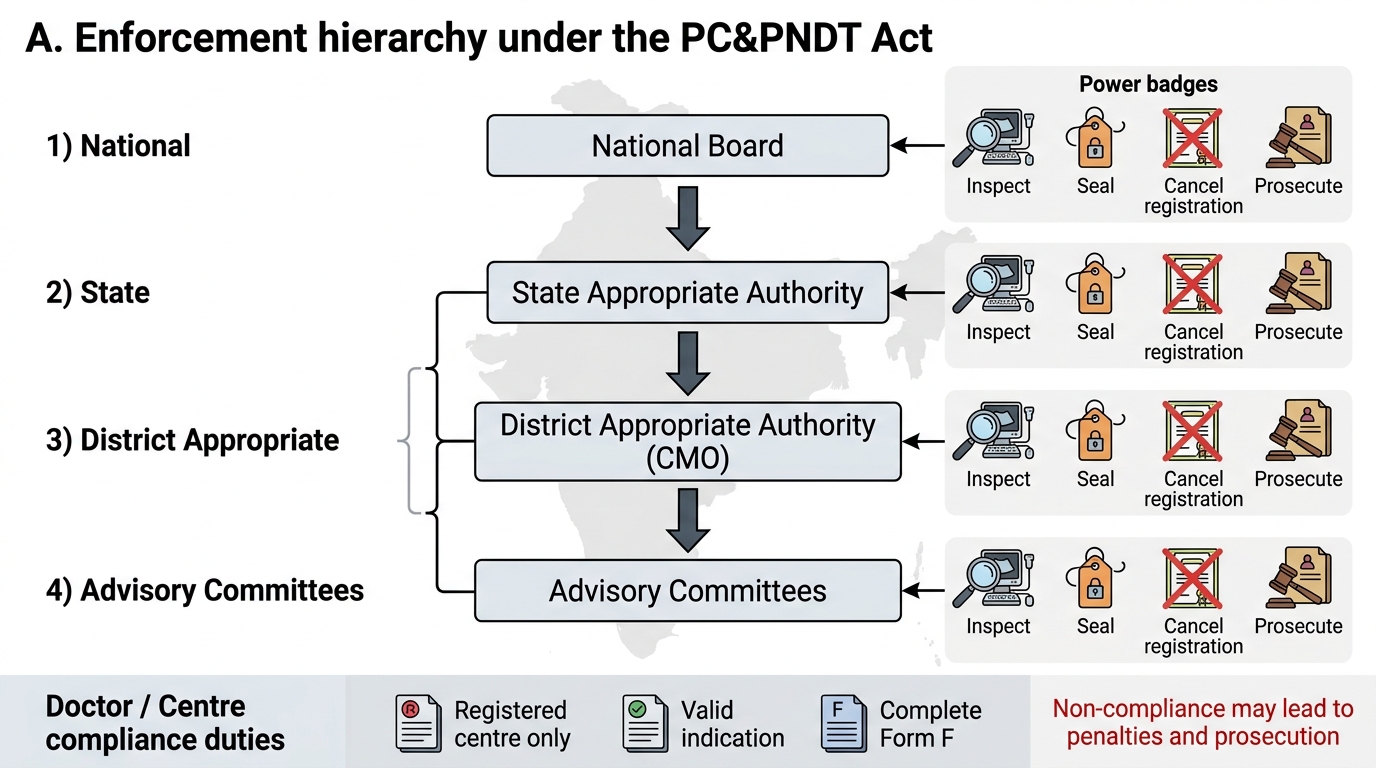
PC&PNDT Act Enforcement Hierarchy
Protection of Women from Domestic Violence Act 2005: Key Provisions
The Protection of Women from Domestic Violence Act 2005 (PWDVA) created India's first comprehensive civil framework to protect women from all forms of domestic abuse. It is a civil law — its primary remedies are civil orders (protection orders, residence orders, maintenance orders) rather than criminal prosecution, though criminal provisions under the BNS/IPC for assault, cruelty, etc., operate in parallel.
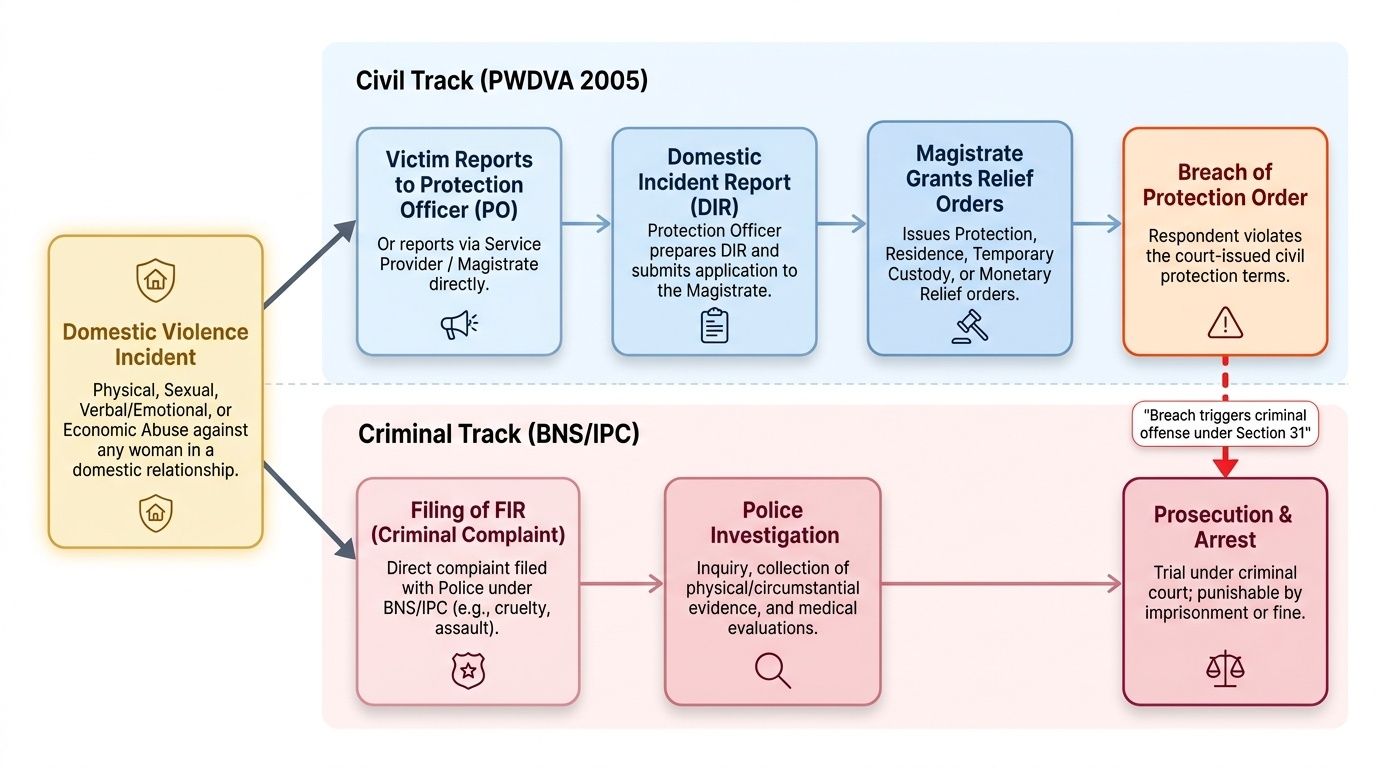
Provided image
Who is covered: Any woman who is or has been in a domestic relationship with the respondent. This includes wives, live-in partners, daughters, mothers, sisters, and daughters-in-law. The woman need not be married.
Definition of domestic violence: The Act provides an unusually broad definition encompassing:
1. Physical abuse: bodily pain, harm, injury, or danger to life or health
2. Sexual abuse: any conduct that abuses, humiliates, degrades, or violates the dignity of a woman in a sexual manner
3. Verbal and emotional abuse: insults, ridicule, humiliation, name-calling, including about inability to bear a child, bringing insufficient dowry, or about any other behaviour
4. Economic abuse: deprivation of financial resources, disposal of household effects, disposal of property she is entitled to, restriction on employment or access to financial resources
Remedies under the Act:
- Protection order: prohibiting the respondent from committing domestic violence, contacting the woman, or entering her workplace or school
- Residence order: entitling the woman to reside in the shared household; respondent may be restrained from entering the woman's portion
- Monetary relief: compensation for medical expenses, losses, and mental anguish
- Custody order: temporary custody of children
Role of the doctor: The doctor's role under the PWDVA is to:
1. Provide medical care for injuries
2. Document injuries accurately (injury description, photographic documentation if possible)
3. Inform the woman of the existence of the Act and available remedies
4. Inform the local Protection Officer (an officer appointed under the Act in every district)
5. Where injuries indicate an offence has occurred, comply with BNSS Section 52 mandatory reporting duties
The doctor is not empowered to compel the woman to file a complaint — the Act emphasises that the woman retains agency over her situation. The doctor's duty is to provide care, document, inform, and report where mandatory.
SELF-CHECK
A woman presents to the emergency with bruising she attributes to her husband's violence. She explicitly says she does not want to file a police complaint. The intern asks what to do. Under the PWDVA and BNSS, which is the correct approach?
A. Respect the woman's choice; provide treatment and send her home without further action
B. Compel her to file an FIR — the doctor's duty overrides her personal decision
C. Provide treatment, accurately document injuries, inform her of the PWDVA and available remedies (Protection Officer, legal aid), and report to the police under BNSS Section 52 as the injuries indicate an offence — the decision to pursue a complaint remains hers
D. Only report to police if the injuries are life-threatening
Reveal Answer
Answer: C. Provide treatment, accurately document injuries, inform her of the PWDVA and available remedies (Protection Officer, legal aid), and report to the police under BNSS Section 52 as the injuries indicate an offence — the decision to pursue a complaint remains hers
The doctor's duties are independent of the patient's decision to file a complaint: (1) treat injuries, (2) document accurately, (3) inform of PWDVA remedies and the Protection Officer, (4) report to police under BNSS Section 52 (mandatory when injuries indicating an offence are present). The woman's agency to decide whether to pursue a complaint is preserved — the doctor's reporting is an independent duty.
CLINICAL PEARL
Under the PC&PNDT Act, even indirect communication of foetal sex is a criminal offence — the law specifically recognises that radiologists developed coded means of conveying sex (positioning the probe, congratulating or condoling, suggesting specific follow-up) without explicit verbal disclosure. A radiologist who nods when asked 'is it a boy?' has committed an offence. The zero-tolerance enforcement posture means procedural compliance (Form F, registration, documentation) is not just best practice — it is a survival requirement for practice.
SELF-CHECK
A husband requests that the radiologist disclose the foetal sex during an ultrasound, saying it is his right to know. The radiologist is bound by the PC&PNDT Act. Which response is correct?
A. Disclose the sex to the husband but not to the wife
B. Disclose only if the husband signs a declaration that he will not use the information for sex-selective abortion
C. Decline to disclose foetal sex under any circumstances; explain that disclosure is absolutely prohibited under the PC&PNDT Act
D. Disclose if the requesting indication is legitimate (not sex-selection)
Reveal Answer
Answer: C. Decline to disclose foetal sex under any circumstances; explain that disclosure is absolutely prohibited under the PC&PNDT Act
The PC&PNDT Act absolutely prohibits disclosure of foetal sex — to anyone, for any reason, at any gestational age. There is no exception permitting disclosure to the husband or on request. The prohibition is categorical, and any disclosure (including indirect communication) is a criminal offence.
KEY TAKEAWAYS
PC&PNDT Act 1994 (amended 2002): all genetic clinics and prenatal diagnostic facilities must register with the Appropriate Authority; Form F is mandatory for every antenatal ultrasound; determination or disclosure of foetal sex (direct or indirect) is absolutely prohibited; penalties include imprisonment, fine, and facility sealing. Domestic Violence Act 2005: broad civil law covering physical, sexual, verbal/emotional, and economic abuse in domestic relationships; remedies include protection orders, residence orders, and monetary relief; the doctor's duties are to treat, document, inform the woman of remedies and the Protection Officer, and report injuries indicating an offence under BNSS Section 52 — all independent of the woman's decision to file a complaint.
REFLECT
A colleague physician says: 'I run a busy obstetrics practice. I complete Form F but sometimes I just sign them without filling in the findings section because I'm rushed. Does it really matter?' How would you explain to them the significance of proper Form F completion — both its legal status and its role in the enforcement framework against sex-selective foeticide?