Page 7 of 35
IM26.{8-11,14,17} | Bacterial Skin Visceral Urinary and Enteric Infections — SDL Guide (Part 3)
Self-Assessment: Bacterial Infection Syndromes
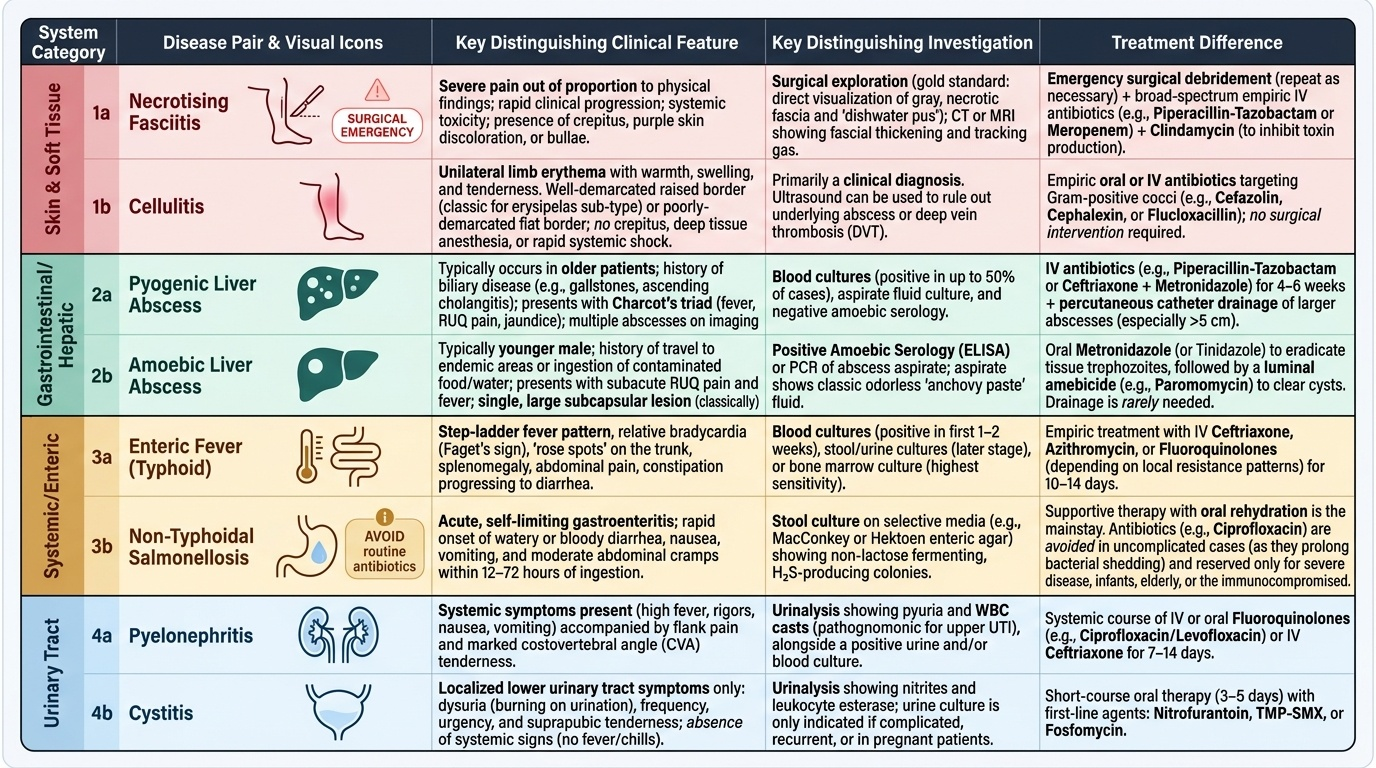
The clinical scenarios below challenge you to apply the organ-system knowledge from this SDL in an integrated fashion. For each scenario, identify the most likely diagnosis, the single most important investigation, and the empirical treatment. Work through the reasoning before reading the analysis — the goal is to build the habit of structured clinical thinking rather than pattern-matching.
Provided image
Scenario A: A 55-year-old diabetic woman presents with fever (38.7°C), right upper quadrant pain, and jaundice for 3 days. She has a history of gallstones. Examination reveals scleral icterus, tender hepatomegaly, and right-upper-quadrant guarding. WBC 19,400/µL. Ultrasound shows a dilated common bile duct (11 mm), multiple gallstones, and two hypoechoic hepatic lesions (3 cm and 5 cm). Amoebic ELISA is negative.
Analysis: Gallstone history + dilated CBD + jaundice + fever (Charcot's triad = ascending cholangitis) + multiple hepatic abscesses + negative amoebic serology = pyogenic liver abscess secondary to ascending cholangitis. Most important investigation: blood cultures × 2, biliary culture at ERCP. Management: IV piperacillin-tazobactam (covers Gram-negatives and anaerobes) + ERCP with bile duct decompression + percutaneous drainage of the larger abscess (5 cm). Cholecystectomy after the acute episode resolves.
Scenario B: A 19-year-old woman presents with 6 hours of sudden-onset fever (39°C), chills, rapidly spreading erythema of the right lower leg with a sharply demarcated raised border, and tender local lymph node. The skin surface is bright red and hot; palpation reveals normal soft tissue without crepitus or woody induration. There is no bullae.
Analysis: Sharp, raised, well-demarcated border + superficial red colour + tender inguinal adenopathy + no wooden texture or bullae = erysipelas (superficial dermis; Group A Streptococcus). The sharp border and young age argue against necrotising fasciitis. No features of deep-tissue involvement. Treatment: IV benzylpenicillin 1.2 g four times daily for hospitalised patients; oral penicillin V (or amoxicillin) for mild cases. Rapid clinical improvement expected within 24–48 hours; failure to improve should prompt reassessment for deeper involvement.
Scenario C: Eleven people who attended a wedding feast the previous afternoon present to the emergency department within 2 hours of each other. All have profuse vomiting and watery diarrhoea within 2–3 hours of eating. The catering involved cream-based sweets stored at room temperature for 6 hours. All are now afebrile and improving.
Analysis: Group outbreak within 2–3 hours of a communal meal, cream-based food stored at room temperature, vomiting predominant, short duration, afebrile = staphylococcal food poisoning (preformed enterotoxin). No antibiotics needed. Treatment: oral rehydration, antiemetics if needed. Resolution expected within 12–24 hours. Notify the local health authority for food safety investigation.
Scenario D: A 60-year-old man with type 2 diabetes and an indwelling urethral catheter presents with fever (39.5°C), confusion, and hypotension (BP 88/52 mmHg). Urine from the catheter is turbid. WBC 22,000/µL. Blood cultures drawn. His blood sugar is 380 mg/dL.
Analysis: Catheter-associated UTI in a diabetic with septic shock (qSOFA = 3). Begin the Surviving Sepsis Bundle immediately: IV meropenem (empirical ESBL/MDR Gram-negative cover in catheter-associated urosepsis + diabetic at high ESBL risk) + IV fluid 30 mL/kg + insulin infusion. Remove or change the indwelling catheter. Urine culture from catheter + blood cultures before antibiotics (but antibiotics should not be delayed in septic shock — culture and treat simultaneously). De-escalate antibiotic based on culture result at 48–72 hours.
CLINICAL PEARL
Necrotising fasciitis is most commonly diagnosed late — because the overlying skin looks deceptively benign in the early stage while the deep fascial planes are undergoing catastrophic necrosis. The single most valuable early clinical sign is pain that is disproportionate to the apparent skin findings. In any patient with cellulitis who is in more pain than the clinical picture justifies, or whose pain worsens despite 24–48 hours of appropriate antibiotics, necrotising fasciitis must be actively excluded — by urgent surgical assessment and, if doubt remains, by intraoperative exploration (the finger test). The surgical principle applies absolutely: no antibiotic regimen can substitute for removal of necrotic fascial tissue. Calling the surgeon before the radiologist is the correct sequence in this emergency.
A second pearl specific to India: the Widal test is unreliable as a single-point titre in endemic areas and should not be used to confirm or exclude enteric fever. A single elevated Widal titre is meaningless — it may reflect past infection, vaccination, or endemic exposure. Blood culture in the first week is the only reliable confirmatory test; when blood culture is negative after prior antibiotics, bone marrow culture provides >90% sensitivity.