Page 9 of 26
PE18.{4,9} | Cold Chain Practice — SDL Guide (Part 2)
Recognising and Managing Cold Chain Failures
Recognising that a cold chain failure has occurred requires systematic monitoring of temperature logs, VVM status, vaccine appearance, and the chain of custody of vaccine batches. A cold chain failure is not always obvious — power outages may be brief and unrecorded, transport ice packs may have been insufficient, or a vial may have been accidentally placed in direct contact with an ice pack. The structured response to a suspected cold chain failure protects both patients (no ineffective vaccine is administered) and the programme (root cause is identified and corrected).
The decision algorithm for a suspect vaccine batch proceeds through three questions: (1) Was there a documented or suspected temperature excursion — either above +8°C (heat exposure) or below 0°C (freeze risk)? (2) What does the VVM show — is the inner square lighter than (usable) or equal/darker than (discard) the outer circle? (3) For adsorbed vaccines, does the shake test indicate accelerated sedimentation (freeze damage present — discard)?
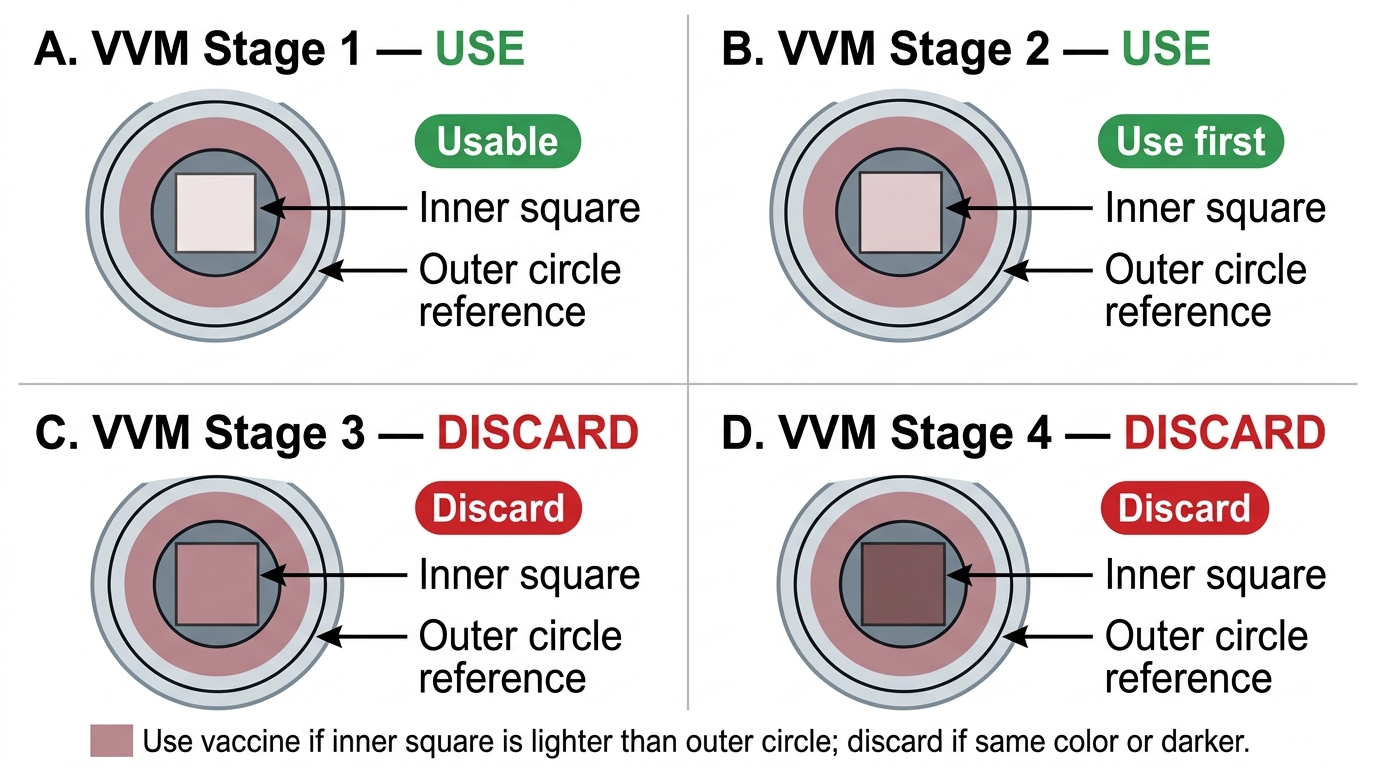
Vaccine Vial Monitor Stages and Use Decision
Actions when a cold chain failure is confirmed:
• Remove suspect vaccines from use immediately. Place in a separate, clearly labelled container: 'Quarantine — DO NOT USE — suspected cold chain failure.'
• Check temperature logs and identify the time and extent of the failure. If the event was at a PHC, check the ILR temperature chart; if during transport, review the carrier loading record and time from dispatch to delivery.
• Apply the shake test to all adsorbed vaccines from the affected batch. Read all VVMs.
• Contact the supervisor or cold chain officer and report the incident. Suspected cold chain failures must be documented on a AEFI/cold chain failure report form and forwarded to the block/district level.
• Dispose of discarded vaccines safely — vaccine waste (including vials) must be disposed of per biomedical waste management rules (yellow bag for pharmaceuticals/vaccines).
• Identify and address root cause — was it a power failure, a packing error, a thermostat malfunction? Preventive action: install an alarm on the ILR, train staff on ice pack conditioning, ensure backup power.
Documentation is a professional and legal requirement. A health worker who administers a knowingly compromised vaccine, or who fails to report a cold chain failure, is clinically negligent. Accurate temperature logs, VVM records, and batch tracking form the audit trail for any post-immunization disease cluster investigation.
SELF-CHECK
A VVM on a pentavalent vaccine vial shows that the inner square is the same shade as the outer circle. The expiry date is still valid. What is the correct action?
A. Use the vaccine — the VVM is within the usable zone
B. Discard the vaccine — VVM stage 3/4 indicates discard regardless of expiry
C. Use the vaccine if the shake test is negative
D. Return the vaccine to the ILR and re-check VVM tomorrow
Reveal Answer
Answer: B. Discard the vaccine — VVM stage 3/4 indicates discard regardless of expiry
When the inner square of the VVM is the same shade (or darker) as the outer circle, the vaccine has been exposed to cumulative heat beyond the acceptable threshold and must be discarded — regardless of expiry date, visual clarity of the liquid, or shake test result. VVM stage 3 (inner square = outer circle) is the discard point; stage 4 (inner square darker) is obvious discard. The VVM reflects cumulative heat exposure that destroys potency; there is no way to restore potency once the VVM threshold is crossed. The shake test detects freeze damage and is irrelevant to this VVM finding.
Observation and Applied Practice
Competency PE18.9 — 'Observe the handling and storing of vaccines' — is a supervised observational competency that you will fulfil during your Community Medicine or Paediatrics posting. This section provides the framework for what to observe, document, and critically evaluate during your PHC or immunization session visit. Structured observation is not passive attendance — it is a deliberate educational exercise that requires you to apply the principles of this module to a real-world setting and note where practice aligns with or deviates from standard. The purpose of structured observation in cold chain management is dual: first, to verify that the vaccines being administered at that session are stored and handled correctly so that patients are actually protected; second, to identify system-level gaps that you can report through appropriate channels — whether a malfunctioning ILR temperature logger, an untrained staff member incorrectly reconstituting BCG, or an open vial policy being violated. Both purposes have direct patient-safety implications.
During your observation, check and document the following at the immunization site:
Storage check (at ILR/cold chain point):
• Is the ILR temperature log maintained twice daily? What is the current temperature (should be +2 to +8°C)?
• Are freeze-sensitive vaccines (DPT, pentavalent, HepB, TT) stored in the body of the ILR, not the door?
• Are vaccines ordered by expiry date (FIFO) on the shelves?
• Is the ILR door seal intact? Is there excessive frost on the walls (suggesting thermostat problem)?
• Are unopened OPV vials stored in a separate deep freezer or the ILR freezer compartment?
Transport check (vaccine carrier):
• Were ice packs conditioned before loading (is there surface water/sloshing)?
• Are freeze-sensitive vials wrapped in paper/foam and NOT in direct contact with ice packs?
• Is the carrier sealed properly?
VVM and vaccine check at session:
• Check the VVM on each vial before administration — is the inner square lighter than the outer circle?
• Has the expiry date been verified?
• For reconstituted vaccines (BCG, MR): what time was reconstitution performed? Is it within 4 hours?
Open vial policy compliance:
• Is the open vial policy being correctly applied — i.e., are multi-dose vials being reused per NIS OVP guidelines and not discarded after each session unnecessarily?
• Are opened lyophilised vaccine vials (BCG, MR) correctly discarded at session end and not carried over?
Waste management:
• Are used vaccine vials disposed of in the correct biomedical waste container?
• Are needles being discarded in sharps disposal containers?
Document your observations in a structured note and identify one area where practice was sub-optimal. Discuss this with your supervising faculty.
Self-Assessment
The following scenario-based questions test your ability to apply cold chain principles to realistic clinical and field situations. These require integrated reasoning — not just recall of facts, but applying the decision logic of the cold chain system. Cold chain management failures are among the most common preventable causes of immunization programme inefficacy, and the clinician who can identify and correct them at the point of care — whether it is a VVM reading, a shake test result, or a reconstitution timing error — directly protects children from vaccine-preventable disease. Work through each scenario without referring to your notes, then verify your answers against the content you have just read. Identifying where your reasoning differs from the correct response is more educationally valuable than simply scoring yourself, as it pinpoints the exact conceptual link — storage equipment, temperature threshold, test interpretation — that needs reinforcement before your clinical posting.
- You arrive at a rural PHC to find the ILR has been off for 4 hours due to a power failure. The internal temperature now reads +12°C. A full tray of pentavalent and a vial of OPV are inside. What do you check first, and what decision do you make for each vaccine?
- A health worker offers to let you administer BCG to a 1-month-old infant at an outreach session. The BCG vial was reconstituted 5 hours ago and has been kept in the vaccine carrier with ice packs. What do you do?
- During transport of vaccines in a carrier, you notice that one pentavalent vial was directly touching a conditioned ice pack. The carrier temperature log shows +1°C throughout. Should you be concerned? What test would you perform?
- A VVM on an OPV vial shows that the inner square is slightly lighter than the outer circle (Stage 2). The vial's expiry date is 3 months away. Is this vaccine suitable for use?
- A mother at a camp says: 'Last time the nurse said the vaccine is cold — it felt frozen in the syringe. Is that normal for the cold vaccine?' What is your response, and what should be investigated?