Page 7 of 25
PA20.1 | Platelet & Vascular Bleeding Disorders — SDL Guide (Part 2)
Thrombotic Thrombocytopenic Purpura (TTP)

Thrombotic Thrombocytopenic Purpura: Pathogenesis, Pentad, and DIC Differentiation
Thrombotic Thrombocytopenic Purpura (TTP) is a life-threatening microangiopathy — recognising its pentad is a clinical emergency.
Pathogenesis:
• Deficiency (inherited or acquired via inhibitory antibodies) of ADAMTS13, the metalloprotease that cleaves ultra-large von Willebrand factor (UL-vWF) multimers.
• Uncleaved UL-vWF binds and activates platelets spontaneously → platelet thrombi in small vessels throughout the body.
• These microthrombi do NOT activate the coagulation cascade significantly → PT and aPTT are normal or near-normal (distinguishing TTP from DIC).
Classic Pentad of TTP:
1. Microangiopathic haemolytic anaemia (MAHA) — RBCs fragmented by fibrin strands in microthrombi → schistocytes on blood film (helmet cells, triangle cells). Elevated LDH, low haptoglobin.
2. Thrombocytopenia — platelet consumption in microthrombi.
3. Neurological abnormalities — TIAs, confusion, seizures (microthrombi in cerebral vessels).
4. Renal dysfunction — mild in TTP (more severe in HUS).
5. Fever.
Key differentiator from DIC: In TTP, PT and aPTT are essentially normal (consumption is limited to platelets + vWF). In DIC, both coagulation factors and platelets are consumed.
> Cross-reference: Cluster H5 (DIC) covers the coagulation factor consumption side; when you see schistocytes, always ask: normal PT/aPTT (TTP/HUS) or prolonged PT/aPTT (DIC)?
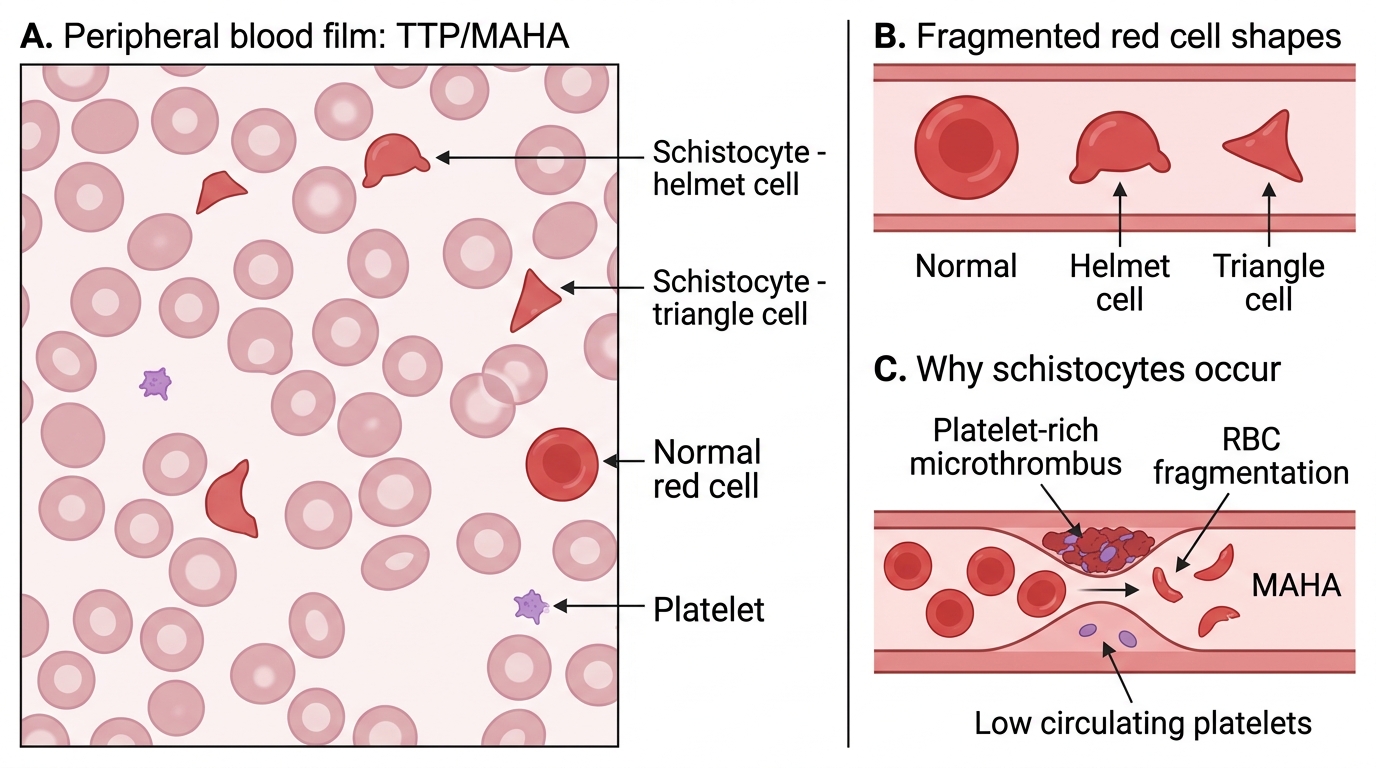
Schistocytes and Thrombocytopenia in TTP/MAHA
Qualitative Platelet Defects

Qualitative Platelet Defects: Glanzmann vs Bernard-Soulier
Normal platelet count but prolonged bleeding time / abnormal PFA-100 → think qualitative (functional) platelet disorder.
Inherited defects:
- Glanzmann thrombasthenia: autosomal recessive deficiency of GPIIb/IIIa (the fibrinogen receptor mediating platelet aggregation). Platelets adhere normally (GPIb intact) but cannot aggregate — aggregation assays show no response to ADP, collagen, or thrombin. Severe mucocutaneous bleeding; platelet count normal.
- Bernard-Soulier syndrome: autosomal recessive deficiency of GPIb-IX-V (the VWF receptor mediating platelet adhesion to sub-endothelium). Platelets cannot adhere to damaged vessel wall. Characteristically large platelets (giant platelets) + mild thrombocytopenia on film. Aggregation with ristocetin (which mimics VWF) is absent.
| Disorder | Defective receptor | Defective step | Distinguishing lab |
|---|---|---|---|
| Glanzmann | GPIIb/IIIa | Aggregation | No aggregation with ADP/collagen; normal ristocetin |
| Bernard-Soulier | GPIb-IX-V | Adhesion | Giant platelets; no aggregation with ristocetin |
Acquired defects:
- Aspirin: irreversibly inhibits COX-1 (cyclo-oxygenase), blocking thromboxane A2 synthesis → impairs platelet activation and aggregation for the platelet's lifespan (~7–10 days).
- Uraemia: retained metabolites (guanidinosuccinic acid, phenolic acids) impair platelet GPIb and granule release — a common and treatable bleeding risk in CKD. Corrected by dialysis or DDAVP.
SELF-CHECK
A child with a normal platelet count has recurrent epistaxis and prolonged bleeding time. Aggregation studies show absent response to ristocetin but normal response to ADP. Giant platelets are seen on film. Which disorder is most likely?
A. Glanzmann thrombasthenia (GPIIb/IIIa deficiency)
B. Aspirin-induced platelet dysfunction
C. Von Willebrand disease type 1
D. Bernard-Soulier syndrome (GPIb deficiency)
Reveal Answer
Answer: D. Bernard-Soulier syndrome (GPIb deficiency)
The triad of absent ristocetin aggregation, giant platelets, and normal ADP response localises the defect to GPIb (the VWF receptor). In Glanzmann thrombasthenia, the defect is GPIIb/IIIa — aggregation to ADP/collagen is absent but ristocetin response is normal and platelets are normal-sized.
Vascular Purpuras

Vascular Purpuras: Mechanisms and Clinical Patterns
Vascular purpuras arise from vessel wall fragility or structural defects — platelet count and coagulation tests are typically normal. The bleeding time may be prolonged.
Henoch-Schönlein Purpura (HSP) / IgA Vasculitis:
• Most common systemic vasculitis in children; follows upper respiratory infection.
• Pathogenesis: IgA-dominant immune complex deposition in small vessel walls → complement activation → leukocytoclastic vasculitis.
• Tetrad: palpable purpura (non-thrombocytopenic) over buttocks/lower limbs, arthralgia, colicky abdominal pain, and renal involvement (IgA nephropathy pattern).
• The purpura is palpable because of perivascular oedema — this distinguishes it from flat thrombocytopenic petechiae.
Scurvy (Vitamin C deficiency):
• Vitamin C is required for hydroxylation of proline and lysine in collagen synthesis → deficient collagen in vessel walls → perivascular haemorrhages.
• Features: perifollicular haemorrhages, corkscrew hairs, gingival swelling and bleeding, subperiosteal haemorrhages in children.
Senile purpura:
• Atrophy of perivascular connective tissue with ageing → purpura on sun-exposed areas (dorsum of hands, forearms) with minor trauma. Benign.
Hereditary Haemorrhagic Telangiectasia (HHT / Osler-Weber-Rendu):
• Autosomal dominant mutation in endoglin or activin receptor-like kinase (ALK1) — proteins involved in TGF-β vascular signalling.
• Abnormal arteriovenous communications (telangiectasias) in skin, mucosae, lungs, liver, brain.
• Recurrent epistaxis + telangiectasias on lips, tongue, fingertips; may cause right-to-left shunts via pulmonary AVMs.

Henoch-Schönlein Purpura: Distinguishing Palpable Purpura from Flat Petechiae
CLINICAL PEARL
Palpable vs flat purpura: Flat, non-palpable petechiae/purpura = thrombocytopenia or platelet dysfunction (extravasated RBCs, no inflammation). Palpable purpura = vasculitis or emboli (inflammatory perivascular infiltrate elevates the lesion). HSP purpura is always palpable — if it's flat, reconsider the diagnosis.