Page 6 of 27
PA21.2 | Blood Components & Clinical Uses — SDL Guide (Part 2)
Fresh Frozen Plasma (FFP)
⚑ AI image — pending faculty review (auto-QA score 6/10; best of 3 attempts)
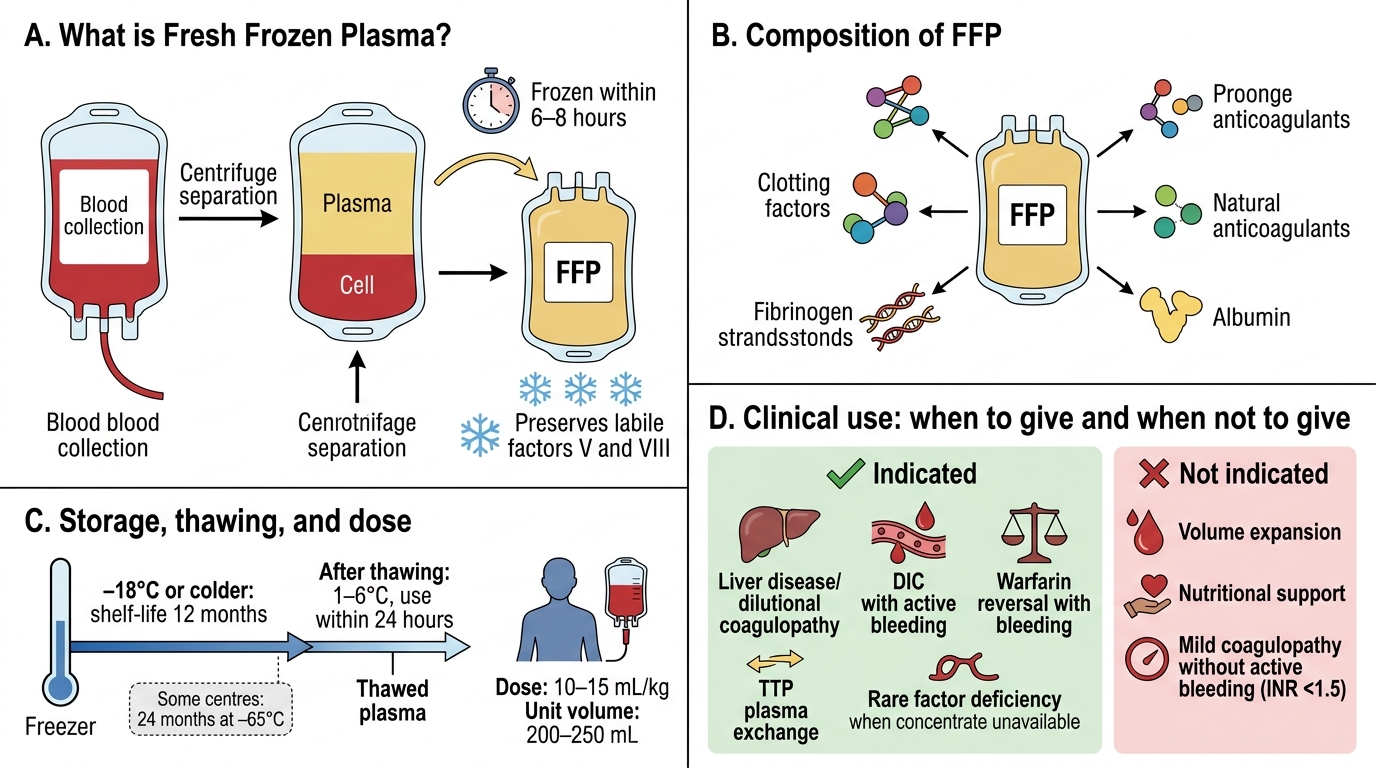
Fresh Frozen Plasma: Preparation, Contents, Storage, and Use
Fresh frozen plasma is plasma separated from whole blood and frozen within 6–8 hours of collection to preserve labile coagulation factors (V and VIII). It contains all clotting factors, fibrinogen, natural anticoagulants (protein C, S, antithrombin), and albumin.
Storage: −18°C or colder; shelf-life 12 months (some centres extend to 24 months at −65°C). Once thawed, must be used within 24 hours (stored at 1–6°C) — it becomes "thawed plasma" and loses labile factors over time.
Volume per unit: ~200–250 mL. Dose: 10–15 mL/kg body weight.
Clinical indications:
• Multiple coagulation factor deficiencies: Liver disease (decreased synthesis), dilutional coagulopathy.
• Disseminated intravascular coagulation (DIC): To replenish consumed factors when active bleeding is present.
• Warfarin reversal (anticoagulant overdose with active bleeding) — when Vitamin K and prothrombin complex concentrate are insufficient or unavailable.
• Thrombotic thrombocytopenic purpura (TTP): Plasma exchange using FFP as replacement fluid — to replenish ADAMTS-13 and remove ultra-large vWF multimers.
• Rare: specific factor deficiencies when factor concentrates are unavailable (e.g., Factor V or XI deficiency).
FFP is NOT indicated for: volume expansion, nutritional support, or mild coagulopathy without active bleeding (INR <1.5). Using FFP as a volume expander is a recognised prescribing error.
Cross-ref H10 SDL: FFP and cryoprecipitate use in bleeding disorders (haemophilia, vWD) is covered there.
CLINICAL PEARL
The TTP–FFP connection is a favourite exam vignette: a young woman with microangiopathic haemolytic anaemia, thrombocytopenia, neurological symptoms, fever, and renal involvement — the pentad of TTP (Moschcowitz syndrome). Treatment is plasma exchange with FFP replacement, not simple FFP transfusion. Simple FFP transfusion alone does not remove the anti-ADAMTS-13 antibody; plasma exchange achieves both removal and replenishment. Confusing the two in an MCQ loses the mark.
Cryoprecipitate

Cryoprecipitate: Preparation, Contents, and Clinical Use
Cryoprecipitate is the cold-insoluble precipitate that forms when FFP is thawed slowly at 1–6°C and the supernatant plasma is removed. It is then refrozen. Each unit (10–20 mL) is rich in:
• Fibrinogen (Factor I) — 150–300 mg/unit
• Factor VIII — 80–120 IU/unit
• von Willebrand factor (vWF)
• Factor XIII
• Fibronectin
Storage: −18°C or colder; shelf-life 12 months. Typically pooled (6–10 units) before administration.
Clinical indications:
• Hypofibrinogenaemia (<1.0 g/L with active bleeding, or <1.5 g/L in massive transfusion) — the primary indication in modern practice.
• Disseminated intravascular coagulation (DIC) — fibrinogen is consumed early; cryoprecipitate is preferred over FFP when fibrinogen replacement is the primary goal (higher concentration, lower volume).
• Historically: Haemophilia A and vWD (now largely replaced by recombinant factor concentrates and desmopressin).
• Uraemic bleeding — Factor XIII and fibronectin may contribute to platelet adhesion.
Key distinction from FFP: Cryoprecipitate is the go-to for isolated fibrinogen replacement (volume-efficient; 10-unit pool in ~150 mL versus 5 units of FFP at 1,000–1,250 mL for equivalent fibrinogen delivery).
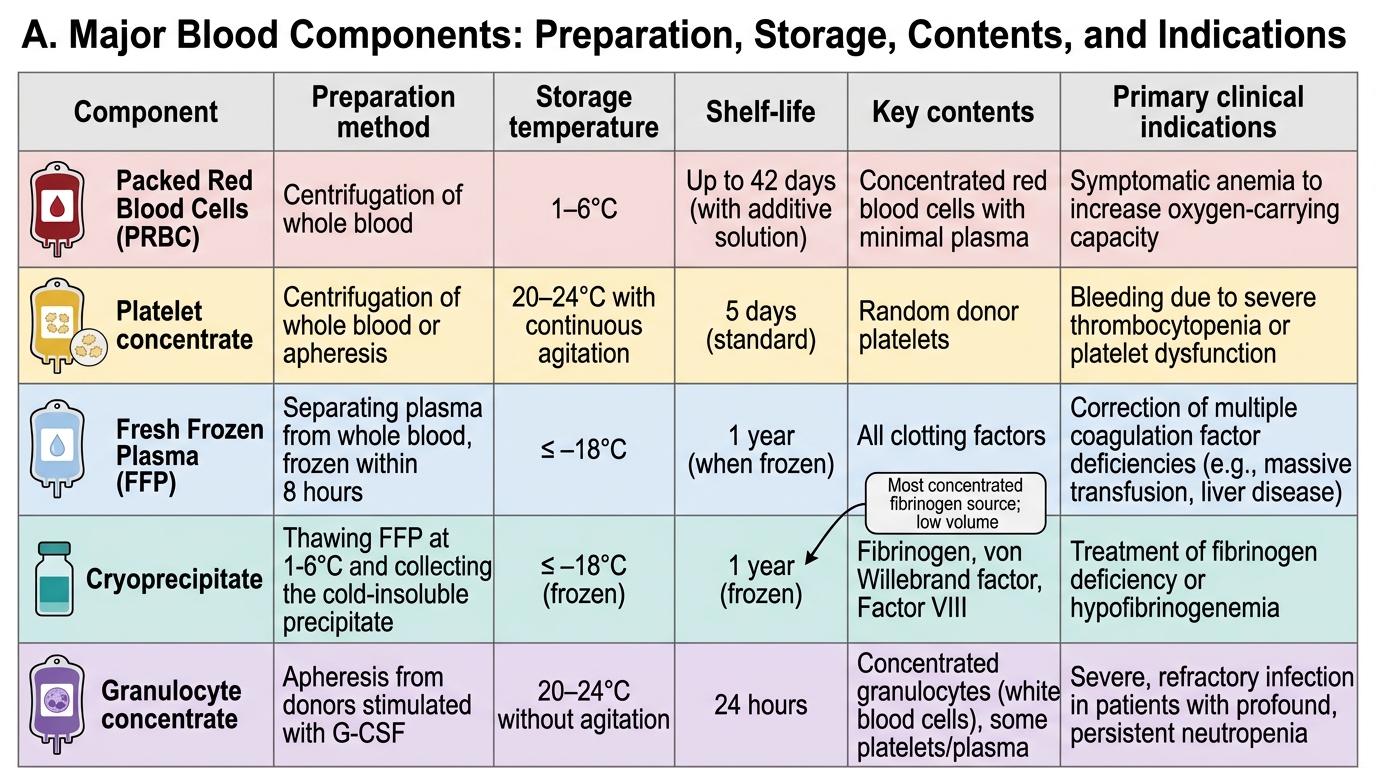
Major Blood Components and Clinical Use
SELF-CHECK
A patient with massive obstetric haemorrhage has a fibrinogen level of 0.8 g/L and active bleeding. Which component is MOST appropriate to correct the fibrinogen deficit with the smallest infused volume?
A. Fresh frozen plasma (FFP)
B. Whole blood
C. Cryoprecipitate
D. Platelet concentrate
Reveal Answer
Answer: C. Cryoprecipitate
Cryoprecipitate provides fibrinogen, Factor VIII, vWF, and Factor XIII in a concentrated small volume (~150 mL for a therapeutic pool). FFP also contains fibrinogen, but in far lower concentration — to deliver equivalent fibrinogen you would need ~1,000–1,250 mL of FFP, risking TACO. Whole blood is not standard of care for isolated fibrinogen deficiency. Platelet concentrate does not contain clotting factors.
Other Components: Granulocytes, Factor Concentrates, Albumin, Immunoglobulins

Other Blood Components in Transfusion Medicine
Granulocyte concentrate: Collected by apheresis; very short shelf-life (24 hours at 20–24°C). Narrow indication: life-threatening bacterial or fungal infection in severely neutropenic patients (<0.5 × 10⁹/L) unresponsive to antibiotics, especially post-chemotherapy or bone marrow transplant. Largely replaced by granulocyte colony-stimulating factor (G-CSF) in most settings.
Factor concentrates: Recombinant or plasma-derived preparations of specific factors (VIII, IX, VIIa, XIII, von Willebrand factor). Now the preferred treatment for haemophilia A (Factor VIII) and haemophilia B (Factor IX) — eliminates transfusion-transmitted infection risk and enables home therapy.
Albumin: 4–5% or 20–25% solution; virus-inactivated. Indications: spontaneous bacterial peritonitis in cirrhosis (prevents hepatorenal syndrome), large-volume paracentesis replacement, hepatic failure. NOT indicated as a routine volume expander (crystalloids are preferred and more cost-effective).
Intravenous immunoglobulin (IVIG): Pooled IgG from thousands of donors. Used in immune thrombocytopenic purpura (ITP — blocks Fc receptors in spleen to reduce platelet destruction), Kawasaki disease, primary immunodeficiencies, Guillain–Barré syndrome.