Page 17 of 27
PA21.5-6 | Blood Grouping, Crossmatch & Autologous Transfusion — SDL Guide
Learning Objectives
- Perform and interpret forward (cell) and reverse (serum) blood grouping correctly, resolving any discrepancy between the two.
- Describe the three methods of blood grouping — slide, tube, and gel-card — and state which is most reliable.
- Explain the purpose, phases (immediate-spin and AHG), and result interpretation of a major crossmatch.
- Distinguish major from minor crossmatch and identify the critical safety role of each.
- Identify common sources of error in blood grouping and crossmatching (clerical, weak D, rouleaux, cold agglutinins).
- Define autologous transfusion, list its three types, and state its key advantages, indications, and contraindications.
INSTRUCTIONS
Blood grouping and crossmatching are the final safety barriers between a patient and a potentially fatal transfusion reaction. This practical-skills module walks you through the bench technique step by step, explains the logic behind forward and reverse grouping, and takes you into the crossmatch — the critical pre-transfusion compatibility test. You will also learn about autologous transfusion, an elegant strategy that sidesteps many of the risks of allogeneic blood. Master this module before the blood-bank practical, as every step maps directly to PA21.6 and PA21.5 of your NMC curriculum.
References
- Robbins & Kumar: Basic Pathology, 11th ed., Ch 14 (Transfusion Medicine) (textbook)
- Harmening: Modern Blood Banking and Transfusion Practices, 7th ed., Ch 6–7 (textbook)
- AABB Technical Manual, 20th ed., Chapter on Pre-transfusion Testing (textbook)
Version 2.0 | NMC CBUC 2024
CLINICAL SCENARIO
A 28-year-old woman arrives in the OT for an elective myomectomy. The blood bank technician labels two tubes from the same patient — but one label was written hastily and the tube numbers are transposed. The crossmatch is set up with the wrong sample. The patient's ABO group is O; the donor unit is A. The immediate-spin crossmatch shows 3+ agglutination — incompatible — and the unit is held back. A clerical catch saved a life.
This is why blood grouping and crossmatching exists: every single step is a deliberate safety gate.
WHY THIS MATTERS
PA21.6 makes blood grouping and crossmatching examinable as a practical skill — you must be able to perform the technique, not merely describe it. PA21.5 pairs this with autologous transfusion, a patient-safety strategy that avoids allogeneic blood altogether. Together, these competencies form the core of pre-transfusion testing in any blood bank or operation-theatre setting. You will encounter these scenarios in your clinical rotations, casualty, and surgical postings — and they are high-yield for university practicals and MBBS exit assessments.
RECALL
Before you begin, activate what you already know:
- ABO system: Four blood groups — A, B, AB, O — determined by surface antigens on red cells. Which antibodies does each group carry in serum? (Hint: Landsteiner's rule — if you lack the antigen, you have the antibody.)
- Rh system: The D antigen is the most clinically significant. What happens when an Rh-negative mother carries an Rh-positive foetus?
- Agglutination: When antibody meets its antigen on red cells, they clump — agglutination. This visible reaction is the readout for almost every blood-group test.
If any of these feel shaky, revisit the Blood Groups & ABO/Rh SDL (H12-SDL1) before continuing.
Why Two Tests? The Logic of Forward and Reverse Grouping
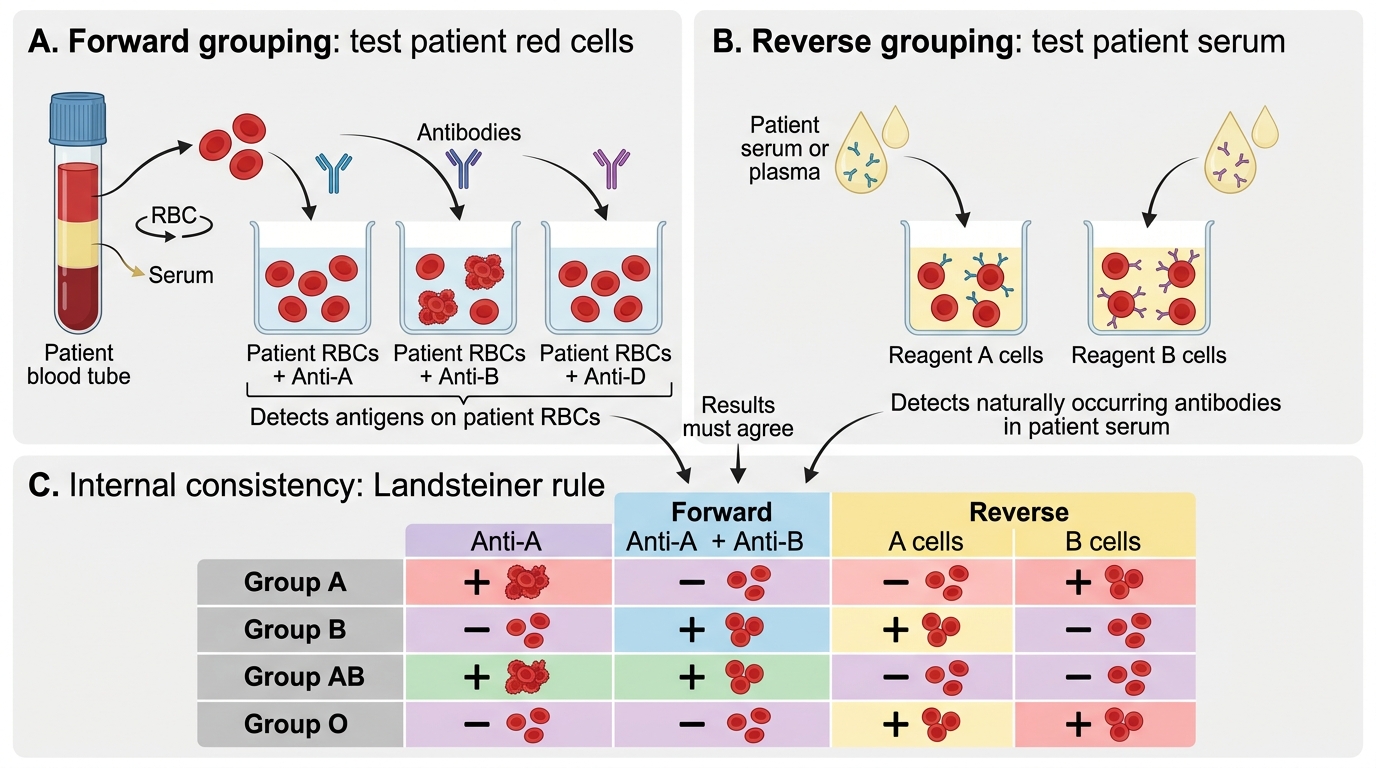
Forward and Reverse ABO Grouping
ABO grouping uses two complementary reactions run simultaneously.
Forward (cell) grouping — also called direct or cell typing — tests the patient's red cells against known commercial antisera:
• Patient RBCs + Anti-A serum
• Patient RBCs + Anti-B serum
• Patient RBCs + Anti-D serum (for Rh typing)
Agglutination with Anti-A means the A antigen is present → group A (or AB).
Reverse (serum) grouping — also called back-typing or serum typing — tests the patient's serum/plasma against known red cells:
• Patient serum + Reagent A cells (group A red cells)
• Patient serum + Reagent B cells
The results must be internally consistent (Landsteiner's rule):
| Forward grouping | Reverse grouping | ABO group |
|---|---|---|
| Anti-A +, Anti-B − | A cells −, B cells + | A |
| Anti-A −, Anti-B + | A cells +, B cells − | B |
| Anti-A +, Anti-B + | A cells −, B cells − | AB |
| Anti-A −, Anti-B − | A cells +, B cells + | O |
If forward and reverse disagree, this is a grouping discrepancy — work must halt and the discrepancy investigated (see later block).

Forward and Reverse Blood Grouping Results for Group A Rh-Positive Sample
Why run both? Each is a cross-check on the other. A label mix-up (wrong patient sample) will produce a discrepancy — you catch the error before transfusing.
Methods: Slide, Tube, and Gel-Card

Blood Grouping Methods and Agglutination Grading
Three bench methods are in use. Know their hierarchy:
1. Slide method
• Drops of whole blood and antiserum placed on a glass slide; rocked for 2 minutes.
• Advantages: rapid (screening, emergencies).
• Limitations: drying artifact can mimic agglutination; only 2–4 minutes read time; cannot detect weak reactions; unsuitable for reverse grouping.
• Not recommended as a standalone confirmatory test.
2. Tube method (traditional gold standard)
• Blood sample + antiserum in a test tube; incubate at appropriate temperature; centrifuge; read button resuspension.
• Reliable for both forward and reverse grouping.
• Allows multiple incubation temperatures (room temperature, 37°C, 4°C) — essential for detecting cold-reactive antibodies.
• Reading button resuspension: gently tilt tube; agglutinates = positive (solid clump or granular); smooth suspension = negative.
3. Gel-card (column agglutination) method
• Micro-columns filled with dextran-acrylamide gel containing pre-dispensed reagent antisera.
• Cells and serum added to the well; card centrifuged.
• Agglutinates are trapped in the gel column; free (unagglutinated) cells pellet to the bottom.
• Advantages: standardised, reproducible, permanent visual record, graded reactions (0 to 4+), no wash step needed.
• Used in modern blood banks for routine and antibody-screening work.
Agglutination grading (tube and gel card):
| Grade | Appearance |
|---|---|
| 4+ | One solid clump, clear background |
| 3+ | Several large clumps, clear background |
| 2+ | Medium clumps, slightly turbid background |
| 1+ | Small clumps, turbid background |
| w+ | Tiny clumps visible only microscopically |
| 0 | Smooth, no clumps |

Gel-Card Column Agglutination Grading System
SELF-CHECK
A technician performs forward grouping: Anti-A shows 3+ agglutination, Anti-B shows no agglutination. Reverse grouping shows no reaction with reagent A cells and 3+ with reagent B cells. What is the ABO blood group?
A. Blood group B
B. Blood group A
C. Blood group AB
D. Blood group O
Reveal Answer
Answer: B. Blood group A
Forward grouping: Anti-A positive → A antigen present; Anti-B negative → no B antigen. Reverse grouping: A cells negative → no anti-A in serum; B cells positive → anti-B in serum. This is a concordant result consistent with group A (Landsteiner's rule: group A individuals have anti-B). Option A would require Anti-B positive forward + A cells positive reverse.
Rh Typing and the Weak-D Problem

Rh Typing and the Weak-D Problem
Rh typing is performed as part of forward grouping:
• Patient RBCs + Anti-D serum (IgM, saline-reactive)
• Agglutination = Rh-positive (D antigen present)
• No agglutination = provisionally Rh-negative
Weak D (Du): Some individuals express the D antigen at very low density — the initial Anti-D test is negative but indirect antiglobulin testing (IAT) is positive. Key points:
• Donors who are weak-D positive are labelled as Rh-positive (their blood can stimulate anti-D in recipients).
• Recipients who are weak-D positive are generally managed as Rh-positive (they rarely form anti-D).
• The distinction matters clinically — misclassifying a weak-D positive donor as Rh-negative could lead to alloimmunisation in an Rh-negative patient.
If the initial Anti-D screen is negative, a Du test (indirect antiglobulin test with Anti-D) should be performed on all donor samples.
SELF-CHECK
A blood donor's RBCs test negative with routine Anti-D saline reagent but positive on the indirect antiglobulin (Du) test. How should this donor be labelled?
A. Rh-negative — the primary test is the definitive one
B. Rh-indeterminate — requires repeat testing at a reference laboratory before labelling
C. Rh-positive — weak-D donors are labelled positive to prevent sensitisation in recipients
D. Rh-negative, but the unit must be irradiated before transfusion to any recipient
Reveal Answer
Answer: C. Rh-positive — weak-D donors are labelled positive to prevent sensitisation in recipients
Weak-D (Du) donors are classified as Rh-positive for labelling purposes. Although their D antigen density is low, their red cells can still stimulate anti-D antibody production in an Rh-negative recipient, causing alloimmunisation. Labelling them as Rh-positive prevents an Rh-negative patient from inadvertently receiving a D-antigen-positive unit. Irradiation (option D) prevents graft-versus-host disease from viable lymphocytes and is not the relevant concern here.