Page 19 of 27
PA21.5-6 | Blood Grouping, Crossmatch & Autologous Transfusion — SDL Guide (Part 3)
Sources of Error in Blood Grouping and Crossmatching

Sources of Error in Blood Grouping and Crossmatching
Recognising error sources is as important as performing the technique:
Clerical errors (most common cause of fatal ABO-incompatible transfusion)
• Wrong patient sample collected, tubes mislabelled, request form error, unit mixed with another patient's paperwork.
• Prevention: bedside identity check with two identifiers; independent label verification in blood bank.
Weak D misclassification (already discussed): Donor typed Rh-negative when actually weak-D positive → alloimmunisation risk.
Rouleaux (pseudo-agglutination)
• Cause: elevated fibrinogen (pregnancy, infection, multiple myeloma), elevated immunoglobulins.
• Appearance: coins stacked in lines, not true clumps.
• Resolution: saline replacement technique — remove serum, replace with saline; rouleaux disperses, true agglutination persists.
Cold agglutinins
• High-titre IgM autoantibodies reactive at low temperature (15–20°C).
• Can cause spontaneous agglutination of patient RBCs at room temperature — false-positive forward or reverse grouping.
• Resolution: perform all testing at 37°C; use warm reagents; pre-warm sample.
Polyagglutination: Patient RBCs express hidden (T, Tn) antigens reactive with almost all adult sera — can cause false-positive reverse grouping.
Contamination / wrong reagent lot: Reagent antisera past expiry or stored incorrectly may give false negatives.

Rouleaux Formation vs True Agglutination in Blood Smear
Autologous Transfusion — Definition and Types

Autologous Transfusion: Definition and Types
Autologous transfusion is the collection and re-infusion of the patient's own blood. It eliminates alloimmunisation and transfusion-transmitted infection risks.
Three types:
1. Preoperative autologous donation (PAD)
• Patient donates 1–4 units of their own blood in the weeks before elective surgery (one unit/week, last donation ≥72 h before surgery).
• Blood is stored as standard packed red cells; re-transfused intra- or post-operatively if needed.
• Requires patient to be fit enough to donate (Hb ≥11 g/dL, cardiovascular fitness).
2. Acute normovolaemic haemodilution (ANH)
• On the day of surgery (post-induction, pre-incision): 1–3 units of blood are withdrawn and replaced simultaneously with crystalloid/colloid to maintain normovolaemia.
• Blood is stored at room temperature in the operating theatre (up to 6 hours).
• During surgery, diluted blood is lost; autologous units are re-infused at the end of the procedure.
• Advantage: RBCs collected have full 2,3-DPG and normal function (no storage lesion).
3. Intraoperative cell salvage (ICS) / postoperative cell salvage
• Blood shed in the operative field is aspirated, anticoagulated, washed, and concentrated via a cell saver machine; returned as packed RBCs.
• Postoperative cell salvage: blood from surgical drains (e.g., joint replacement) collected and re-infused within 6 hours.
• ICS is standard in cardiac surgery, major vascular surgery, orthopaedic procedures with expected blood loss >500 mL.
Autologous Transfusion — Indications, Advantages, and Contraindications
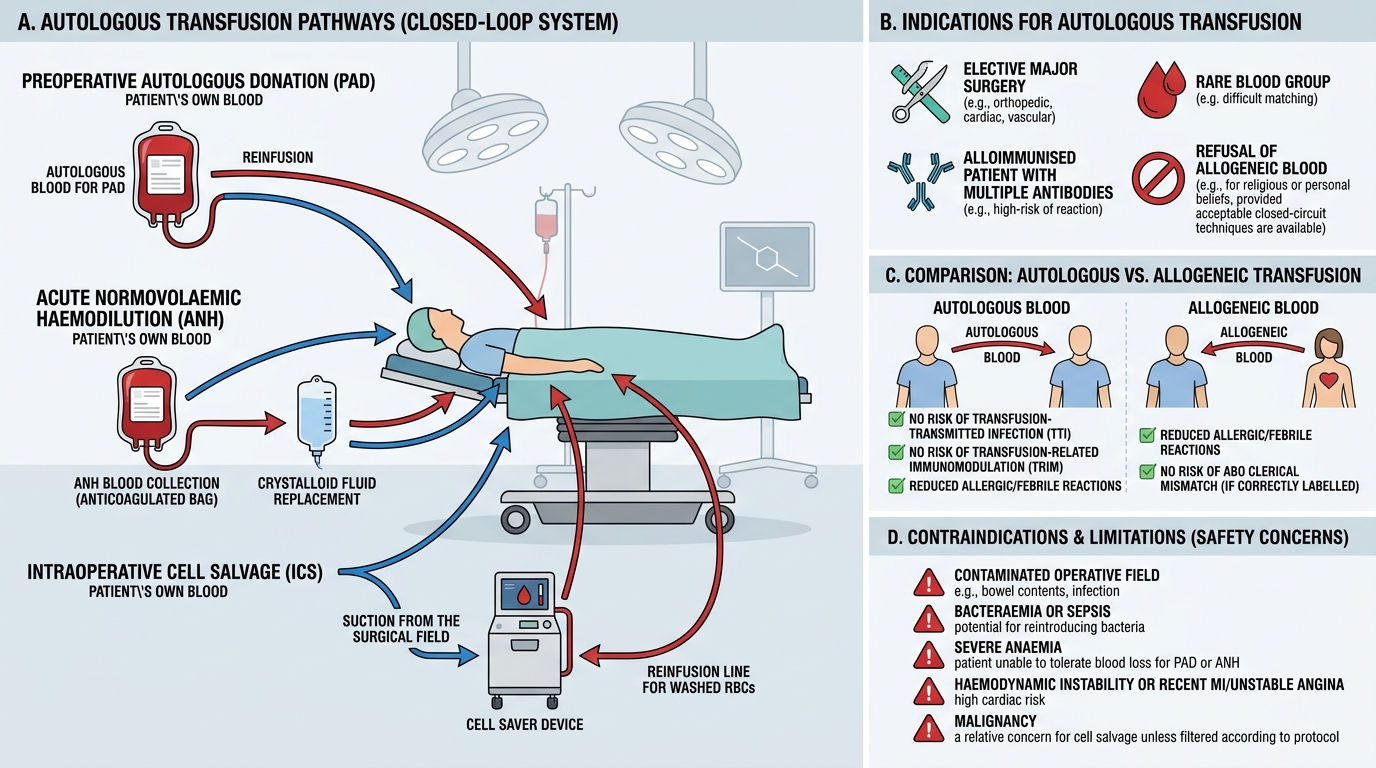
Autologous Transfusion: Indications, Advantages, and Contraindications
Indications:
• Elective surgery with anticipated major blood loss (cardiac, vascular, orthopaedic, hepatic)
• Patients with rare blood groups (compatible allogeneic blood may be unavailable)
• Alloimmunised patients (multiple antibodies make crossmatching difficult)
• Patients who refuse allogeneic blood on religious or personal grounds (e.g., Jehovah's Witnesses — ANH and ICS may be acceptable as blood does not leave the circuit)
• Patients with high risk of alloimmunisation (young women of childbearing age, transplant candidates)
Advantages over allogeneic transfusion:
• No risk of alloimmunisation (no foreign antigens)
• No risk of transfusion-transmitted infections (HIV, HCV, HBV, CMV, syphilis)
• No risk of transfusion-related immunomodulation (TRIM)
• No risk of febrile non-haemolytic or allergic reactions to foreign leukocytes/plasma proteins
• No risk of ABO incompatibility from clerical error (if unit correctly labelled)
• Avoids blood conservation in situations of shortage
Limitations and contraindications:
| Limitation | Notes |
|---|---|
| Bacterial contamination risk | Cell salvage field contaminated by bowel contents — contraindication to ICS in colorectal surgery |
| Malignancy | ICS in cancer surgery risks re-infusing tumour cells (controversial; leucocyte-depletion filters used) |
| Anaemia | Patient Hb <11 g/dL — not suitable for PAD |
| Cardiovascular instability | ANH risky if cardiac reserve is limited |
| Infection at operative site | Risk of re-infusing bacteraemic blood via cell salvage |
| Administrative/cost | PAD requires scheduling; cell-saver machines are expensive |
| Wastage | Up to 50% of PAD units are never transfused (but were donated) |
Key principle: autologous blood is NOT zero-risk — it still carries risks of clerical error, bacterial contamination, and volume overload.
SELF-CHECK
A 35-year-old female patient with known multiple alloantibodies (anti-E, anti-c, anti-Jka) is scheduled for elective hip replacement. Which autologous transfusion strategy is most appropriate for this patient?
A. No autologous strategy — crossmatch-compatible allogeneic blood is easier to arrange
B. Transfuse O Rh-negative blood without crossmatch as it is the universal donor
C. Preoperative autologous donation (PAD) — collect 2 units over the two weeks before surgery
D. Intraoperative cell salvage only, as PAD is not suitable for alloimmunised patients
Reveal Answer
Answer: C. Preoperative autologous donation (PAD) — collect 2 units over the two weeks before surgery
PAD is the ideal strategy for alloimmunised patients. Multiple alloantibodies make finding crossmatch-compatible allogeneic blood extremely difficult and time-consuming. By donating her own blood pre-operatively, the patient avoids compatibility issues entirely. Option A is incorrect — compatible allogeneic blood may simply not exist for this antibody combination. O Rh-negative blood (option B) is safe only for ABO/Rh; it offers no protection against the patient's clinically significant alloantibodies (anti-E, anti-c, anti-Jka). Intraoperative cell salvage alone (option D) is a good adjunct but provides no pre-stored reserve in case blood is needed immediately at incision.