Page 13 of 27
PA21.4 | Transfusion Reactions & Investigation — SDL Guide
Learning Objectives
- Classify transfusion reactions as acute (<24 h) vs delayed and immune vs non-immune.
- Describe the pathophysiology, clinical features, and consequences of acute haemolytic transfusion reaction (AHTR).
- Explain febrile non-haemolytic, allergic, anaphylactic, and TRALI reactions.
- Distinguish acute non-immune reactions: TACO, septic, and metabolic.
- Identify delayed reactions: delayed haemolytic, TA-GVHD, iron overload, and post-transfusion purpura.
- Enumerate the stepwise investigation of a suspected transfusion reaction in correct order.
- Appreciate preventability — especially of ABO AHTR through bedside clerical checks.
INSTRUCTIONS
Every unit of blood is a biological transplant — and like any transplant, it carries the risk of rejection and adverse reactions. Transfusion reactions span from the trivial (mild urticaria) to the catastrophic (ABO haemolysis with DIC). As a clinician you will both administer transfusions and be first to recognise when something goes wrong. This module equips you with a classification framework, the ability to explain key mechanisms, and a practised response algorithm — skills that directly protect your patients.
References
- Robbins & Kumar, Basic Pathology, 11th ed., Ch 11 (Red Cell Disorders) (textbook)
- Harsh Mohan, Textbook of Pathology, 8th ed., Ch 12 (textbook)
- AABB Technical Manual, 20th ed. (textbook)
Version 2.0 | NMC CBUC 2024
CLINICAL SCENARIO
A 28-year-old woman, Group A Rh-positive, is 15 minutes into her second unit of packed red cells after a post-partum haemorrhage. She develops sudden rigors, low back pain, and her blood pressure drops to 80/50 mmHg. A nurse notices the unit label reads 'Group B'. What has happened, and what must you do in the next 60 seconds?
This scenario — an ABO-incompatible transfusion — kills within hours if not stopped immediately. Yet it is almost entirely preventable.
WHY THIS MATTERS
Transfusion is one of the most common clinical interventions in hospital medicine. In India, over 12 million units of blood are transfused annually. You will encounter transfusion reactions as a house officer, during your medical posting, and throughout any surgical or obstetric rotation. PA21.4 is examined in both theory and practical OSCEs — classification tables and investigation algorithms are recurring short-answer and MCQ themes. More importantly, recognising a reaction early and responding correctly is a core patient-safety competency.
RECALL
Before proceeding, consolidate your prior learning:
- ABO blood group system — naturally occurring IgM antibodies (anti-A, anti-B) are present WITHOUT prior sensitisation. Recall why O-negative is the 'universal donor'.
- Rh system — anti-D forms only after sensitisation (transfusion or pregnancy). Recall haemolytic disease of the newborn.
- Direct antiglobulin test (DAT / Coombs test) — detects immunoglobulin or complement on the red cell surface; indirect Coombs detects free antibody in serum.
- HLA antigens — expressed on leukocytes and platelets; relevant to febrile and TRALI reactions.
- Complement cascade — the membrane attack complex (MAC) mediates intravascular haemolysis in ABO reactions.
- DIC — disseminated intravascular coagulation; consumption coagulopathy triggered by massive cytokine and thrombin release.
Classification Framework

Classification Framework for Transfusion Reactions
Transfusion reactions are classified along two independent axes:
Axis 1 — Timing
• Acute reactions occur within 24 hours of transfusion (most within the first few minutes to 6 hours).
• Delayed reactions occur after 24 hours, sometimes weeks later.
Axis 2 — Mechanism
• Immune-mediated — involve antibody–antigen reactions or T-cell responses.
• Non-immune-mediated — physical, metabolic, or microbial causes.
This 2 × 2 framework generates four quadrants:
| Immune | Non-Immune | |
|---|---|---|
| Acute | AHTR, FNHTR, allergic/anaphylactic, TRALI | TACO, septic, metabolic |
| Delayed | Delayed haemolytic, TA-GVHD, PTP | Iron overload |
Memorise this table — it structures every examination answer on this topic.

Transfusion Reaction Classification and AHTR Pathophysiology
Acute Haemolytic Transfusion Reaction (AHTR)

Acute Haemolytic Transfusion Reaction
Acute haemolytic transfusion reaction (AHTR) is the most feared transfusion complication. It is almost always due to ABO incompatibility caused by a clerical error — wrong patient, wrong unit, or a labelling mistake — not a laboratory failure.
Mechanism:
1. Recipient has pre-formed IgM anti-A or anti-B antibodies.
2. IgM activates the classical complement pathway rapidly.
3. Intravascular haemolysis — the membrane attack complex (C5b-9) lyses donor red cells within the circulation.
4. Released haemoglobin, red cell stroma, and ADP activate:
- Macrophages → massive cytokine storm (TNF-α, IL-1, IL-6, IL-8)
- Bradykinin → hypotension and vasodilatation
- Tissue factor release → disseminated intravascular coagulation (DIC)
- Renal vasoconstriction + haemoglobin precipitation in tubules → acute renal failure
Clinical features (onset within minutes):
• Fever, rigors, flushing
• Loin / back pain (ureteric spasm from haemoglobin deposits)
• Hypotension, tachycardia
• Haemoglobinuria (port-wine urine)
• Haemoglobinaemia (pink/red plasma)
• DIC → oozing from IV sites, petechiae
• Oliguria / anuria
In an unconscious patient under general anaesthesia, the only signs may be unexplained hypotension and haemoglobinuria.
Key point: As few as 10 mL of ABO-incompatible blood can initiate a fatal reaction. STOP the transfusion immediately.
SELF-CHECK
A patient receiving a blood transfusion develops sudden hypotension, haemoglobinuria, and back pain 10 minutes after the transfusion starts. Which immunological mechanism best explains the intravascular haemolysis?
A. IgG-mediated extravascular haemolysis in the spleen
B. IgM-mediated classical complement activation leading to MAC formation
C. T-cell cytotoxicity against donor erythrocytes
D. IgE-mediated mast cell degranulation
Reveal Answer
Answer: B. IgM-mediated classical complement activation leading to MAC formation
ABO incompatibility triggers pre-formed IgM antibodies that rapidly activate the classical complement cascade, assembling the membrane attack complex (C5b-9) which directly lyses donor red cells intravascularly. IgG-mediated reactions (option A) cause extravascular haemolysis (spleen/liver phagocytosis) — slower and less catastrophic. T-cell cytotoxicity (C) is the mechanism of TA-GVHD. IgE/mast cell degranulation (D) causes anaphylaxis, not haemolysis.
Febrile Non-Haemolytic Transfusion Reaction (FNHTR)
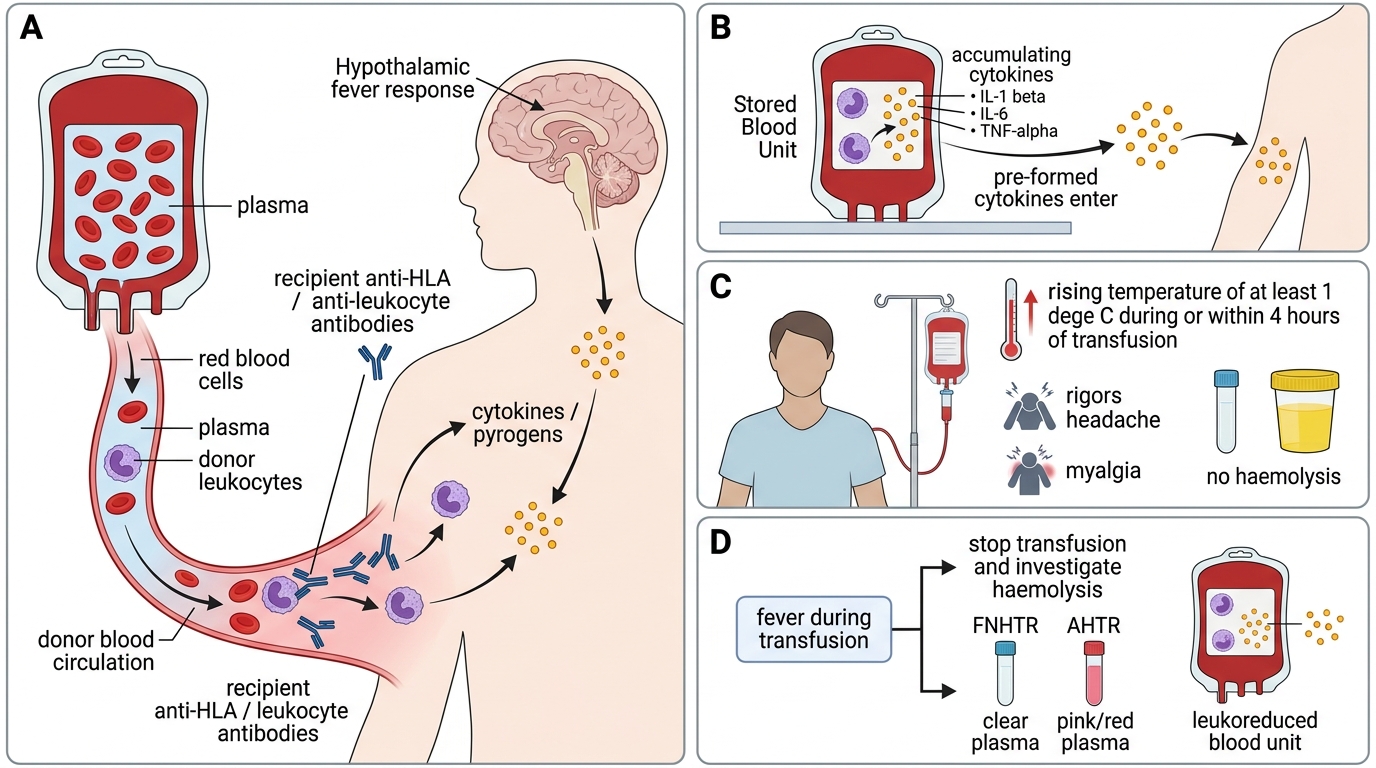
Febrile Non-Haemolytic Transfusion Reaction
Febrile non-haemolytic transfusion reaction (FNHTR) is the commonest transfusion reaction, occurring in 0.5–1% of transfusions.
Mechanism:
Two complementary mechanisms:
1. Anti-leukocyte (anti-HLA) antibodies in the recipient react with donor leukocytes in the unit — cytokine and pyrogen release.
2. Cytokine accumulation in stored blood — IL-1β, IL-6, TNF-α released by leukocytes during storage; even without recipient antibodies, pre-formed cytokines trigger fever.
Clinical features:
• Temperature rise ≥1°C during or within 4 hours of transfusion
• Rigors, headache, myalgia
• No haemolysis — plasma remains clear, urine normal
• Self-limiting; resolves within hours
Key distinction: FNHTR must be distinguished from early AHTR (which also causes fever). If in doubt, stop the transfusion and investigate for haemolysis before attributing fever to FNHTR.
Prevention: Leucoreduction (leukocyte-depleted blood) reduces but does not eliminate FNHTR — cytokines already accumulated in storage persist.