Page 10 of 27
PA21.3 | Transfusion-Transmitted Infections — SDL Guide (Part 2)
CMV, HTLV, and Other Viral Agents

CMV and HTLV Risk in Transfusion Medicine
Cytomegalovirus (CMV) is transmitted via leukocytes in blood components. In immunocompetent recipients, primary CMV infection is usually mild or asymptomatic. However, CMV is a major pathogen in two vulnerable groups:
- Immunocompromised recipients — transplant patients, patients on chemotherapy: CMV can cause pneumonitis, retinitis, colitis, and encephalitis.
- CMV-seronegative neonates — particularly premature infants receiving transfusions: neonatal CMV disease carries significant mortality.
For these groups, two strategies are used:
- CMV-seronegative blood: Donors are tested and only CMV-antibody-negative units are issued. This is logistically demanding.
- Leukoreduced blood: Removal of white cells (filtration to <5×10⁶ leukocytes/unit) is considered equivalent to CMV-seronegative transfusion because CMV resides in monocytes and lymphocytes. Leukoreduction is thus the preferred universal strategy.
HTLV-I and HTLV-II (Human T-lymphotropic virus): These retroviruses are endemic in certain regions (Japan, Caribbean, parts of Africa and South America) and cause adult T-cell leukaemia/lymphoma (HTLV-I) and tropical spastic paraparesis. Leukoreduction reduces transmission risk. HTLV screening is NOT currently mandatory in India but is recommended for donations in high-risk areas and for immunocompromised recipients.
Bacterial Contamination: The Most Common Cause of Transfusion Death

Bacterial Contamination in Blood Transfusion
Bacterial contamination of blood components is the commonest infectious cause of transfusion-related death — a fact that surprises most students who expect viral infections to dominate. It occurs because:
- Skin flora from venepuncture inoculate the collection bag despite chlorhexidine preparation — the first 10–20 mL of blood (which contains the highest bacterial load from the skin plug) is routinely diverted into a small diversion pouch and discarded to reduce this risk.
- Donor bacteraemia: Donors with asymptomatic bacteraemia (dental procedures, GI infection) can seed the unit.
The critical storage-temperature distinction:
- Red cell concentrates are stored at 2–6°C → psychrotolerant organisms can grow: Yersinia enterocolitica is the classic culprit, producing endotoxin that causes severe septic shock even when the bacteria themselves are killed by the recipient's immune system.
- Platelet concentrates are stored at 20–24°C with continuous agitation (to maintain platelet function) → mesophilic skin flora thrive: Staphylococcus aureus, Staphylococcus epidermidis, coagulase-negative staphylococci, Streptococcus spp., and Gram-negative organisms (Klebsiella, E. coli).
Platelets have the highest bacterial contamination rate of all blood products — approximately 1 in 2,000–3,000 units — because of their room-temperature storage. The clinical picture is transfusion-related sepsis: high fever, rigors, hypotension, and cardiovascular collapse during or immediately after transfusion.
Prevention:
- Diversion pouches (first-fraction diversion)
- Bacterial culture of platelet units (BacT/ALERT system) before issue
- Pathogen reduction technology (e.g., Intercept system — psoralen + UV-A light inactivates nucleic acids of bacteria, viruses, and parasites in platelets)
- 5-day maximum shelf life for platelets in most blood banks (7 days with bacterial culture verification)
- Bedside visual inspection — do not transfuse discoloured, cloudy, or clumped components
SELF-CHECK
A 55-year-old man with acute myeloid leukaemia develops fever (39.8°C), rigors, and hypotension 30 minutes into a platelet transfusion. Which organism is the most likely causative agent?
A. Staphylococcus epidermidis
B. Yersinia enterocolitica
C. Cytomegalovirus
D. Plasmodium falciparum
Reveal Answer
Answer: A. Staphylococcus epidermidis
Room-temperature-stored platelets are most commonly contaminated by skin commensal Gram-positive organisms — coagulase-negative staphylococci (including Staphylococcus epidermidis) and Staphylococcus aureus. Yersinia enterocolitica is the classic organism in red cell contamination (cold-stored units). CMV causes an insidious viral syndrome, not acute septic shock. Malaria presents over a longer post-transfusion interval with a cyclical fever pattern.
Emerging and Other Transmissible Agents
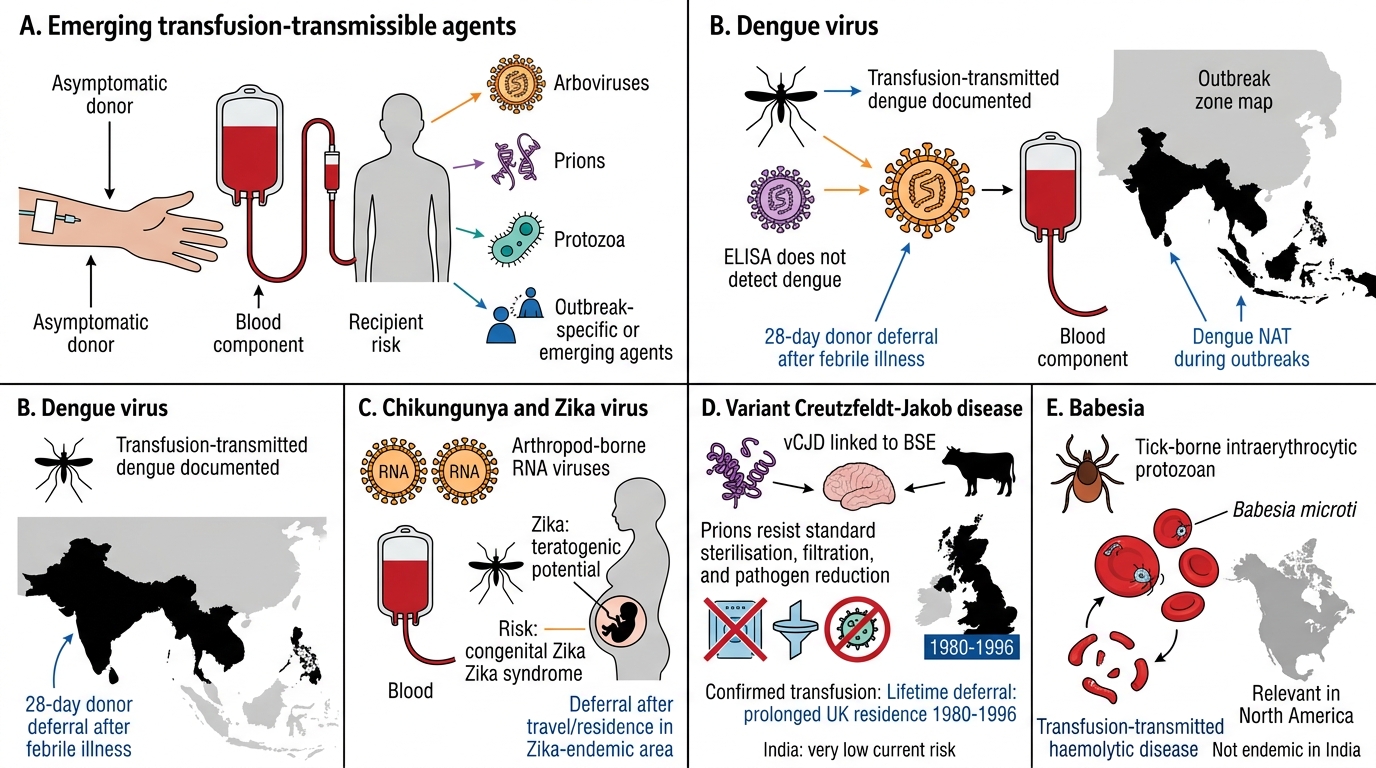
Emerging Transfusion-Transmissible Agents
Several agents pose an evolving or context-specific risk:
Dengue virus: Transfusion-transmitted dengue has been documented in India and Southeast Asia, particularly during outbreak periods. Standard ELISA screening does not detect dengue. Donor deferral for 28 days after febrile illness is the current mitigation. NAT for dengue is used in some blood banks during outbreaks.
Chikungunya and Zika virus: Both are arthropod-borne RNA viruses. Zika is of particular concern because of its teratogenic potential — transfusion-transmitted Zika to a pregnant recipient (or a recipient who later becomes pregnant) carries the risk of congenital Zika syndrome. Deferral of donors with recent travel to or residence in Zika-endemic areas is recommended by WHO.
Variant Creutzfeldt–Jakob disease (vCJD): The human prion disease linked to bovine spongiform encephalopathy ('mad cow disease'). Prions are NOT inactivated by standard sterilisation, filtration, or pathogen reduction. Transfusion-transmitted vCJD cases have been confirmed in the UK. The primary mitigation is permanent lifetime deferral of donors who lived in the UK for extended periods between 1980–1996. India's risk is currently considered very low.
Babesia: A tick-borne intraerythrocytic protozoan (Babesia microti in the USA). Not endemic in India but relevant to note as a cause of transfusion-transmitted haemolytic disease in North America. Babesia survives well in refrigerated red cells.
Hepatitis E virus (HEV): Emerging evidence suggests HEV (genotype 3) can be transfusion-transmitted in immunosuppressed recipients, causing chronic hepatitis. Japan and some European countries have begun screening. India has high rates of HEV genotype 1 (enteric; not chronic) but genotype 3 is being reported.