Page 5 of 15
PA13.4 | Performing Common Haematological Tests: Hb, RBC/WBC, DLC — SDL Guide
Learning Objectives
- Perform hemoglobin estimation using cyanmethemoglobin (gold standard) and Sahli's methods, explaining the principle and sources of error for each
- Carry out manual and automated RBC and WBC counts using the Neubauer hemocytometer, applying the correct diluting fluids, dilution ratios, and counting formulas
- Prepare a wedge peripheral blood smear, apply Leishman stain, and perform a 100-cell differential leukocyte count (DLC) using the systematic scanning approach
- Apply daily calibration, quality-control principles, and delta checks when using automated haematology analyzers
- Identify pre-analytical and analytical errors (clotted sample, storage artefacts, EDTA-platelet clumping) and take corrective action before reporting results
INSTRUCTIONS
Your EDTA tube from the phlebotomy session is now in the lab. The next 14 minutes convert that sample into the numbers that clinicians use every day: Hb, total counts, and a differential. Getting these right — or catching when they are wrong — is the core practical skill of this module. Work through each section step by step; the micro-quizzes test the calculations and troubleshooting logic you will use in your CP posting.
References
- Harsh Mohan — Textbook of Pathology, 8th ed., Chapter on Laboratory Haematology (textbook)
- Dacie & Lewis — Practical Haematology, 12th ed. (textbook)
- Mukherjee — Clinical Haematology, 3rd ed. (textbook)
- ICMR Standard Operating Procedures for Haematology Labs (2022) (guideline)
Version 2.0 | NMC CBUC 2024
CLINICAL SCENARIO
It is 8 AM in the CP lab. The registrar hands you a report: 'Automated Hb 9.5 g/dL, WBC 11,000/µL, platelets 50,000/µL.' Before you stamp it, your eye catches the QC log — yesterday's platelet control was borderline. The EDTA tube has a tiny fibrin strand at the top. Do you report it? Panic? Or do you know exactly what to check? By the end of this module, you will have a protocol for exactly this situation — and you will understand why each number was generated in the first place.
WHY THIS MATTERS
Complete blood count (CBC) is the single most-ordered lab test in medicine. As a resident, you will interpret hundreds per week. More importantly, you will sometimes be the one catching a wrong report before it reaches the ward. Understanding how Hb, RBC, WBC, and DLC are generated — manually and on the analyzer — is not archaic knowledge; it is the error-detection layer that keeps patients safe. PA13.4 ('SH' level) means you must be able to do this with your hands, not just describe it.
RECALL
Recall from H1 (Specimen Collection) that EDTA (purple-top) is the anticoagulant for CBC — it chelates calcium and prevents clotting without distorting cell morphology at 2 mg/mL blood. The tube must be gently inverted 8 times immediately after draw. Blood stored beyond 4 hours at room temperature begins to show artefactual RBC swelling (falsely high MCV) and WBC degeneration. Today's module starts the moment that correctly collected sample reaches the analyzer or bench.
Hemoglobin Estimation
Why Hb matters: Hemoglobin concentration is the single most clinically relevant CBC parameter. Two methods are in widespread use in Indian labs.

Hemoglobin Estimation Methods: Cyanmethemoglobin vs Sahli's Acidhaematin
Method 1 — Cyanmethemoglobin (Gold Standard)
Principle: Blood is diluted in Drabkin's reagent (potassium ferricyanide + potassium cyanide + sodium bicarbonate). Ferricyanide oxidises haemoglobin → methaemoglobin; cyanide converts it → cyanmethemoglobin, a stable compound that absorbs maximally at 540 nm.
Step-by-step procedure:
1. Pipette 5 mL of Drabkin's reagent into a cuvette.
2. Add 20 µL of well-mixed EDTA blood (dilution = 1:251, effectively 1:250).
3. Mix gently; wait 3 minutes at room temperature for complete conversion.
4. Read absorbance at 540 nm on the spectrophotometer against a Drabkin's blank.
5. Read Hb from the calibration curve (or apply: Hb g/dL = absorbance × factor from standard curve).
Calibration: Use certified cyanmethemoglobin standard (e.g., 18 g/dL standard diluted to a 5-point curve). Run calibration at the start of each batch and whenever a new reagent lot is opened.
Advantages: Measures all haemoglobin forms except sulphemoglobin. Internationally standardised (ICSH reference method). Coefficient of variation (CV) < 1% on a well-maintained photometer.
Limitation: Requires spectrophotometer; reagent contains cyanide (toxic waste disposal rules apply).
Method 2 — Sahli's (Acidhaematin) Method
Principle: Blood is mixed with 0.1N HCl → haemoglobin converted to brown acidhaematin → colour compared visually to a brown glass comparator.
Quick steps: 20 µL blood into tube with HCl, wait 5 min, dilute with distilled water until colour matches comparator, read from calibration tube markings (g/dL).
Use case: Field settings, resource-limited labs, no electricity.
Inaccuracy caveats (critical for exams): Only converts oxyHb partially; foetal Hb (HbF) is more resistant to acid — falsely low in neonates. Subjective colour matching varies between observers (CV 5–10%). Fails in jaundiced or lipaemic samples. Never use Sahli's for precise clinical decisions when a spectrophotometer is available.
| Parameter | Cyanmethemoglobin | Sahli's |
|---|---|---|
| CV | < 1% | 5–10% |
| HbF accurate? | Yes | No |
| Equipment | Spectrophotometer | Comparator tube |
| Toxic waste | Yes (cyanide) | No |
| WHO standard | Yes | No |
CLINICAL PEARL
Turbid sample artefact: Lipaemia and very high WBC counts (>100,000/µL) can falsely elevate Hb on the spectrophotometer because they scatter/absorb light at 540 nm. If the cuvette looks milky and Hb seems implausibly high, run the Drabkin's blank through the patient sample matrix to detect this. Automated analyzers flag this as 'Hb interference — verify by alternate method.'
RBC Count — Manual and Automated

Neubauer Hemocytometer Structure and RBC Counting Technique
The Improved Neubauer Hemocytometer
The chamber has a central platform 0.1 mm below the cover slip. Each of the 9 large squares has an area of 1 mm². The central large square is subdivided into 25 medium squares, each into 16 small squares.
Volume per small square = 1/400 mm² × 0.1 mm = 1/4000 µL
Manual RBC Count
Reagent: Hayem's fluid (mercuric chloride + sodium sulphate + sodium chloride). Isotonic, fixes cells, prevents clumping.
Dilution: 1:200 (20 µL blood + 3.98 mL Hayem's, or use RBC Thoma pipette to the 0.5 mark, Hayem's to the 101 mark).
Counting area: Count RBCs in 5 small squares of the central RBC area (one central + four diagonal corner small squares of the central medium square). These 5 squares have a combined area of 5/400 mm² = 1/80 mm².
Formula:
$$\text{RBC count} = N \times \frac{200}{1} \times \frac{1}{(5/400 \times 0.1)} \div 1000 = N \times 10{,}000$$
Simplified: RBC/µL = cells counted × 10,000
Example: Count 200 cells in 5 small squares → RBC = 200 × 10,000 = 2,000,000/µL (2.0 × 10⁶/µL)
Normal ranges:
- Men: 4.5–5.9 × 10⁶/µL
- Women: 3.8–5.2 × 10⁶/µL
Automated RBC Count
Modern analyzers use two principles in tandem:
- Electrical impedance (Coulter principle): Cells suspended in electrolyte solution pass through an aperture; each cell causes a brief resistance change proportional to its volume — counts and sizes simultaneously.
- Light scatter (laser): Forward scatter ≈ size; side scatter ≈ internal complexity (granularity). Differentiates cell types beyond what impedance alone achieves.
Why you still need to know manual: Analyzer flags (e.g., 'RBC fragments', 'schistocytes') must be verified on the smear. If the sample is haemolysed, the automated Hb is unreliable and the RBC count may be spuriously low.
SELF-CHECK
You count 180 RBCs in 5 small squares of the Neubauer chamber central RBC area using a 1:200 dilution of the blood sample. What is the RBC count per µL?
A. A. 360,000/µL
B. B. 1,800,000/µL
C. C. 900,000/µL
D. D. 3,600,000/µL
Reveal Answer
Answer: B. B. 1,800,000/µL
RBC/µL = cells counted × 10,000 (the combined factor for dilution 1:200, area 5/400 mm², and depth 0.1 mm). 180 × 10,000 = 1,800,000/µL (1.8 × 10⁶/µL) — this is below the normal female lower limit of 3.8 × 10⁶/µL, suggesting significant anaemia. Option A forgets the depth factor; Option C halves the result (wrong area used); Option D doubles (used 10 squares instead of 5).
WBC Count — Total and Differential
Total WBC Count (Manual)
Reagent: Turk's fluid (glacial acetic acid + crystal violet/gentian violet + distilled water). Acetic acid lyses RBCs; crystal violet stains WBC nuclei pale blue so they are visible.
Dilution: 1:20 (50 µL blood + 950 µL Turk's, or WBC Thoma pipette to 0.5, Turk's to the 11 mark).
Counting area: Count all nucleated cells in the 4 corner large squares of the hemocytometer (each 1 mm²; total area = 4 mm²; volume = 4 × 0.1 = 0.4 µL after dilution correction).
Formula:
$$\text{WBC/µL} = N \times \frac{20}{4 \times 0.1} = N \times 50$$
Example: Count 160 cells in 4 large squares → WBC = 160 × 50 = 8,000/µL
Normal WBC range: 4,000–11,000/µL (WHO; paediatric ranges differ — neonates can be 9,000–30,000/µL normally).

WBC Count Methodology: Manual Counting and Blood Smear Preparation
Sources of Falsely Abnormal WBC Counts
| Error | Effect on WBC |
|---|---|
| Clotted/partially clotted sample | Falsely low (cells trapped in fibrin) |
| Nucleated RBCs (NRBCs) counted as WBCs | Falsely high — automated analyzer cannot distinguish NRBCs without specific channel; manual: do not count NRBCs in WBC square |
| Platelet clumps (large aggregates) | Flagged as WBCs in some channels — falsely high |
| Cryoglobulin precipitate at RT | Falsely high WBC (protein aggregates look like cells) — warm sample to 37°C |
Differential Leukocyte Count (DLC)
Why DLC is done on the smear, not the chamber: The morphology of each cell — nucleus shape, cytoplasm granularity, toxic granulation — is invisible in the hemocytometer. A Romanowsky-stained smear is mandatory.
Smear preparation — Wedge method:
1. Place a small drop of blood (~3 µL) on a clean, grease-free slide near one end.
2. Hold a second slide (spreader) at 30–45° to the first slide, touch the drop, and push steadily forward in one smooth motion.
3. Ideal smear: thumb-sized, fish-tail tail, thins to a feather edge. Bone-dry before staining.
Staining — Leishman stain (Romanowsky-type):
1. Flood air-dried smear with Leishman stain; wait 2 min.
2. Add twice the volume of phosphate buffer (pH 6.8); mix by tilting; wait 12–15 min.
3. Wash gently with buffer, drain, air-dry. Do NOT blot — blotting distorts cells.
4. Result: RBCs pink-salmon; WBC nuclei blue-purple; granules specific colours (neutrophil = pink-purple, eosinophil = bright red-orange, basophil = dark blue-black).
Systematic scanning — the 'battlements' technique:
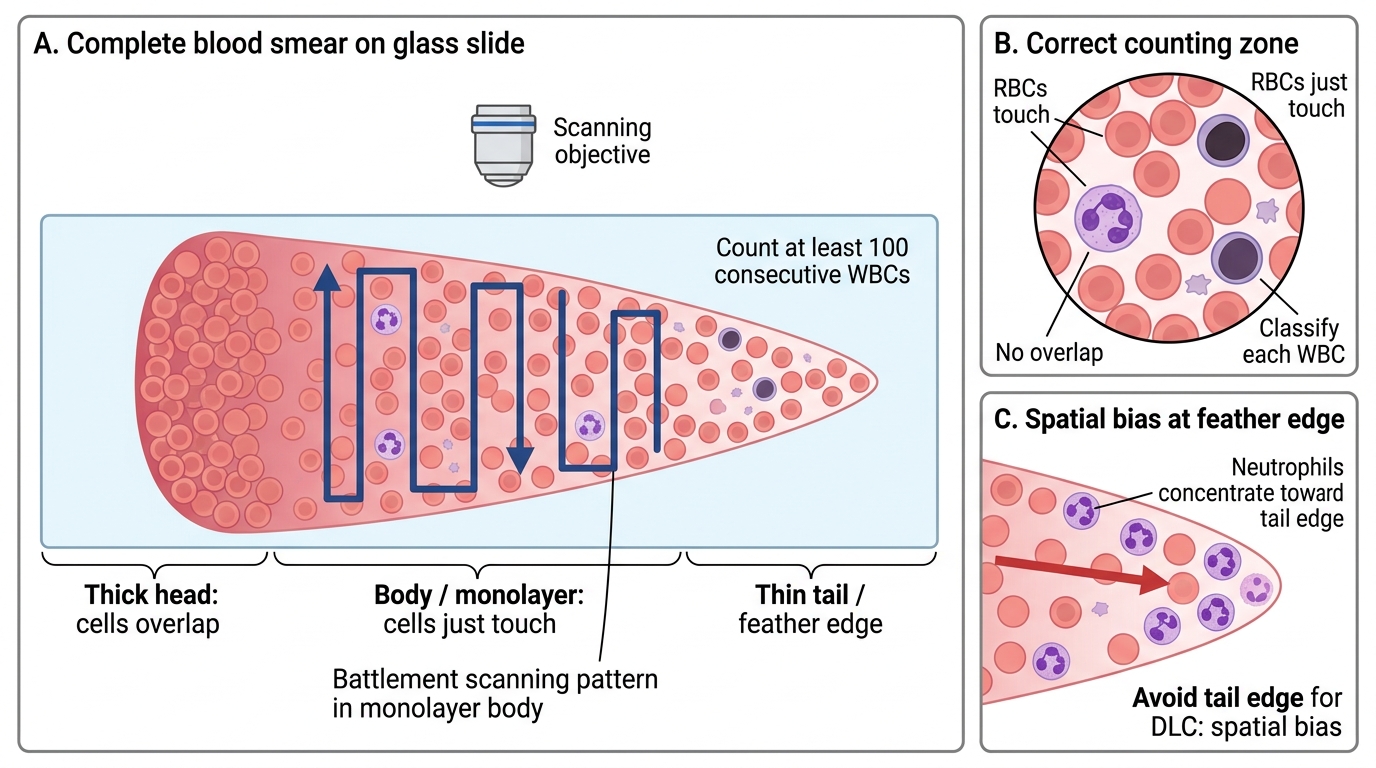
Peripheral Blood Smear Zones and DLC Scanning Path
Scan in the monolayer body (mid-smear, where cells just touch but do not overlap). Use 40× objective. Move in a regular grid pattern (up-across-down, like battlements). Count at least 100 consecutive WBCs, classifying each.
Normal DLC:
| Cell | Normal % | Absolute count (normal WBC 5,000–10,000) |
|---|---|---|
| Neutrophils (segmented) | 50–70% | 2,500–7,000/µL |
| Lymphocytes | 20–40% | 1,000–4,000/µL |
| Monocytes | 2–8% | 200–800/µL |
| Eosinophils | 1–6% | 40–600/µL |
| Basophils | 0–1% | 0–100/µL |
Absolute counts are more clinically useful than percentages. A lymphocyte percentage of 45% means nothing if the WBC is 3,000 (absolute = 1,350, which is borderline low — not high).
The left shift rule: Bands (immature neutrophils) > 10% = left shift → bacterial infection, sepsis, tissue damage. A 'leukaemoid reaction' is WBC > 50,000/µL with marked left shift, mimicking leukaemia but reactive in cause (e.g., severe sepsis, tuberculosis).
CLINICAL PEARL
Two traps every resident falls into at least once:
- DLC at the tail = false neutrophilia. Neutrophils (being larger and heavier) concentrate at the feather edge and lateral edges of the smear during spreading. Counting here inflates neutrophil % by 10–15 percentage points. Always count in the monolayer body — where cells just touch without overlapping.
- Pseudothrombocytopenia from EDTA-induced platelet clumping. Some patients have EDTA-dependent platelet antibodies that cause platelet aggregation in vitro but NOT in vivo. The analyzer sees clumps as large particles (or counts them as WBCs) and reports platelets as alarmingly low (e.g., 20,000/µL). The smear shows platelet clumps. Repeat the sample in a sodium citrate tube (blue-top) — normal platelet count confirms EDTA pseudothrombocytopenia. Never transfuse based on an EDTA platelet count alone if the smear shows clumps.
SELF-CHECK
An automated CBC reports platelets 28,000/µL on an EDTA sample. The peripheral smear shows large platelet clumps throughout the monolayer. What is the most appropriate next step?
A. A. Immediately request a platelet transfusion
B. B. Repeat CBC on the same EDTA sample after warming to 37°C
C. C. Repeat CBC on a fresh sample collected into a citrate (blue-top) tube
D. D. Call the clinician to withhold all anticoagulants
Reveal Answer
Answer: C. C. Repeat CBC on a fresh sample collected into a citrate (blue-top) tube
Platelet clumps visible on the smear in the setting of a very low automated platelet count strongly suggest EDTA-dependent pseudothrombocytopenia. The correct action is to recollect into a citrate tube — citrate is a milder anticoagulant that does not trigger the EDTA-dependent antibodies causing clumping. Warming the EDTA sample (Option B) does not reliably reverse EDTA-induced clumping. Transfusion (Option A) based on a spuriously low count is dangerous. Option D is clinically inappropriate without confirming a true thrombocytopenia.