Page 4 of 25
PA14.1 | Iron Deficiency Anaemia: Pathogenesis to Lab Diagnosis — SDL Guide
Learning Objectives
- State the global and Indian epidemiology of iron deficiency anaemia (IDA)
- Classify the four etiological buckets of IDA with clinical examples stratified by patient demographic
- Trace the pathogenesis of IDA through the three stages of iron depletion (building on SDL 1)
- Enumerate the specific clinical features of IDA — general anaemia signs and IDA-specific epithelial changes
- Interpret the complete laboratory workup of IDA: CBC, iron studies, peripheral smear, reticulocyte index, and bone marrow findings
- Apply a 'Find-the-Cause' clinical framework to guide the workup of newly diagnosed IDA
- Outline principles of iron replacement therapy and criteria for therapeutic response
INSTRUCTIONS
IDA is the anaemia you will encounter most often — in OPD, in wards, in obstetrics, and in your own family. Knowing IDA is not optional for a clinician. This module builds directly on the iron metabolism physiology you studied in SDL 1. You already know the stages of iron depletion and how hepcidin regulates iron. Now we apply that framework to the world's most prevalent nutritional deficiency disorder — affecting over 500 million people and 50% of Indian women of reproductive age. Work through every section actively: pause at the lab tables and interpret the numbers yourself before reading the explanation. Complete all three micro-quizzes. The case challenge at the end is the kind of clinical decision you will face as a PG resident — think before scrolling to the answer.
References
- Robbins & Cotran Pathologic Basis of Disease, 10th ed. — Chapter 14: Red Cell and Bleeding Disorders (textbook)
- Harsh Mohan — Textbook of Pathology, 8th ed. — Chapter 13: Disorders of Red Blood Cells (textbook)
- Hoffbrand & Moss — Essential Haematology, 7th ed. — Chapter 3: Iron Deficiency Anaemia (textbook)
- WHO — Haemoglobin concentrations for the diagnosis of anaemia and assessment of severity (2011) (guideline)
- National Family Health Survey 5 (NFHS-5, 2019-21) — Anaemia prevalence data, India (national_data)
Version 2.0 | NMC CBUC 2024
CLINICAL SCENARIO
A 28-year-old woman presents to your OPD. She teaches at a school, eats a predominantly vegetarian diet, and has had 'tiredness for the past few months.' She mentions her nails have become oddly curved — spoon-shaped. Her periods are heavy. Her Hb is 7.8 g/dL.
You have just walked in on the most common anaemia in the world.
Iron deficiency anaemia (IDA) affects an estimated 500 million people globally. In India, it is not a rare complication — it is an epidemic. NFHS-5 data (2019–21) reports anaemia in 57% of women aged 15–49 years and 67% of children aged 6–59 months. Behind many of these numbers is IDA.
By the end of this module, you will know exactly how to diagnose her, why her nails are curved, and — most importantly — what you must do BEFORE you write the iron prescription.
WHY THIS MATTERS
IDA will appear throughout your clinical career:
- Obstetrics & Gynaecology: the pregnant woman at 28 weeks with Hb 9 g/dL; the teenager with menorrhagia
- Medicine wards: the 65-year-old man with unexplained anaemia who is hiding a colorectal carcinoma
- Paediatrics: the exclusively breastfed 9-month-old with IDA and developmental delay
- Surgery pre-op: optimising Hb before elective procedures
- General OPD: the vegetarian family with chronic fatigue
Diagnosing IDA is step one. Finding the cause is the clinical imperative. You cannot treat a bleed with iron alone.
RECALL
Recall from SDL 1 (Iron Metabolism):
Three stages of iron deficiency (Bothwell's staging):
1. Stage 1 — Storage depletion: Serum ferritin falls first. Bone marrow iron disappears. No anaemia yet. No symptoms. This stage is often missed.
2. Stage 2 — Transport depletion (Iron-deficient erythropoiesis): Serum iron falls, TIBC rises, transferrin saturation drops below 15%. Erythropoiesis becomes iron-restricted. RBCs start coming out microcytic and hypochromic. RDW rises.
3. Stage 3 — Frank IDA: Hb falls below the threshold. Full microcytic, hypochromic anaemia. Symptoms emerge.
Hepcidin suppresses ferroportin on enterocytes and macrophages. In IDA, hepcidin falls dramatically — the body tries to maximise iron absorption and release from stores. This is why your gut absorbs iron more efficiently when you're depleted (and why oral iron works at all).
Keep this staging framework in mind as you read the lab section — every test maps onto one of these stages.
Epidemiology: The Scale of the Problem
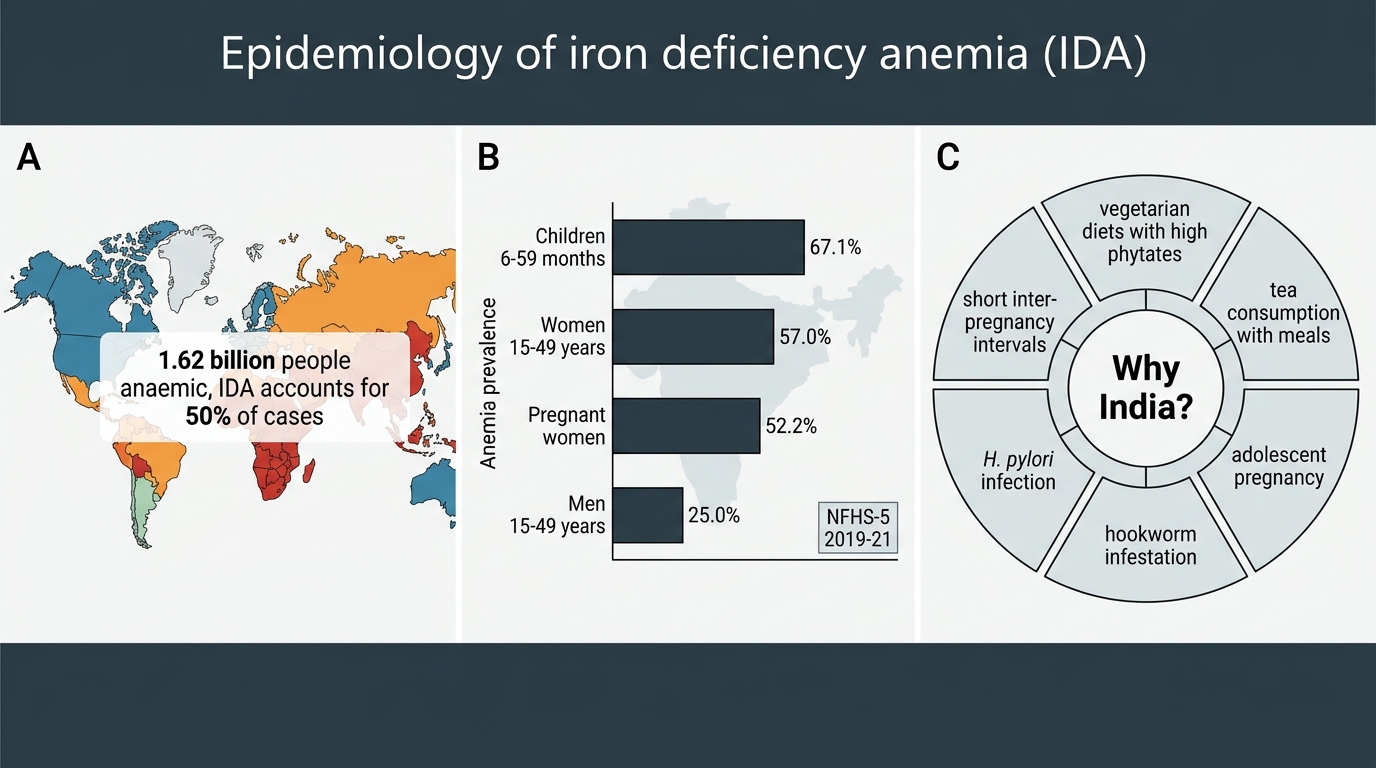
Epidemiology of Iron Deficiency Anemia: Global Burden and Indian Context
Global burden:
IDA is the most common nutritional deficiency disorder and the most common cause of anaemia worldwide. WHO estimates 1.62 billion people are anaemic, and IDA accounts for approximately 50% of cases. It is a leading cause of disability-adjusted life-years (DALYs) — not because it kills acutely, but because it chronically impairs productivity, cognitive development, and maternal-fetal outcomes.
India — the numbers you must know (NFHS-5, 2019–21):
| Population group | Anaemia prevalence |
|---|---|
| Children 6–59 months | 67.1% |
| Women 15–49 years | 57.0% |
| Pregnant women | 52.2% |
| Men 15–49 years | 25.0% |
The majority of anaemia in women and children in India is nutritional IDA. The male figure is lower — but when a middle-aged or older Indian man has anaemia, you must exclude GI blood loss aggressively.
Why India? Several structural factors converge:
- Predominantly vegetarian diets with high phytate and low haem iron intake
- Tea consumption with meals (tannins chelate non-haem iron)
- High adolescent pregnancy rates (demand surge)
- Chronic hookworm infestation in rural populations (still prevalent)
- High prevalence of Helicobacter pylori infection (impairs iron absorption)
- Frequent short inter-pregnancy intervals depleting maternal stores
IDA in India is not simply a dietary problem — it is a syndemic of diet, infection, and reproductive patterns.
Etiology: The Four Buckets
Think of every IDA case through four mechanistic buckets. The patient's demographic tells you which bucket to open first.

Iron Deficiency Anemia: Clinical Framework by Patient Demographics
1. Decreased Intake (Nutritional)
- Vegetarian/vegan diets: only 2–5% of non-haem iron is absorbed vs. 15–35% of haem iron. Phytates in whole grains and legumes further reduce absorption.
- Milk-only infants: breast milk has low iron; exclusively breastfed infants need supplementation from 6 months. Cow's milk is a double threat — low iron + occult intestinal blood loss from protein intolerance.
- Geriatric malnutrition: reduced appetite, monotonous diet, poor dentition.
- Tea/coffee with meals: tannins form insoluble iron complexes.
2. Decreased Absorption
- Post-gastrectomy: acid converts Fe³⁺ → Fe²⁺ (absorbable form). Loss of acid-secreting stomach means poor reduction. Also bypasses the duodenum (primary absorption site).
- Coeliac disease: villous atrophy destroys the absorptive surface of the proximal small bowel — the very site of iron absorption. IDA may be the presenting feature of undiagnosed coeliac.
- Atrophic gastritis / autoimmune gastritis: hypochlorhydria impairs iron solubilisation. Often co-exists with B12 deficiency (pernicious anaemia).
- H. pylori infection: impairs iron absorption + may cause occult GI blood loss.
- PPI overuse: raises gastric pH, reduces Fe²⁺ availability.
3. Increased Loss (Chronic Haemorrhage)
This is the most common cause overall — and the one you must never miss.
| Patient group | Most common cause |
|---|---|
| Women of reproductive age (most common IDA group) | Menorrhagia (uterine fibroids, adenomyosis, coagulopathy) |
| Elderly men & post-menopausal women | GI blood loss (peptic ulcer, colorectal carcinoma, angiodysplasia) |
| Rural populations, especially children | Hookworm (Ancylostoma/Necator) — each worm loses 0.2 mL blood/day |
| Chronic aspirin/NSAID users | Occult peptic ulceration + platelet dysfunction |
| Haematuria | Renal tract malignancy, bladder transitional cell carcinoma |
| Dialysis patients | Repeated blood sampling + dialyser losses |
⚠️ Key rule: Unexplained IDA in any adult male or post-menopausal woman = GI malignancy excluded FIRST. Do not attribute to diet until the colon is cleared.
4. Increased Demand
- Pregnancy: plasma volume expands 50%, RBC mass expands 30% → relative iron dilution + fetal demands (~300 mg iron transferred to fetus, ~500 mg to RBC expansion). Iron requirement triples in the third trimester.
- Lactation: 0.5–1 mg iron per day secreted in breast milk.
- Infancy: rapid growth doubles blood volume; preterm infants have lower hepatic iron stores.
- Adolescent growth spurt: accelerated erythropoiesis + onset of menstruation in girls create a double demand.
Clinical mnemonic — demographic → bucket:
- Young woman with menorrhagia → Increased Loss
- Breastfed infant, 9 months → Decreased Intake
- Post-gastrectomy patient → Decreased Absorption
- Third-trimester pregnant woman → Increased Demand
- 65-year-old man, diet fine → Increased Loss (exclude GI malignancy)
CLINICAL PEARL
RDW rises BEFORE MCV drops in early IDA. When iron stores first fall, the marrow begins producing some smaller, iron-deficient RBCs alongside normal-sized older cells — a mixed population. This anisocytosis drives the RDW up while the MCV (an average) is still normal. A normocytic anaemia with elevated RDW should trigger an iron panel to exclude early IDA (or a mixed B12/folate + iron deficiency, which produces a 'dimorphic' picture). Don't wait for a low MCV to consider IDA.
Pathogenesis: From Empty Stores to Hypochromic Microcytes
You covered the three-stage model in SDL 1. Here is what happens at the cellular level when stage 3 is reached.
The iron-haemoglobin connection:
Haemoglobin synthesis requires iron at the final step: iron is inserted into protoporphyrin IX by the enzyme ferrochelatase to form haem. When iron is insufficient, this step is rate-limiting. The erythroid precursor in the marrow continues to divide (because EPO drives it), but each daughter cell gets less iron — so each cell makes less haemoglobin.
Result:
- Microcytosis: the cell is 'underfilled.' Without enough Hb to fill the cytoplasm, the cell remains small (MCV <80 fL). Erythrocytes achieve their final size partly by how much they distend with haemoglobin.
- Hypochromia: less Hb per cell means less colour. The central pallor zone, normally <1/3 of cell diameter, expands. MCHC drops (<31 g/dL).
- Anisocytosis: some cells are more iron-depleted than others — hence the high RDW (>14.5%).
- Poikilocytosis: thin, flattened hypochromic cells distort into elongated 'pencil cells' and target cells.
Why doesn't the reticulocyte count compensate?
In haemolysis, the marrow floods the blood with reticulocytes. In IDA, erythropoiesis is iron-restricted — the marrow CANNOT produce cells at the rate EPO demands. The reticulocyte production index (RPI) is <2, signalling ineffective production. This is a hypoproliferative anaemia, not a haemolytic one.
Erythroid hyperplasia paradox: Despite ineffective production, the marrow DOES show erythroid hyperplasia (more erythroid precursors, reduced M:E ratio) on biopsy — because EPO keeps stimulating the precursors. They just can't complete maturation efficiently. Perls Prussian blue stain shows absent stainable iron in macrophages — the definitive marrow sign of IDA.
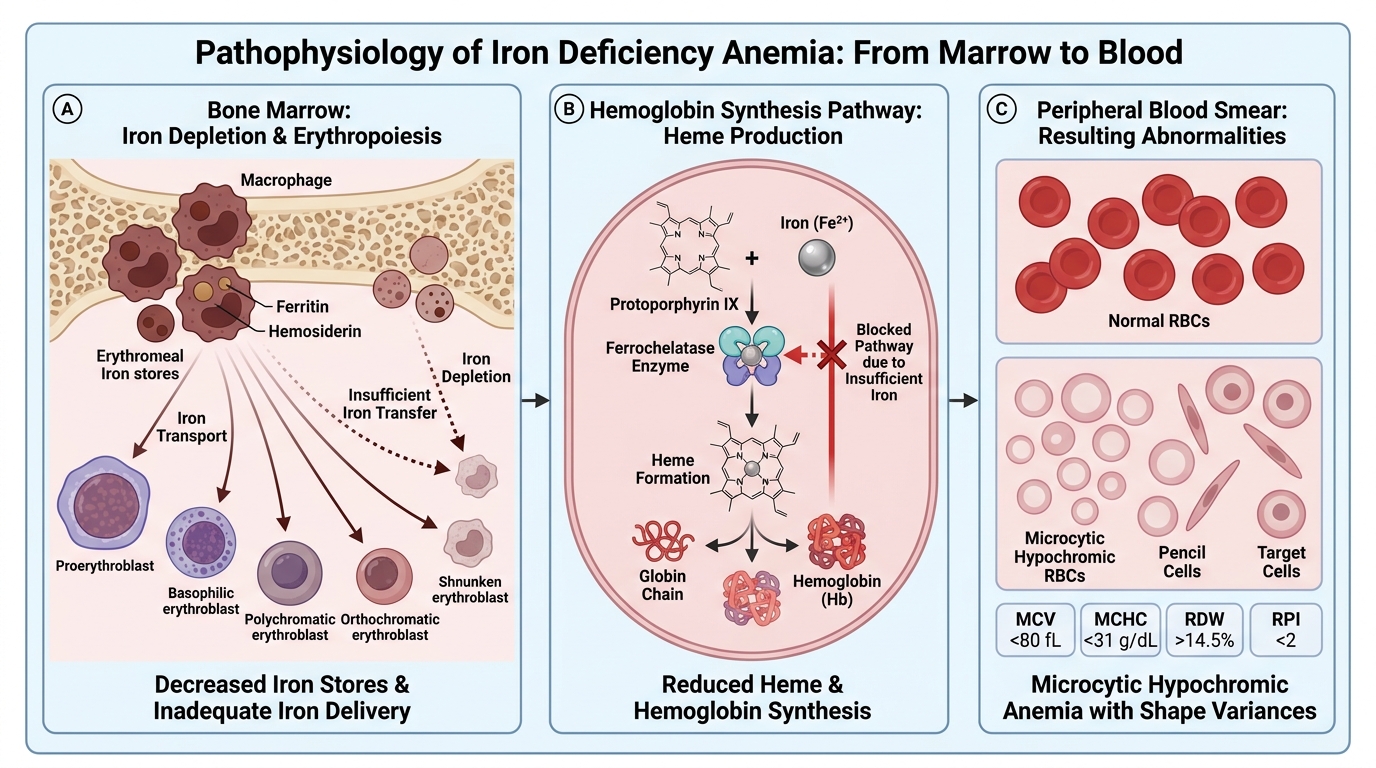
Pathogenesis of Iron Deficiency Anemia: From Iron Depletion to Microcytic Hypochromic Anemia