Page 3 of 17
PA15.1 | Vitamin B12 & Folate Metabolism — Deficiency Pathogenesis — SDL Guide (Part 3)
Pernicious Anaemia — Closer Look at the Autoimmune Mechanism
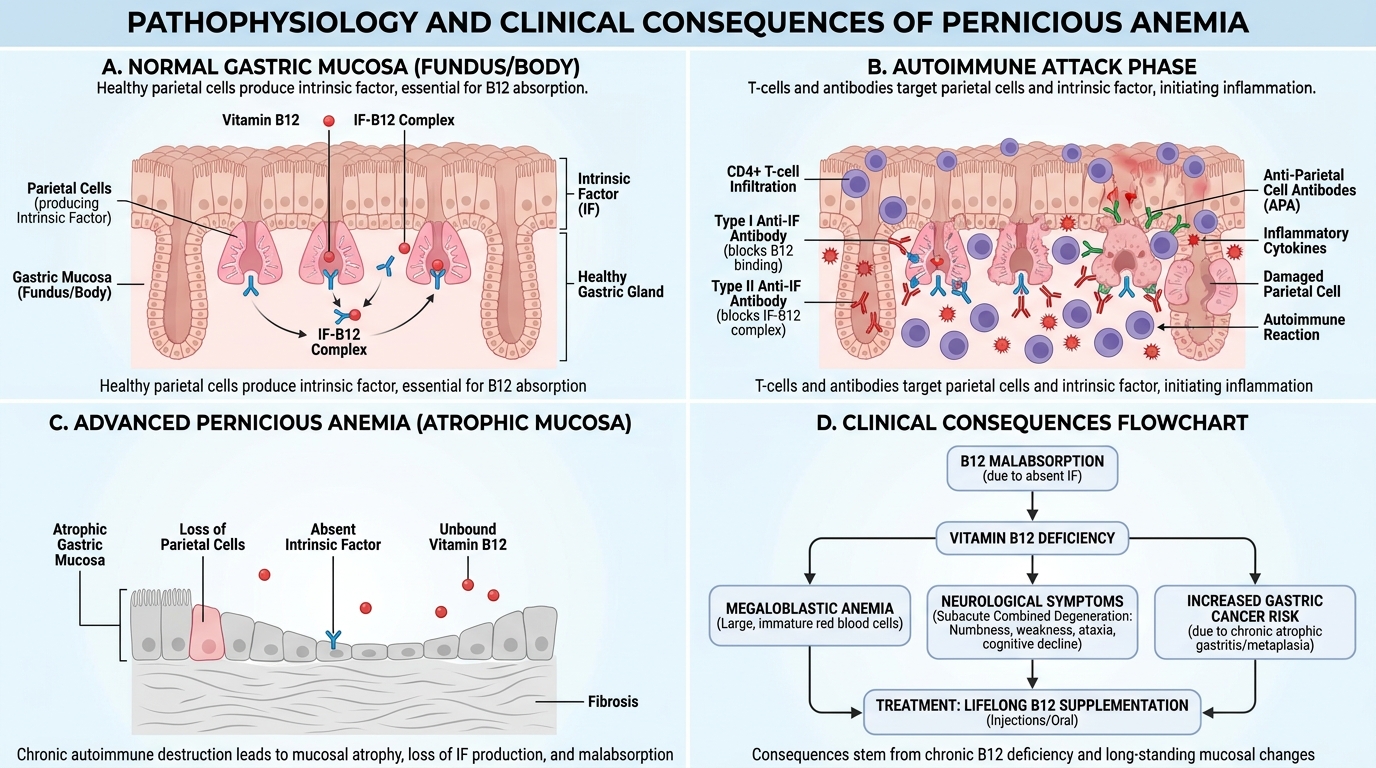
Pernicious Anemia: Autoimmune Pathogenesis and Clinical Progression
Pernicious anaemia (PA) deserves its own block because it is the single most common cause of B12 deficiency in clinical practice and a model of organ-specific autoimmunity.
Pathogenesis:
1. Type A chronic atrophic gastritis — autoimmune CD4+ T-cell attack on parietal cells of the gastric fundus/body.
2. Loss of parietal cells → loss of both HCl and intrinsic factor.
3. Two auto-antibodies (detectable in serum and gastric juice):
• Type I (blocking) anti-IF antibodies — prevent B12 binding to IF. Highly specific (~99%) for PA.
• Type II (binding) anti-IF antibodies — bind IF-B12 complex, blocking cubilin attachment.
• Anti-parietal-cell antibodies (APC-Abs) — target H⁺/K⁺-ATPase; found in ~90% of PA but also ~10% of normal elderly population (low specificity).
4. Absent IF → B12 not absorbed → years of progressive store depletion.
Clinical context: PA can present with any combination of haematological (megaloblastic anaemia), neurological (subacute combined degeneration, SCD), gastrointestinal (glossitis, anorexia), or even isolated neuropsychiatric features with a normal blood count in some patients with high-normal folate intake who bypass the haematological threshold.
Gastric cancer risk: longstanding atrophic gastritis → loss of acid → reduced inhibition of gastrin (hypergastrinaemia) → enterochromaffin-like (ECL) cell hyperplasia → small risk of gastric carcinoid tumours. PA patients have a 2–3× increased risk of gastric carcinoma.
Neurological Involvement — Subacute Combined Degeneration of the Spinal Cord
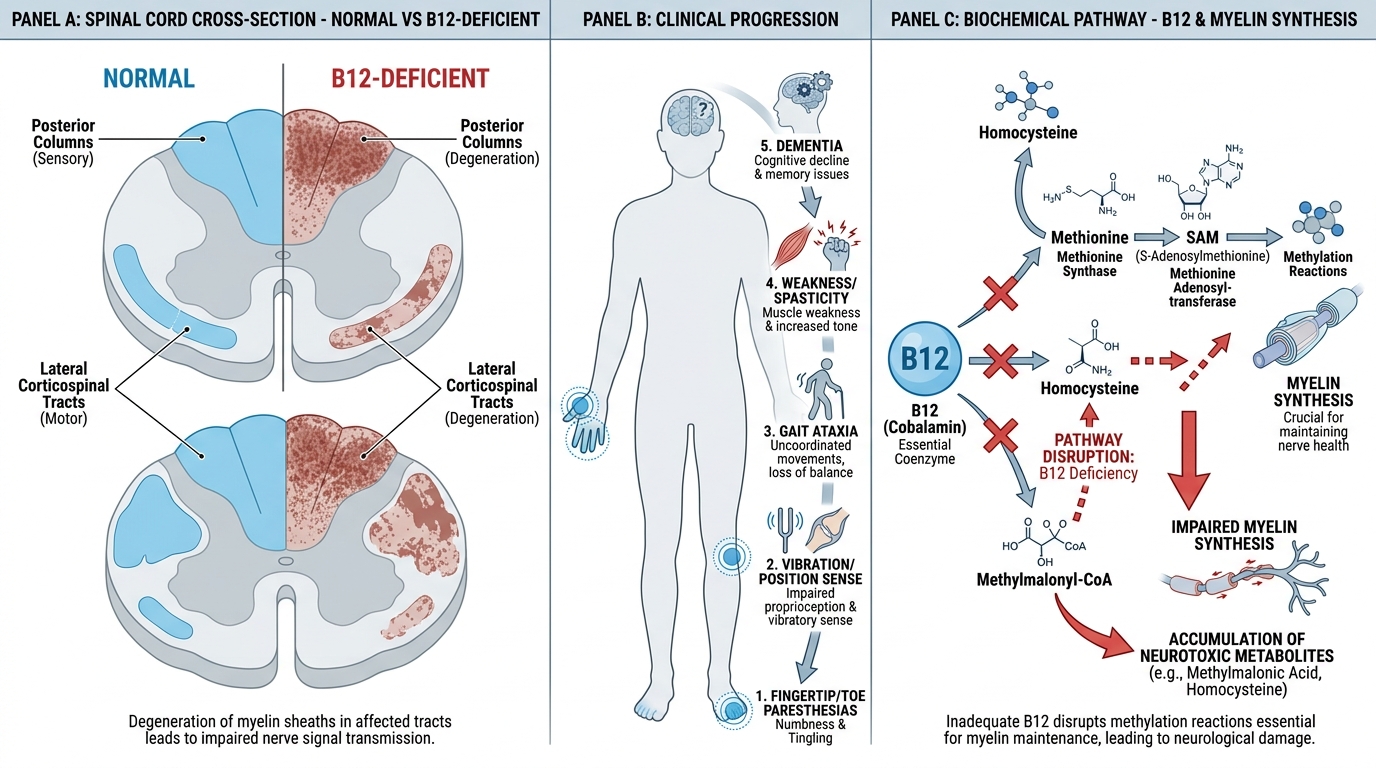
Subacute Combined Degeneration of the Spinal Cord in B12 Deficiency
Subacute combined degeneration of the spinal cord (SCD) is the most clinically alarming and diagnostically crucial feature that separates B12 from folate deficiency.
Affected tracts ("combined" = two tracts):
• Posterior columns (dorsal funiculi) — position sense, vibration sense, two-point discrimination.
• Lateral (pyramidal) corticospinal tracts — upper motor neuron signs (spasticity, hyperreflexia in advanced disease).
• Peripheral nerves may also be affected (lower motor neuron signs, glove-and-stocking paraesthesiae).
Biochemical basis:
• Myelin synthesis requires SAM (via methionine → SAM pathway, B12-dependent).
• Without adequate SAM, myelin cannot be synthesised or maintained. Abnormal fatty acids derived from methylmalonyl-CoA accumulation may also be incorporated into myelin phospholipids, disrupting their structure.
• Folate deficiency does NOT raise MMA and does NOT affect SAM production directly — this is why neurological involvement is absent in pure folate deficiency.
Clinical sequence: paraesthesiae in fingertips/toes (earliest) → loss of vibration and position sense → gait ataxia → weakness and spasticity (pyramidal) → dementia and subacute encephalopathy in severe untreated cases.
Critical teaching point: SCD can occur with a normal or only mildly abnormal MCV — the nervous system may be severely damaged before the blood picture becomes frankly macrocytic. Never reassure a B12-deficient patient with normal haemoglobin that they are safe from neurological damage.
SELF-CHECK
A 35-year-old woman with folate deficiency megaloblastic anaemia asks whether she might develop neurological problems similar to B12 deficiency. The BEST biochemical explanation for why her neurological risk is minimal is:
A. Folate deficiency does not elevate homocysteine, unlike B12 deficiency
B. Folate deficiency does not impair methylmalonyl-CoA mutase, so MMA does not accumulate and myelin metabolism is preserved
C. Folate cannot cross the blood-brain barrier, so central nervous system metabolism is unaffected
D. The posterior columns are resistant to folate-related metabolic changes
Reveal Answer
Answer: B. Folate deficiency does not impair methylmalonyl-CoA mutase, so MMA does not accumulate and myelin metabolism is preserved
Methylmalonyl-CoA mutase requires adenosylcobalamin (a B12 derivative) as its cofactor — folate has no role here. Elevated MMA and the resulting myelin disruption are B12-specific. Note that folate deficiency DOES raise homocysteine (option A is wrong), and folate metabolites certainly reach the CNS (option C is wrong). The correct explanation is enzyme-specific: only MUT activity and the SAM-dependent myelin methylation pathway require B12.
Causes of Folate Deficiency — Contrast with B12
⚑ AI image — pending faculty review (auto-QA score 7/10; best of 3 attempts)
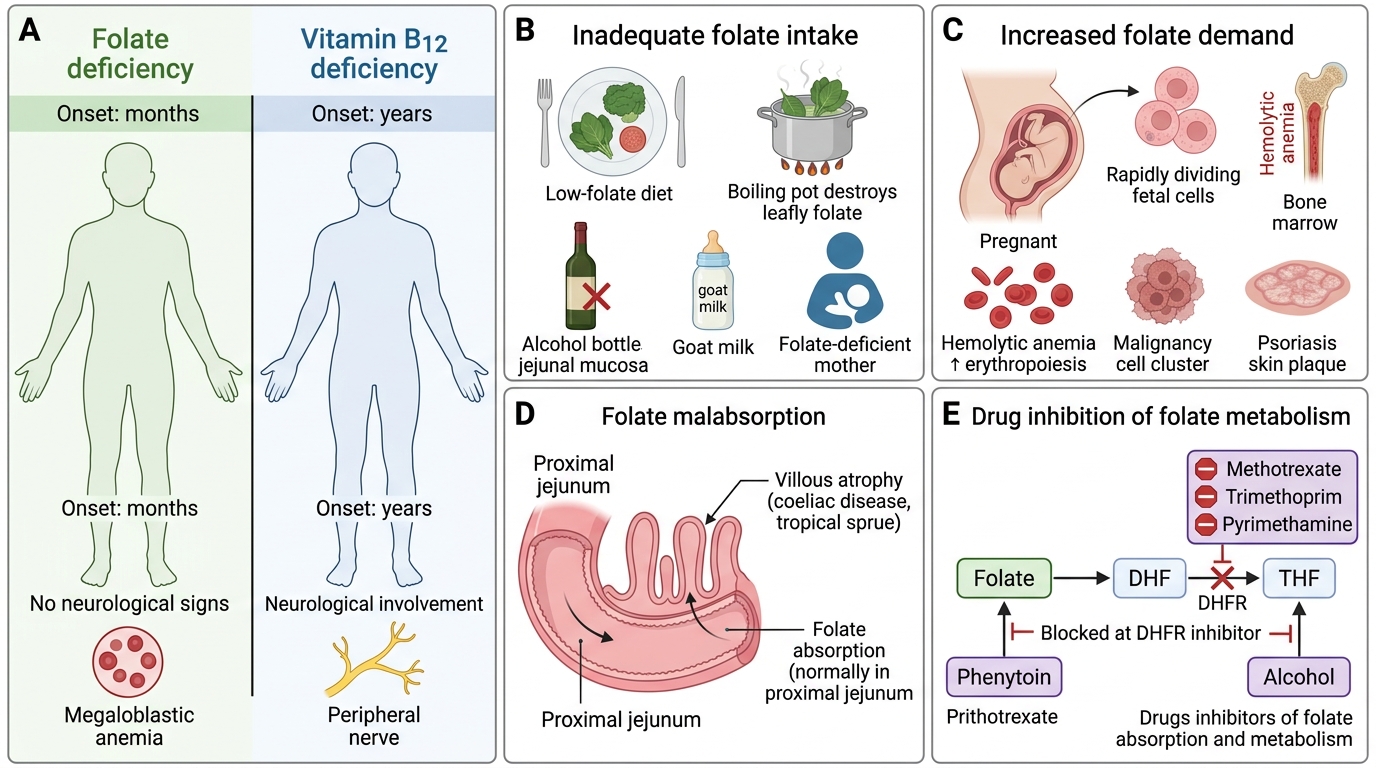
Causes of Folate Deficiency: Contrast with B12
Folate deficiency is more common globally than B12 deficiency, but the clinical syndrome differs in two critical ways: (a) faster onset (months vs years), and (b) no neurological involvement.
Causes:
1. Inadequate dietary intake (most common worldwide)
• Poor diet — cooking destroys folate; no fortified foods.
• Alcoholism — poor intake + impaired enterohepatic recycling + direct jejunal mucosal damage.
• Infancy — exclusive breast milk from folate-deficient mothers; goat milk (very low folate).
2. Increased demand
• Pregnancy — fetal cell division is a huge folate sink; supplementation mandatory (prevents neural tube defects).
• Haemolytic anaemias (chronic high erythropoiesis), malignancy, psoriasis.
3. Malabsorption
• Coeliac disease (proximal jejunal villous atrophy — remember, folate is absorbed proximally).
• Tropical sprue.
4. Drug inhibition of folate metabolism
• Methotrexate (MTX) — competitive inhibitor of DHFR; used therapeutically in cancer/RA but causes folate-depletion as a side-effect.
• Trimethoprim and pyrimethamine — selective DHFR inhibitors (bacterial/protozoal DHFR has higher affinity, but high doses affect human DHFR).
• Phenytoin — impairs folate absorption.
• Alcohol — multiple mechanisms (absorption + metabolism).
| Cause category | B12 deficiency | Folate deficiency |
|---|---|---|
| Dietary | Vegans only | Any poor diet, alcohol |
| Demand-driven | Rare | Pregnancy, haemolysis |
| Malabsorption | Terminal ileum | Proximal jejunum |
| Autoimmune | Pernicious anaemia | Not applicable |
| Drug-induced | Metformin, N₂O, PPIs | MTX, trimethoprim, phenytoin |
CLINICAL PEARL
Folate in pregnancy: Neural tube defects (anencephaly, spina bifida) result from folate insufficiency during neural tube closure — days 21–28 post-conception, before most women know they are pregnant. This is why periconceptional folate supplementation (0.4 mg/day; 5 mg/day for high-risk) must begin before conception, not after the first missed period. India's National Health Mission mandates folate supplementation from 12 weeks — recognise this as a public-health application of this very biochemistry.
Putting It Together — B12 vs Folate Deficiency at a Glance
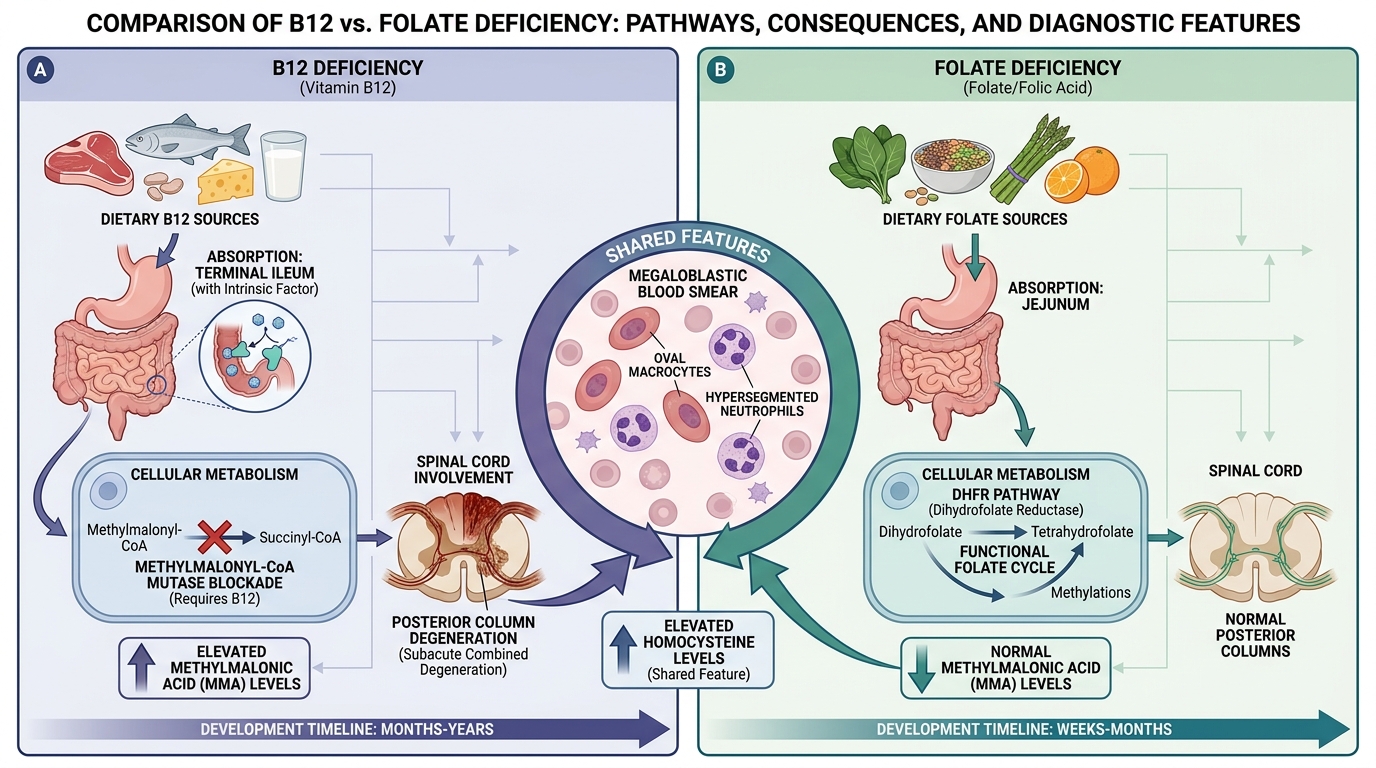
B12 vs Folate Deficiency: Comparative Pathophysiology and Clinical Features
For a structured differential, remember four axes:
1. Speed of onset: Folate deficiency → weeks to months (small stores). B12 deficiency → months to years (large stores). A patient with B12 deficiency of only 6 months' duration has almost certainly been B12-depleted for longer.
2. Aetiology pivot: Ask "vegan?" → dietary B12. Ask "alcoholic, pregnant, coeliac?" → folate. Ask ">50 years + autoimmune history?" → pernicious anaemia.
3. Neurological exam: Any posterior-column signs (impaired vibration/position) or pyramidal signs → B12 (never folate alone).
4. Biochemistry:
• Both → ↑ homocysteine.
• Only B12 → ↑ MMA. (MMA elevation is the gold-standard biochemical fingerprint of B12 deficiency.)
• Only B12 deficiency requires checking serum anti-IF antibodies and doing a Schilling test (now rarely performed; replaced by serum gastrin + anti-IF-Ab).

Comparison of B12 and Folate Deficiency in Megaloblastic Anemia