Page 6 of 21
PA18.2 | Acute Leukaemias — AML & ALL — SDL Guide (Part 2)
Classification: WHO 2022 and FAB

Classification of Acute Leukaemias: WHO 2022 and FAB
WHO 2022 classifies acute leukaemias primarily by lineage (AML vs ALL) and defining genetic abnormalities, moving away from pure morphology:
AML subtypes include: AML with recurrent genetic abnormalities (the cytogenetic entities below), AML with myelodysplasia-related changes, therapy-related AML, AML NOS.
ALL (now called B-lymphoblastic or T-lymphoblastic leukaemia/lymphoma): B-ALL subtypes defined by genetics (Philadelphia+, ETV6-RUNX1, hyperdiploidy, hypodiploidy); T-ALL is a separate entity.
FAB classification (French-American-British, 1976) uses morphology and cytochemistry to subtype:
| FAB | AML Name | Key feature |
|---|---|---|
| M0 | Minimally differentiated | MPO negative by light microscopy |
| M1 | Without maturation | Some MPO+ blasts |
| M2 | With maturation | t(8;21); Auer rods |
| M3 | Acute promyelocytic (APL) | t(15;17); faggot cells; DIC risk |
| M4 | Myelomonocytic | Mixed myeloid + monocytic |
| M4Eo | M4 + eosinophilia | inv(16) |
| M5 | Monocytic | Gum hypertrophy; NSE+ |
| M6 | Erythroleukaemia | Predominant erythroid precursors |
| M7 | Megakaryoblastic | Down syndrome association |
FAB L1 (small blasts, children), L2 (large blasts, adults), L3 (Burkitt-like, now reclassified) for ALL.
For exams: know M2 (t(8;21), Auer rods) and M3 (APL, t(15;17), ATRA treatment, DIC) by heart.
Acute Myeloid Leukaemia (AML): Pathology and Cytogenetics
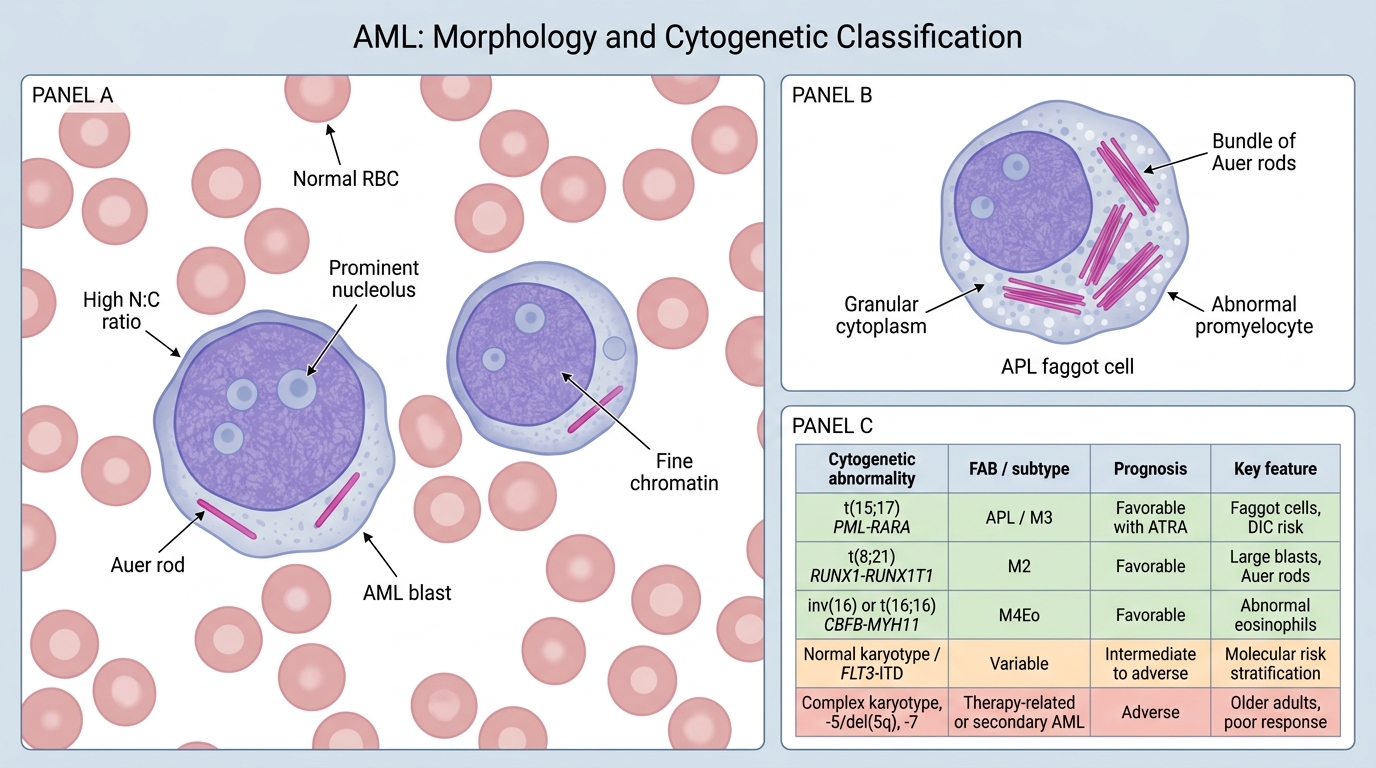
AML Morphology and Cytogenetic Classification
AML is predominantly a disease of adults (median age ~65 years), though it occurs at all ages.
Morphology:
• Blasts are large with high N:C ratio, prominent nucleoli, and fine chromatin.
• Auer rods — pathognomonic of AML. These are crystallised, fused primary granules that form needle-like pink inclusions in the blast cytoplasm on Romanowsky stain. A single Auer rod confirms myeloid lineage. In APL, bundles of Auer rods form faggot cells.

AML Blasts: Morphology and Cytogenetic Classification
Key cytogenetic–prognostic groups in AML:
| Abnormality | FAB | Prognosis | Special feature |
|---|---|---|---|
| t(15;17) — PML-RARα | M3 (APL) | Favourable with ATRA | DIC at presentation; ATRA differentiates the blasts |
| t(8;21) — RUNX1-RUNX1T1 | M2 | Favourable | Auer rods abundant; responds well to cytarabine |
| inv(16) — CBFB-MYH11 | M4Eo | Favourable | Abnormal eosinophils in marrow |
| FLT3-ITD | Any | Poor | Common; targeted by midostaurin |
| Complex karyotype (≥3 abnormalities) | t-AML / MDS-related | Poor | Often therapy-related |
Acute Promyelocytic Leukaemia (APL) — must-know:
The t(15;17) fuses PML with RARα, producing a fusion protein that blocks myeloid differentiation at the promyelocyte stage. The hypergranular promyelocytes release tissue factor and proteases → DIC (bleeding + clotting) is a life-threatening presentation. All-trans retinoic acid (ATRA) binds the PML-RARα fusion, overcoming the differentiation block → promyelocytes mature, blast count falls. ATRA + arsenic trioxide has turned APL from the most lethal to the most curable AML subtype.
CLINICAL PEARL
A patient with newly diagnosed AML who presents with simultaneous bleeding and thrombosis (purpura + limb ischaemia, or gum bleeding + DVT) should raise immediate suspicion for APL and DIC. Start ATRA empirically while awaiting FISH confirmation for t(15;17)—delay is dangerous. Check PT, aPTT, fibrinogen, and D-dimer immediately. This is one of the few haematological emergencies where treatment precedes cytogenetic confirmation.
Acute Lymphoblastic Leukaemia (ALL): Pathology and Cytogenetics

Acute Lymphoblastic Leukaemia: Morphology and Cytogenetics
ALL is the commonest malignancy of childhood (peak 2–5 years). Adult ALL carries a worse prognosis. ALL arises from committed lymphoid progenitors — either B-cell (80–85%) or T-cell (15–20%).
Morphology:
• Lymphoblasts are generally smaller than myeloblasts, with scant cytoplasm, inconspicuous nucleoli, and smooth nuclear contours.
• Cytoplasm lacks granules; Auer rods are ABSENT.
• In T-ALL, blasts may have a convoluted nucleus.

Acute Lymphoblastic Leukemia: Morphology and Cytogenetic Classification
Key cytogenetic subtypes in B-ALL:
| Genetic finding | Age group | Prognosis | Note |
|---|---|---|---|
| Hyperdiploidy (>50 chromosomes) | Children | Excellent | ~25% of childhood B-ALL; responds to methotrexate |
| ETV6-RUNX1 (TEL-AML1), t(12;21) | Children | Excellent | Commonest translocation in children; cryptic on standard karyotype, needs FISH |
| Philadelphia chromosome t(9;22) — BCR-ABL1 | Adults | Poor (historically) | ~25% of adult ALL; now treated with TKI (imatinib/dasatinib) + chemo |
| Hypodiploidy (<44 chromosomes) | Any | Very poor | Near-haploid: worst prognosis |
| MYC rearrangements (L3/Burkitt) | Any | Variable | Highly proliferative; separate protocol |
T-ALL: Adolescent males; mediastinal mass (thymus involvement) causing SVC syndrome. Worse prognosis than favourable B-ALL but better than Ph+ B-ALL. Treated with augmented protocols.
Sanctuary sites in ALL:
• CNS: Leukaemic blasts cross the blood-brain barrier; CNS prophylaxis (intrathecal methotrexate ± cranial radiation) is mandatory.
• Testicular: Blasts in testicular parenchyma (blood-testis barrier); boys require testicular surveillance; testicular relapse can occur years after apparent remission.
SELF-CHECK
A 4-year-old boy is diagnosed with B-ALL. FISH shows ETV6-RUNX1 fusion and karyotype reveals 54 chromosomes. Which of the following BEST describes his prognosis?
A. Poor — Philadelphia-positive ALL has high relapse rate
B. Intermediate — hyperdiploidy alone is not favourable
C. Excellent — both hyperdiploidy and ETV6-RUNX1 are independently favourable markers
D. Cannot be determined without flow cytometry
Reveal Answer
Answer: C. Excellent — both hyperdiploidy and ETV6-RUNX1 are independently favourable markers
ETV6-RUNX1 (TEL-AML1) fusion and hyperdiploidy (>50 chromosomes) are the two most favourable cytogenetic findings in B-ALL. Each independently confers excellent prognosis, and their co-occurrence is considered doubly favourable. Philadelphia chromosome (t(9;22)) and hypodiploidy are the adverse markers to contrast with.