Page 5 of 23
PA19.{2,5} | Tuberculous Lymphadenitis — Pathology & Specimen — SDL Guide (Part 2)
Microscopic Features: Reading the Slide

Reading the TB Lymph Node Slide
This is the core of PA19.5. When you examine a lymph node section for suspected TB, look systematically at four zones — low power first, then high power.
Low power (4× or 10×):
You will see the normal lymph node architecture effaced — the usual follicles and sinuses are replaced by pale, amorphous areas (caseous necrosis) surrounded by cellular zones. In early disease, architecture may be partially preserved.
Intermediate power (10×):
Around each pale necrotic zone, a cellular mantle of epithelioid histiocytes and giant cells forms the granuloma wall. In lymph nodes, multiple adjacent granulomas typically fuse, forming confluent caseating epithelioid granulomas rather than discrete compact follicles (the latter are more typical of early pulmonary TB).
High power (40×) — the diagnostic zone:
- Epithelioid histiocytes: Large cells with abundant, pale eosinophilic cytoplasm. Nuclei are elongated, folded, or kidney-shaped (vesicular chromatin — open, not condensed). Cells lie in sheets, borders indistinct (syncytial arrangement).
- Langhans giant cells: Multinucleate cells with 5–50 nuclei arranged in a horseshoe (peripheral/wreath) pattern at the cell margin. Cytoplasm is abundant and pale. Do not confuse with foreign-body giant cells (nuclei central and randomly distributed).
- Caseous necrosis centre: Pink, granular, structureless material — no nuclei, no cell outlines. May show dystrophic calcification in older lesions.
- Lymphocytic cuff: CD4+ T lymphocytes ring the outer margin of the granuloma (small, dark nuclei).
- Fibrous reaction: In older lesions, a fibrous capsule or collar encircles the granuloma; may show hyalinisation.

Langhans Giant Cell in Tuberculous Granuloma (H&E, 400×)
SELF-CHECK
On a high-power H&E section of a lymph node, you see a large multinucleate cell with nuclei arranged in a peripheral horseshoe pattern. The surrounding cells have folded kidney-shaped nuclei and pale syncytial cytoplasm. Centralmost is pink structureless material. This picture is MOST consistent with:
A. Suppurative inflammation with central necrosis
B. Sarcoidosis — non-caseating granuloma with Schaumann bodies
C. Tuberculous lymphadenitis — caseating epithelioid granuloma
D. Diffuse large B-cell lymphoma with geographic necrosis
Reveal Answer
Answer: C. Tuberculous lymphadenitis — caseating epithelioid granuloma
The triad — Langhans giant cell (horseshoe nuclei peripherally), epithelioid histiocytes (kidney-shaped folded nuclei, pale syncytial cytoplasm), and central caseous (structureless pink) necrosis — is pathognomonic for TB. Sarcoidosis produces tight epithelioid granulomas but without caseous necrosis (non-caseating). DLBCL shows large lymphoid cells with prominent nucleoli, not granuloma formation. Suppurative inflammation features neutrophils, not epithelioid cells.
Ziehl-Neelsen Stain and Demonstrating the Bacillus

Ziehl-Neelsen Stain for Acid-Fast Bacilli in TB Lymphadenitis
Histological morphology alone is strongly suggestive, but the definitive morphological confirmation of TB requires demonstration of acid-fast bacilli (AFB).
Ziehl-Neelsen (ZN) stain principle: M. tuberculosis has a thick, waxy cell wall rich in mycolic acids that binds hot carbol fuchsin (red dye) and resists decolourisation with acid-alcohol — hence acid-fast. Background and non-AFB organisms are counterstained blue (methylene blue).
What you see: Slender, slightly curved, red (magenta) rods, 1–4 µm long, set against a blue background. They may appear individually or in small clusters. They are often sparse in lymph node caseum — you may need to scan multiple high-power fields.
Reporting: 'AFB seen — consistent with Mycobacterium sp.' Note: ZN does not distinguish M. tuberculosis from non-tuberculous mycobacteria (NTM) — culture or GeneXpert is required for species identification.
Why AFB may be scanty in nodes: The host's immune response is effective at limiting bacillary load in lymph nodes (unlike post-primary pulmonary TB cavities, which are teeming with organisms). A negative ZN stain does not exclude TB.

Acid-Fast Bacilli Identification and TB Lymphadenitis Diagnostic Approach
CLINICAL PEARL
The diagnostic hierarchy for TB lymphadenitis — remember this sequence:
- FNAC (Fine Needle Aspiration Cytology): First-line, minimally invasive. Smear shows epithelioid cell clusters, Langhans giant cells, caseous background. Sensitivity ~70–80% in India. ZN stain on FNAC material detects AFB in ~40–60% of confirmed cases.
- Excision biopsy / core biopsy: Gold standard for histology. Provides tissue architecture — confluent granulomas, caseous necrosis, ZN stain.
- Culture (Löwenstein-Jensen or BACTEC liquid medium): Definitive species ID and drug-sensitivity testing (DST). Takes 2–8 weeks. Required for drug-resistant TB.
- GeneXpert MTB/RIF (CBNAAT): Molecular rapid test from FNAC material, pus, or biopsy tissue. Detects M. tuberculosis DNA AND rifampicin resistance within 2 hours. WHO-endorsed first-line test where available (AYUSH/NTEP protocol in India).
- Mantoux / IGRA: Adjuncts. Positive = exposure, not active disease (especially in BCG-vaccinated individuals). Not diagnostic alone.
Key practical rule: In India, treat as TB if FNAC shows caseating granulomas + clinical context, even with negative ZN, while culture is pending. Do not wait 8 weeks for culture before starting treatment in a confirmed granulomatous picture.
Differential Diagnosis: Granulomatous Lymphadenitis
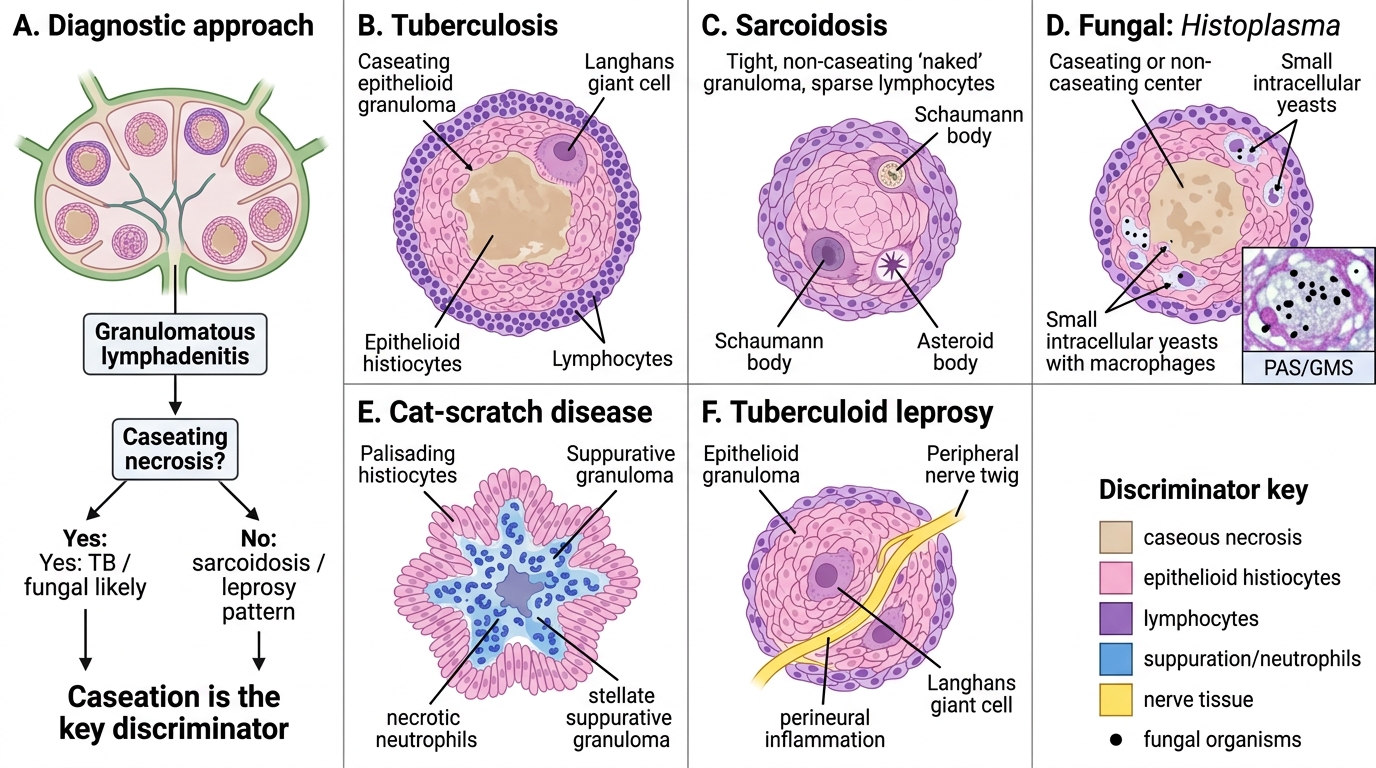
Differential Diagnosis of Granulomatous Lymphadenitis
Not every granuloma is TB. The caseation is your most important discriminator. Construct your differential systematically:
| Feature | TB | Sarcoidosis | Fungal (Histoplasma) | Cat-Scratch Disease | Leprosy (tuberculoid) |
|---|---|---|---|---|---|
| Granuloma type | Caseating epithelioid | Non-caseating, tight (naked granuloma) | Caseating or non-caseating | Stellate/suppurative + granuloma | Epithelioid, perineural |
| Giant cells | Langhans type | Schaumann/asteroid bodies | Langhans type | Rare | Langhans type |
| Organisms | AFB (ZN +) | None | PAS/GMS + yeast | Gram-neg rod (Warthin-Starry) | AFB (modified ZN) |
| Caseous necrosis | Yes, central | Absent (key!) | Variable | Central stellate necrosis | Absent/focal |
| Special feature | Merging granulomas | Fibrotic capsule, hyaline | Capsule-positive yeast (narrow bud) | Bartonella serology | Nerve infiltration |
Sarcoidosis is the most commonly confused entity in India. The absence of caseous necrosis is the defining distinguishing feature — sarcoid granulomas are sometimes called 'naked' because they lack the surrounding lymphocytic cuff as well. Schaumann bodies (laminated calcium-phosphate inclusions) and asteroid bodies (star-shaped inclusions in giant cells) support sarcoidosis but are not pathognomonic.
Practical tip: When a granuloma lacks caseous necrosis, always request special stains — PAS and GMS (for fungi), Gram stain (for bacteria), Fite-Faraco stain (for leprosy) — before calling it sarcoidosis.
SELF-CHECK
A 28-year-old presents with bilateral hilar lymphadenopathy and cervical lymph nodes. Biopsy shows tight, well-formed epithelioid granulomas WITHOUT caseous necrosis. Giant cells contain laminated calcific inclusions. ZN stain is negative. The MOST likely diagnosis is:
A. Tuberculous lymphadenitis
B. Cat-scratch disease
C. Sarcoidosis
D. Cryptococcal lymphadenitis
Reveal Answer
Answer: C. Sarcoidosis
The combination of bilateral hilar nodes, tight non-caseating epithelioid granulomas, Schaumann bodies (laminated calcific inclusions in giant cells), and negative ZN stain is characteristic of sarcoidosis. TB is excluded by the absence of caseous necrosis and negative AFB. Cat-scratch disease shows stellate/suppurative necrosis (not granulomatous without necrosis). Cryptococcal infection would show capsulate yeast on mucin stains (mucicarmine positive).