Page 4 of 8
AN13.1-8 | General Features, Joints, radiographs & surface marking (Upper Limb) — SDL Guide (Part 4)
Muscle Testing of the Upper Limb
Testing muscles is a fundamental clinical skill. You test a muscle by asking the patient to perform its primary action against resistance, while you palpate the muscle belly to confirm it's contracting.

Figure: Muscle Testing of the Upper Limb
Here are the key muscles to test:
Trapezius (spinal accessory nerve, CN XI):
• Action: Elevation and retraction of the scapula
• Test: Ask the patient to shrug their shoulders against your downward pressure. Palpate the muscle between the neck and shoulder.
Pectoralis major (medial and lateral pectoral nerves):
• Action: Adduction and medial rotation of the arm
• Test: Ask the patient to press their palms together in front of the chest ("prayer position with force"). Palpate the anterior axillary fold.
Serratus anterior (long thoracic nerve):
• Action: Protracts the scapula and holds it against the chest wall
• Test: Ask the patient to push against a wall with outstretched arms. If the nerve is damaged, the medial border of the scapula sticks out — called "winging of the scapula".
Latissimus dorsi (thoracodorsal nerve):
• Action: Extension, adduction, and medial rotation of the arm
• Test: Ask the patient to cough while you palpate the posterior axillary fold. Latissimus dorsi contracts forcefully during coughing.
Deltoid (axillary nerve):
• Action: Abduction of the arm (especially 15-90°)
• Test: Ask the patient to abduct the arm to 90° against your resistance. Palpate the rounded contour of the shoulder.
Biceps brachii (musculocutaneous nerve):
• Action: Flexion of the elbow and supination of the forearm
• Test: Ask the patient to flex the elbow against resistance with the forearm supinated. The biceps tendon is easily visible and palpable in the cubital fossa.
Brachioradialis (radial nerve):
• Action: Flexion of the elbow (especially in mid-pronation)
• Test: Ask the patient to flex the elbow with the forearm in mid-prone position against resistance. Palpate the lateral forearm just below the elbow.
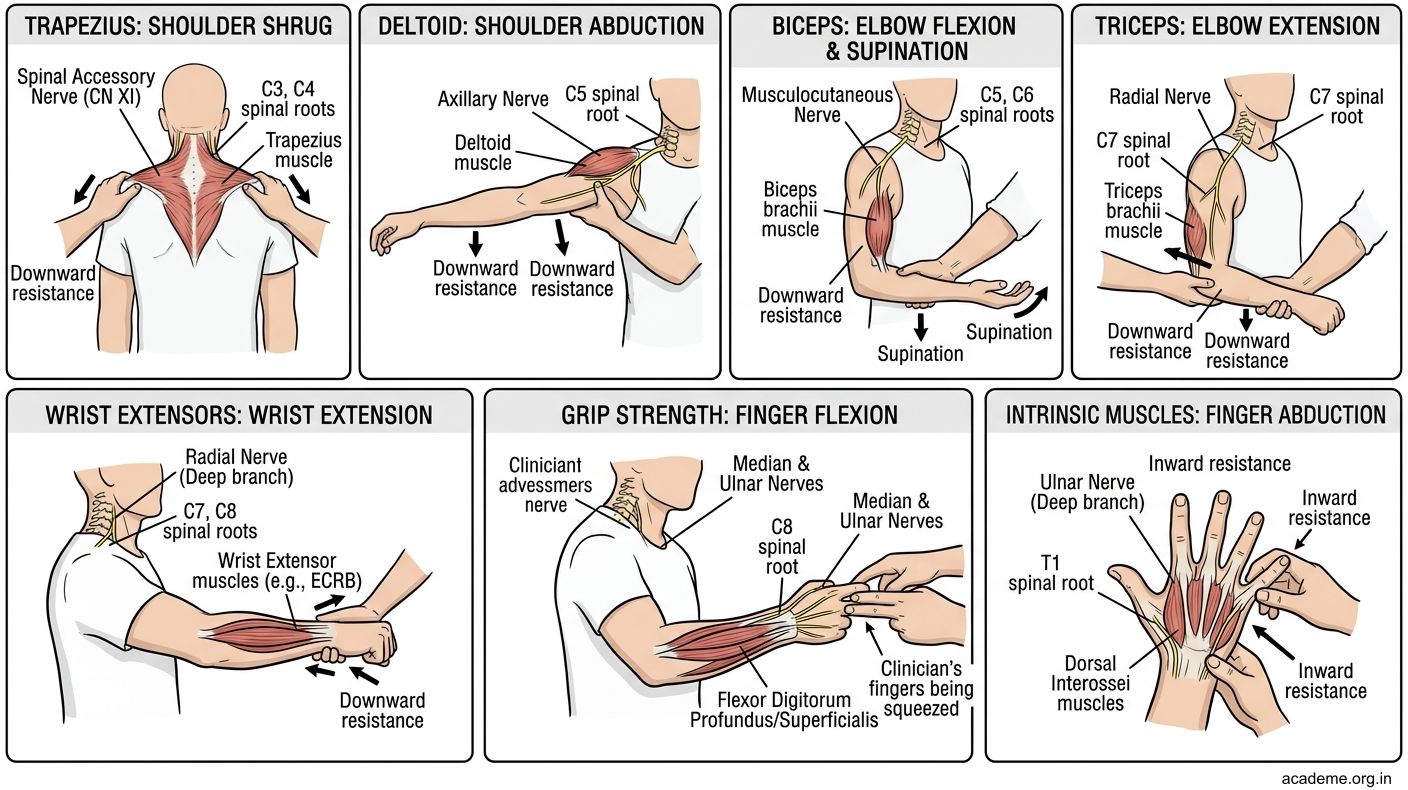
Figure: Muscle Testing of the Upper Limb
Development of the Upper Limb
The upper limb develops from a small bud of tissue that appears during the 4th week of embryonic development. Understanding this process explains many congenital anomalies you may see in clinical practice.

Figure: Thalidomide and Limb Development

Figure: Timeline of development:

Figure: Development of the Upper Limb
Timeline of development:
- Week 4: Upper limb buds appear as small elevations on the lateral body wall. The upper limb bud appears slightly before the lower limb bud (about 2 days earlier). Each bud has a core of mesenchyme (embryonic connective tissue from lateral plate mesoderm) covered by ectoderm.
- Week 5: The tip of the limb bud develops a thickened ridge of ectoderm called the apical ectodermal ridge (AER). This ridge acts like a "growth engine" — it sends signals (mainly FGF proteins) that keep the underlying mesenchyme proliferating. If the AER is damaged, limb growth stops at that point.
- Week 6: The hand plate forms as a flattened expansion at the tip. Finger rays appear as condensations of mesenchyme.
- Week 7: Apoptosis (programmed cell death) between the finger rays separates the digits — like removing the webbing between fingers. If this process is incomplete, the result is syndactyly (webbed or fused fingers), one of the commonest congenital hand anomalies.
- Week 8: The limb rotates laterally by 90° so that the elbow points posteriorly and the palm faces anteriorly. (The lower limb rotates medially — elbow back, knee front. This opposite rotation is why the dermatome pattern spirals differently in each limb.)
Key signalling centres:
• AER: Controls proximal-distal growth (shoulder → hand direction)
• Zone of polarising activity (ZPA): Controls anterior-posterior patterning (thumb → little finger). Produces Sonic Hedgehog (SHH) protein — too much SHH can cause extra digits (polydactyly)
• Wnt and BMP pathways: Control dorsal-ventral patterning (back of hand → palm)
Common congenital anomalies:
• Polydactyly: Extra digits (most common in the little finger, may run in families)
• Syndactyly: Fused digits (failure of apoptosis between finger rays)
• Amelia: Complete absence of a limb (failure of limb bud formation)
• Meromelia/Phocomelia: Partial absence — historically associated with thalidomide exposure
• Cleft hand (lobster-claw deformity): Absence of central rays
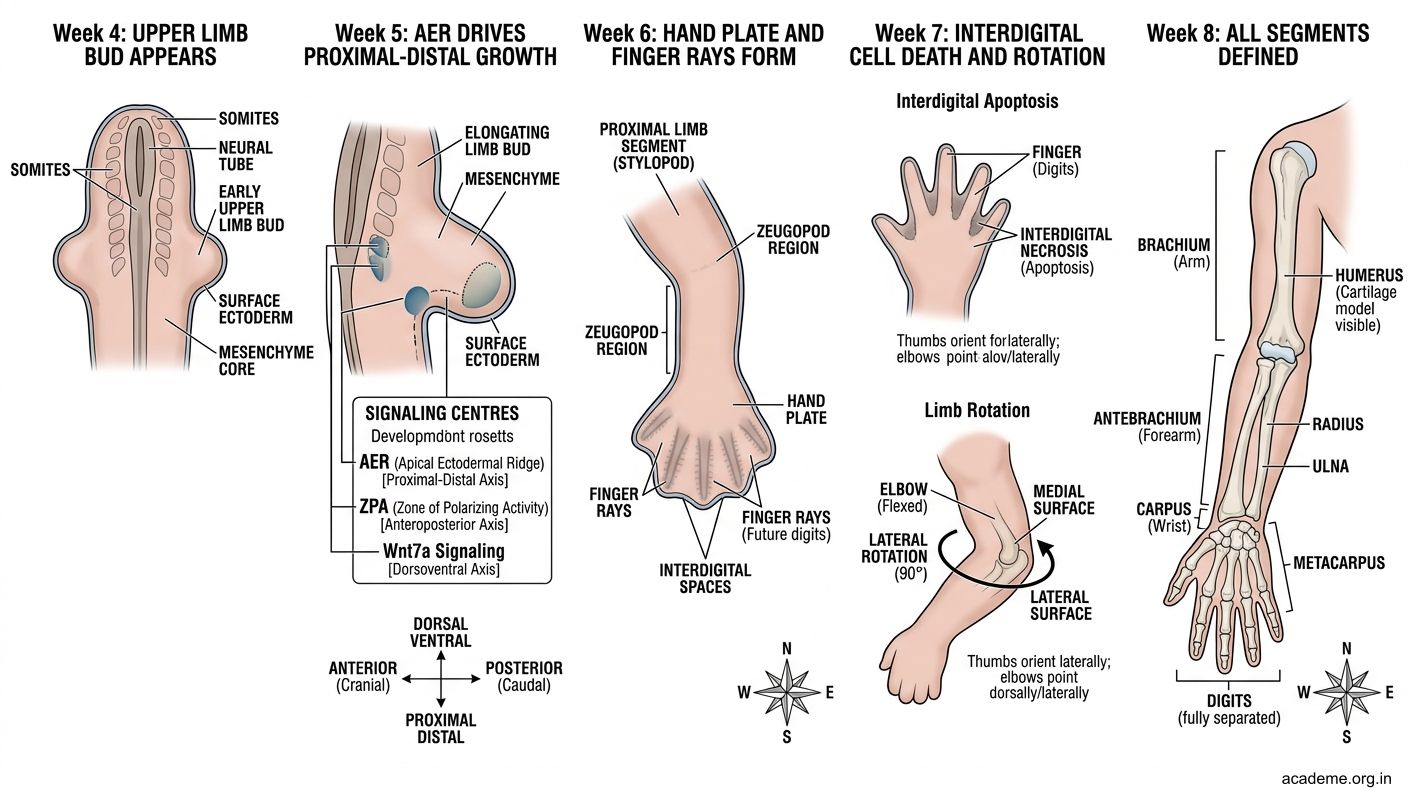
Figure: Development of the Upper Limb
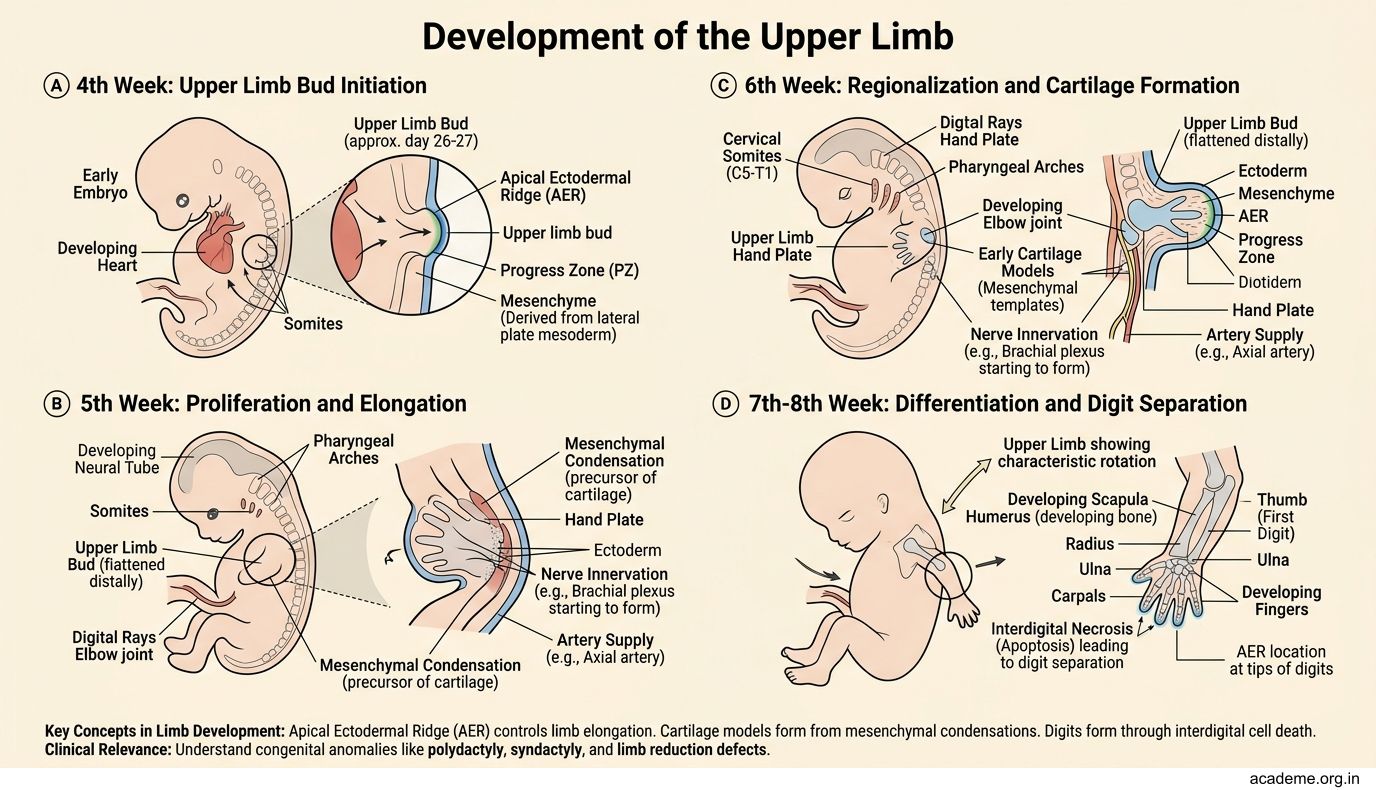
Figure: Timeline of development:
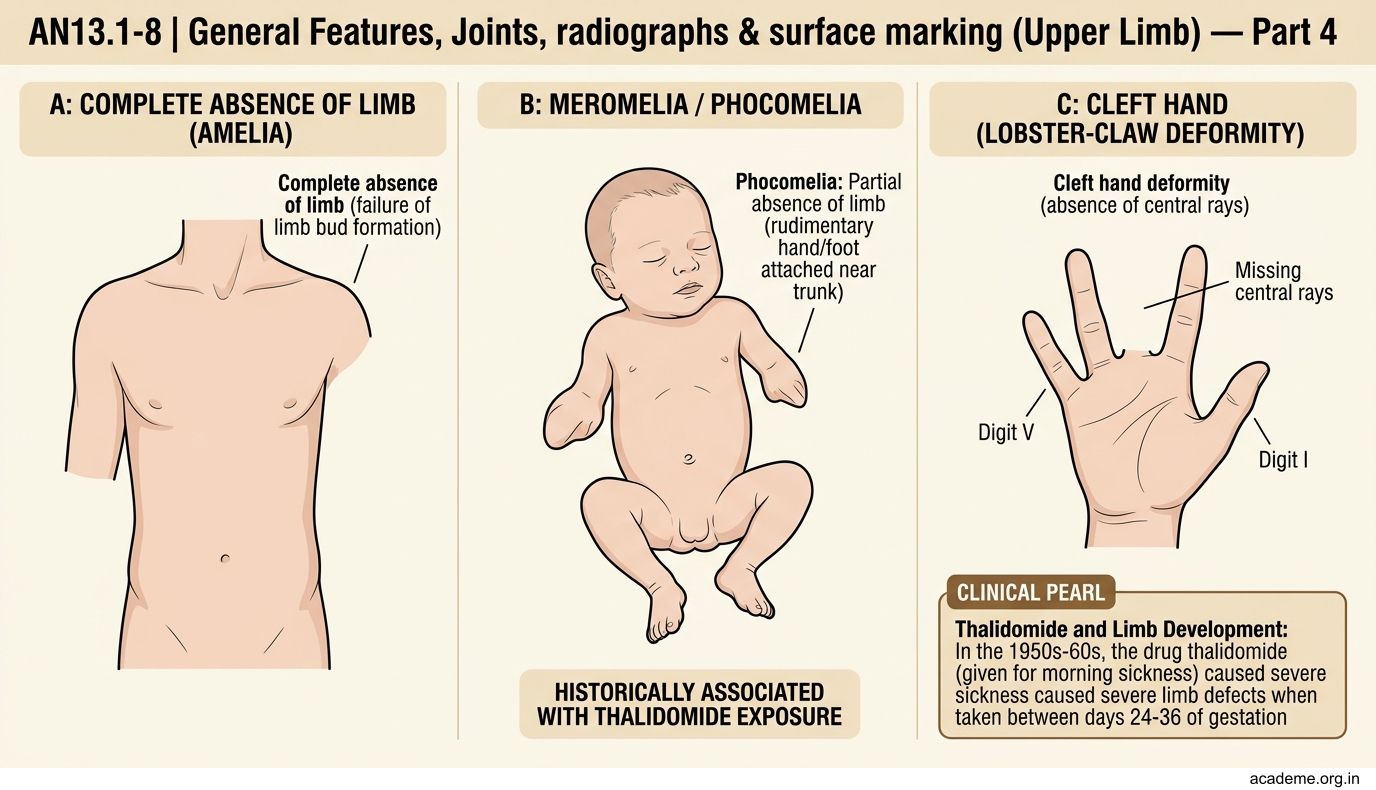
Figure: Thalidomide and Limb Development
CLINICAL PEARL
Thalidomide and Limb Development: In the 1950s-60s, the drug thalidomide (given for morning sickness) caused severe limb defects when taken between days 24-36 of gestation — the critical window for limb bud development. This tragedy led to the creation of modern drug safety regulations. Thalidomide is still used today (for leprosy reactions and multiple myeloma) but with strict prescribing controls. In India, where leprosy is still prevalent, awareness of this teratogenic risk is particularly important.
SELF-CHECK — Surface Anatomy & Development
A patient has weakness of arm abduction. On examination, the rounded contour of the shoulder is lost. Which nerve is most likely damaged?
A. Long thoracic nerve
B. Axillary nerve
C. Musculocutaneous nerve
D. Thoracodorsal nerve
Reveal Answer
Answer: B. Axillary nerve
A newborn is found to have webbed fingers (syndactyly). Which embryological process has failed?
A. Formation of the apical ectodermal ridge
B. Sonic Hedgehog signalling from the ZPA
C. Apoptosis between the digital rays
D. Lateral rotation of the limb bud
Reveal Answer
Answer: C. Apoptosis between the digital rays