Page 2 of 8
BI2.1-5 | Enzyme — SDL Guide (Part 2)
Lock-and-Key vs Induced Fit — How the Substrate Meets the Enzyme (BI2.2)
How does a substrate bind to an enzyme? Two models explain this:
1. Lock-and-Key Model (Emil Fischer, 1894)
The substrate fits into the enzyme's active site like a key into a lock — the shapes are perfectly complementary before binding. This model explains specificity well: only the right key (substrate) fits the lock (active site).
2. Induced Fit Model (Daniel Koshland, 1958) — the currently accepted model
The active site is not rigid — it's flexible. When the substrate approaches, the enzyme changes shape slightly to wrap around the substrate, like a hand closing around a ball. This induced fit:
• Brings catalytic residues into the correct position
• Strains the substrate, making it easier to react
• Excludes water from the active site
The induced fit model explains why some enzymes can act on similar substrates (the hand can grip different-sized balls) and why binding actually promotes catalysis (the conformational change contributes to lowering activation energy).
Think of it this way: Lock-and-key = a rigid lock; Induced fit = a smart lock that adjusts its shape when the right key approaches. The induced fit model is more accurate because proteins are flexible, not rigid.
Factors Affecting Enzyme Activity (BI2.2)
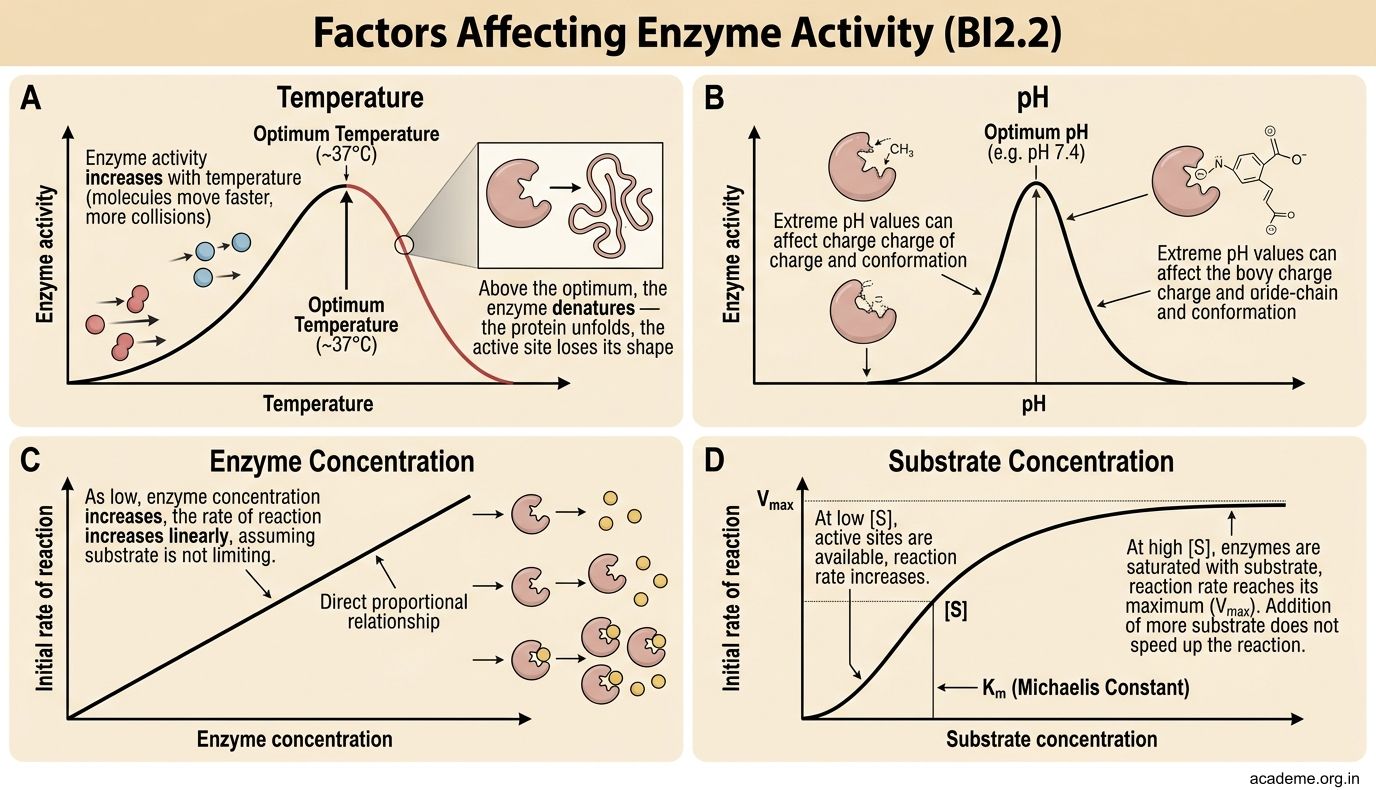
Enzyme activity depends on several factors. Understanding these helps you predict how enzymes behave in the body and in the lab.
1. Temperature
• Enzyme activity increases with temperature (molecules move faster, more collisions) up to an optimum temperature (~37°C for human enzymes).
• Above the optimum, the enzyme denatures — the protein unfolds, the active site loses its shape, and activity drops to zero.
• Clinical link: This is why fever above 41°C is dangerous — enzymes start to denature.
2. pH
• Each enzyme has an optimum pH where it works best.
- Pepsin (stomach): optimum pH 2 (very acidic)
- Most intracellular enzymes: optimum pH 7.4 (physiological)
- Trypsin (small intestine): optimum pH 8 (slightly alkaline)
• Extreme pH changes the ionisation of amino acids in the active site, disrupting substrate binding.
3. Substrate concentration
• At low substrate concentration, adding more substrate increases the rate (more active sites are occupied).
• At high substrate concentration, all active sites are occupied — the enzyme is saturated — and the rate reaches a maximum (Vmax). Adding more substrate doesn't help.
• This saturation behaviour is the basis of Michaelis-Menten kinetics.
4. Enzyme concentration
• If substrate is in excess, doubling the enzyme concentration doubles the rate (more active sites available).
5. Inhibitors and activators — covered in Part 3.
Michaelis-Menten Kinetics — Km and Vmax Made Intuitive (BI2.2)
Don't panic — we're going to make this intuitive, not mathematical.
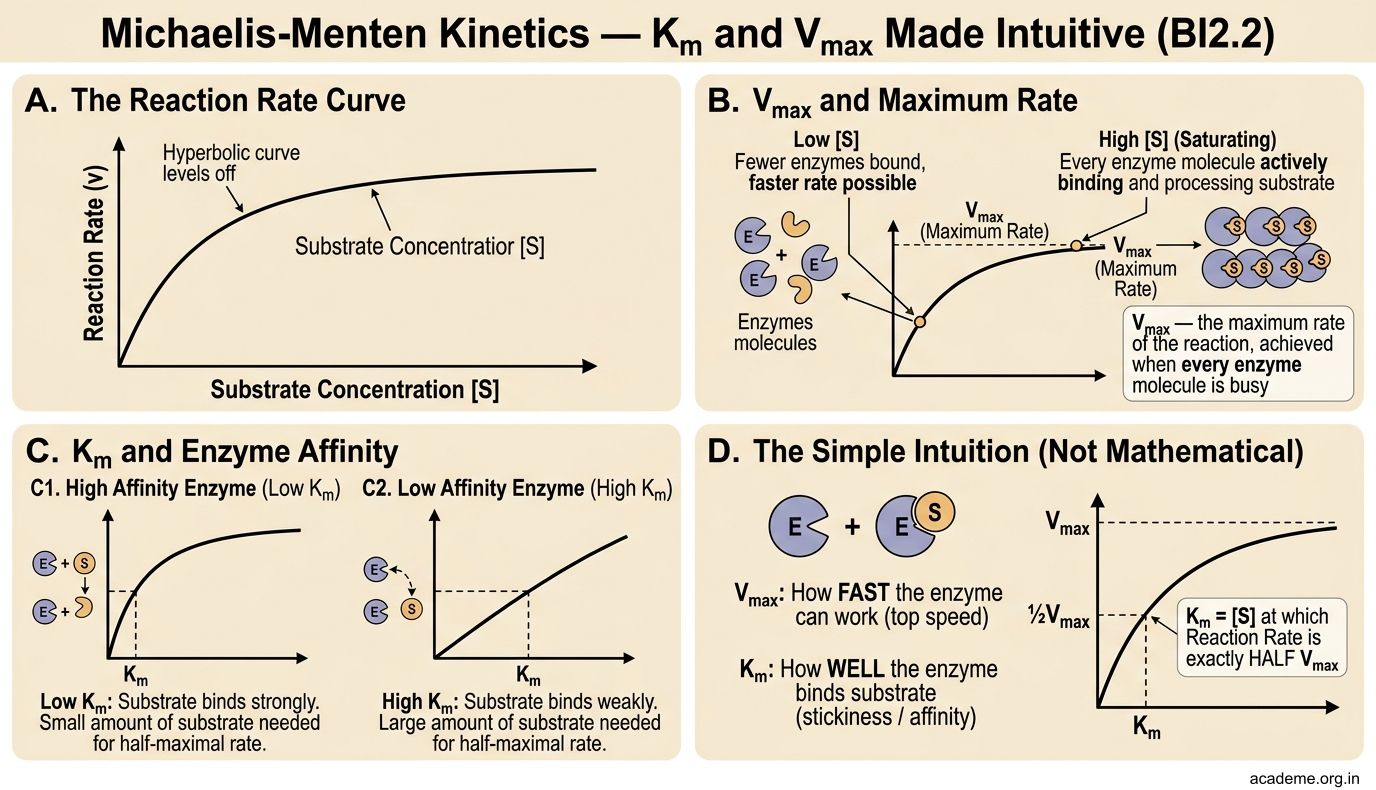
When you plot reaction rate (v) against substrate concentration [S], you get a characteristic hyperbolic curve that levels off. This curve is described by the Michaelis-Menten equation, but you need to understand just two numbers:
Vmax — the maximum rate of the reaction, achieved when every enzyme molecule has a substrate bound to it (the enzyme is fully saturated). Think of it as the speed limit — the fastest the enzyme can work.
Km (Michaelis constant) — the substrate concentration at which the reaction rate is half of Vmax (½Vmax). This is the number that tells you about the enzyme's affinity for its substrate.
- Low Km = the enzyme reaches half-speed at a low substrate concentration = it binds substrate tightly = high affinity
- High Km = the enzyme needs a lot of substrate to reach half-speed = it binds substrate loosely = low affinity
Analogy: Imagine a taxi (enzyme) picking up passengers (substrates) on a street.
• A taxi with low Km is like a driver who spots and picks up passengers quickly — even with few people on the street, the taxi is half-full. High affinity.
• A taxi with high Km is like a picky driver — you need crowds of people before the taxi is half-full. Low affinity.
What changes Vmax?
• Increasing enzyme concentration increases Vmax (more taxis = more capacity)
• Vmax is NOT changed by adding more substrate — it's already at maximum
What changes Km?
• Km is an intrinsic property of the enzyme-substrate pair — it doesn't change with enzyme concentration
• Inhibitors can alter the apparent Km (we'll see how in Part 3)
SELF-CHECK
Enzyme X has a Km of 0.1 mM for its substrate. Enzyme Y has a Km of 10 mM for the same substrate. Which enzyme has a higher affinity for the substrate?
A. Enzyme Y — because a higher Km means stronger binding
B. Enzyme X — because a lower Km means the enzyme reaches ½Vmax at a lower substrate concentration, indicating tighter binding
C. Both have the same affinity — Km only affects Vmax
D. Cannot be determined without knowing the Vmax of each enzyme
Reveal Answer
Answer: B. Enzyme X — because a lower Km means the enzyme reaches ½Vmax at a lower substrate concentration, indicating tighter binding
Lower Km = higher affinity. Enzyme X reaches half its maximum speed at just 0.1 mM substrate, meaning it grabs onto the substrate very efficiently. Enzyme Y needs 10 mM (100× more) substrate to reach the same relative activity — it has lower affinity. Think of the taxi analogy: Enzyme X is the eager driver who fills up quickly.