Page 2 of 11
CM4.1-2 | CM4.1-2 | Methods of Health Education and Counselling — SDL Guide (Part 2)
Organising Health Promotion Activities in Different Settings
Knowing the classification of methods is necessary but insufficient — a health professional must also know how to organise these activities across the three primary settings mandated by CM4.2: the individual/family setting, the clinical setting, and the community setting. Each setting has a characteristic organisational structure, a typical health worker cadre, and a defined target.
At the individual and family level, the primary activity is the home visit, conducted by ANMs and ASHAs under the supervision of the Medical Officer. A structured home visit involves: (a) advance preparation — list of households due for follow-up, educational materials in local language; (b) rapport establishment — greeting family members, reviewing previous contact; (c) health assessment — observation of sanitation, water storage, feeding practices; (d) targeted health education — addressing one or two specific practices using the counselling or demonstration method; (e) referral if needed; (f) documentation. The Village Health and Nutrition Day (VHND) is the community-level counterpart, organised monthly at the anganwadi centre, where ANM, ASHA, and AWW converge for immunisation, growth monitoring, ANC registration, and health talks using IEC (Information, Education, and Communication) materials.
At the clinical setting, health education opportunities arise at every point of care: OPD waiting area (posters, health talks), injection room (counselling during ANC or immunisation visits), labour room (breast-feeding initiation counselling), and discharge from wards (take-home instructions). The challenge in clinical settings is time — a busy OPD does not allow for thirty-minute counselling sessions. This is where BCC (Behaviour Change Communication) materials — flip charts, pictorial job aids, take-home pamphlets — allow health workers to deliver a structured message quickly. Pre-prepared health education calendars ensure seasonal topics (diarrhoea prevention in summer, dengue prevention in monsoon) are covered systematically.
At the community setting, health education is organised through: (a) school health programmes — systematic curriculum-linked health talks, screenings, and activities for children; (b) workplace health programmes — occupational health education (dust/chemical hazards, ergonomics, mental health) for factory workers; (c) community meetings (gram sabha, mohalla meetings) — where the Medical Officer presents on a health priority, fielding questions from community members; (d) self-help group (SHG) sessions — leveraging an existing social structure to embed health education into a trusted peer network; (e) health melas and exhibitions — at district level, using stalls, models, films, and quizzes to attract and educate large numbers. The National Health Mission mandates many of these activities through the annual Programme Implementation Plan (PIP), which allocates resources for IEC materials, outreach sessions, and community mobilisation activities.
SELF-CHECK
An ANM is conducting a Village Health and Nutrition Day. She wants to teach correct ORS preparation to ten mothers assembled at the anganwadi. Which combination of methods is MOST appropriate?
A. Distribute a pamphlet and show a television spot on ORS
B. Conduct a demonstration of ORS preparation followed by return demonstration by participants
C. Give a fifteen-minute lecture on diarrhoea epidemiology, then distribute ORS packets
D. Arrange a role play where one mother acts as a doctor explaining ORS to another mother
Reveal Answer
Answer: B. Conduct a demonstration of ORS preparation followed by return demonstration by participants
A demonstration (showing the correct method) followed by return demonstration (participants repeat the skill) is the gold-standard group method for teaching a psychomotor skill like ORS preparation. It addresses knowledge, attitude, and practice simultaneously and allows immediate feedback. Option A uses mass media (pamphlet + TV) — inappropriate for a ten-person group and insufficient for skill transfer. Option C is didactic and does not build the skill. Option D (role play) is useful for communication skills, not for a precise preparation skill.
Counselling: Process, Frameworks, and Application
Counselling is the most evidence-supported individual-level health education method and the one most frequently examined in MBBS OSCEs and Viva voce. It is defined as a process of communication between a counsellor (a trained health professional) and a client (patient or community member) that enables the client to understand their health problem, make informed decisions, and take positive action. Unlike a health talk, counselling is two-way, non-judgmental, and client-centred.
The most widely taught counselling framework in India is GATHER, used particularly for reproductive health and family planning counselling. Each letter represents a step:
- G — Greet: Welcome the client respectfully, ensure privacy, build rapport.
- A — Ask: Use open-ended questions to understand the client's needs, concerns, and current practices. Do not assume.
- T — Tell: Provide relevant health information tailored to the client's specific question — not a generic lecture.
- H — Help: Assist the client in choosing the option that best fits their needs, values, and circumstances. This is shared decision-making, not prescription.
- E — Explain: Clarify any instructions or next steps — how to use the chosen method, what side effects to watch for, when to return.
- R — Return: Confirm the follow-up plan. Invite the client to return if concerns arise.
A related framework is REDI (Rapport, Explore, Decide, Implement), used in nutrition counselling (IYCF — Infant and Young Child Feeding). It emphasises exploring current practices before offering advice — a principle of adult learning that prevents the health worker from 'teaching' what the client already knows.
Motivational Interviewing (MI), developed by Miller and Rollnick, is an advanced counselling technique that elicits the client's own reasons for change rather than imposing external reasons. The four core principles of MI — expressing empathy, developing discrepancy, rolling with resistance, and supporting self-efficacy — are evidence-based for changing tobacco use, alcohol use, and medication adherence behaviours. MI is increasingly incorporated into AYUSH and NCD clinic protocols in India.
Key settings for counselling in primary care include: ANC counselling (birth preparedness, institutional delivery, breastfeeding, iron-folic acid adherence); HIV pre- and post-test counselling (at ICTCs — Integrated Counselling and Testing Centres); family planning counselling (method choice, side effects, switching); nutrition counselling (growth faltering, complementary feeding); and tobacco/alcohol de-addiction counselling (brief intervention at every OPD contact — the 5A framework: Ask, Advise, Assess, Assist, Arrange).
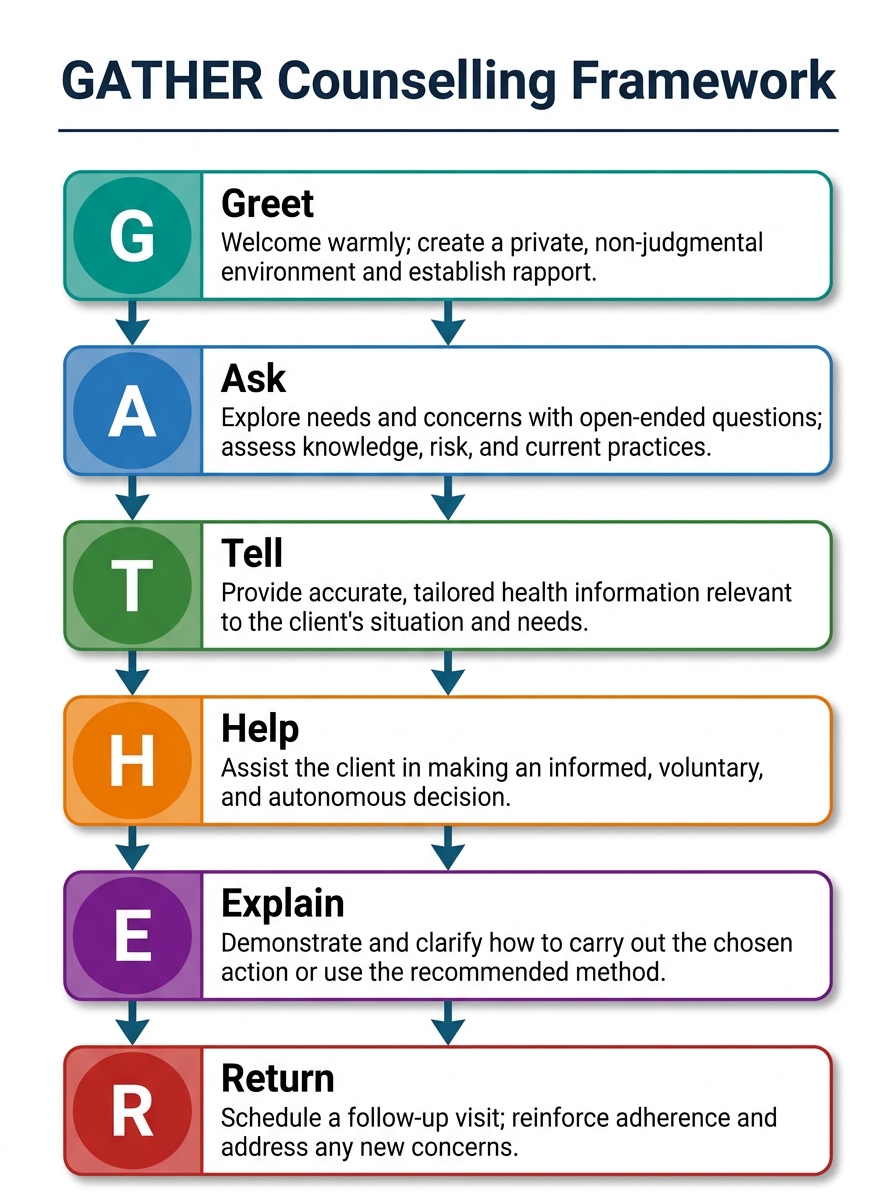
The GATHER Counselling Framework: Six-Step Sequential Guide
CLINICAL PEARL
The three-minute brief intervention for tobacco. In a busy PHC OPD with no time for full counselling, use the 5 A's at every encounter with a tobacco user: Ask (Does the patient use tobacco? — this is a vital sign), Advise (Give clear, strong, personalised advice to quit — 'Quitting tobacco is the single most important thing you can do for your health'), Assess (Is the patient willing to make a quit attempt today?), Assist (Provide self-help material, refer to Quitline 1800-11-2356 if available), Arrange (Schedule a follow-up in one to two weeks). Even a 3-minute brief intervention by a physician has been shown in trials to increase quit rates by 2–3% over controls — which, across 30 patients per OPD session, represents hundreds of quit attempts per year. Brief interventions are the most scalable counselling method in clinical practice.
Evaluating Method Effectiveness and Programme Outcomes
Selecting and implementing a health education method is only half of the task. The public health professional must also evaluate whether the method achieved its intended outcomes — a step that is often neglected in practice but is central to programme improvement and accountability.
Evaluation of health education methods follows the KAP framework: was there a change in Knowledge (factual information), Attitude (values, beliefs, and predispositions), and Practice (actual behaviour)? These are measured sequentially because each is harder to change than the previous. An immunisation awareness campaign may successfully increase knowledge about vaccine schedules (easy to measure) while leaving vaccination rates unchanged (because the barrier was not knowledge but access or trust). Knowing which level the intervention changed — and which it did not — tells the health worker what the next intervention must address.
Four domains of programme evaluation correspond to Donabedian's structure-process-outcome framework: (a) Process evaluation — were activities delivered as planned? (Number of sessions held, attendance rates, materials distributed, health worker training completed); (b) Output evaluation — were immediate products delivered? (Number of pamphlets distributed, number of home visits conducted, community meetings held); (c) Outcome evaluation — were KAP changes achieved in the target population? (Pre-post KAP surveys using structured questionnaires); (d) Impact evaluation — did the programme ultimately improve health status? (Change in immunisation coverage, disease incidence, maternal mortality rates — measured over a longer horizon, usually district or state level).
Common monitoring indicators for health education programmes include: coverage rate (proportion of target population reached), session completion rate, change in KAP scores (pre vs post), proportion of pregnant women attending at least 4 ANC visits, full immunisation coverage, and open defecation free (ODF) status at village level. The HMIS (Health Management and Information System) in India collects many of these indicators routinely. For a Medical Officer, the ability to read HMIS data and identify which health education activities are working — and which require redesign — is a practical competency that bridges public health theory and field action.
SELF-CHECK
A health team conducts an ORS demonstration for mothers at a VHND. Six weeks later, they survey those mothers and find that 80% can correctly describe ORS preparation but only 30% actually used ORS during their child's last episode of diarrhoea. What does this discrepancy most likely indicate?
A. The demonstration method failed to transfer knowledge
B. The mothers did not attend the session attentively
C. A barrier at the attitude or practice level is preventing knowledge from translating into behaviour
D. ORS is not effective for this population's diarrhoea type
Reveal Answer
Answer: C. A barrier at the attitude or practice level is preventing knowledge from translating into behaviour
The 80% knowledge rate confirms the demonstration succeeded at the Knowledge level of the KAP framework. The gap between knowledge (80%) and practice (30%) is classic — it signals a barrier at the Attitude or Practice level. Common barriers include: stored ORS sachets not available at home, belief that traditional remedies (jeera water) are sufficient, social/family pressure against hospital-advised treatment, or lack of confidence in preparation. The next health education intervention must address the specific attitude or practice barrier, not repeat the knowledge-level demonstration.
Applying Method Selection in Practice: Case Scenarios
The competency CM4.1 requires not just description but application of method knowledge — choosing the right method for a given scenario. This section presents the decision framework that Medical Officers use in field settings, illustrated with worked examples that map onto OSCE-style questions.
The method selection decision tree works as follows: (1) Define the target population — size, setting, literacy, age group, gender composition, cultural context. (2) Define the message — simple awareness vs complex skill vs attitude change. (3) Match method tier — individual (complex/personal/sensitive), group (shared characteristic/social reinforcement needed), mass (awareness/reach). (4) Check resource availability — personnel, time, materials, venue. (5) Select specific method within the tier — counselling vs home visit (individual); demonstration vs group discussion (group); poster vs radio spot vs folk media (mass). (6) Plan for evaluation — pre-post KAP, session documentation.
Worked example 1: A district health officer wants to reduce tobacco use among male agricultural labourers aged 20–45 in 50 villages. Most have Class 5–8 education. Target: 50,000 men. Analysis: Large number, low literacy, dispersed setting. Mass media for awareness (radio spots in local dialect, wall paintings), combined with group methods at village level (nukkad natak performed by an NGO troupe showing health effects of tobacco, followed by group discussion facilitated by an ASHA). Individual brief counselling (5As) at every PHC contact opportunity. This is the combined-method approach — layers of reach (mass), social reinforcement (group), and personalised support (individual).
Worked example 2: A Medical Officer at a CHC wants to improve postnatal breastfeeding rates. Target: all postpartum mothers admitted in the maternity ward — typically 5–10 per week. Analysis: Small group, clinical setting, motivated (just delivered), diverse literacy. Best method: individual counselling by a trained lactation support nurse immediately after delivery (latching demonstration, return demonstration by mother), supported by a group health talk in the postnatal ward and a take-home pictorial pamphlet in local language. Mass media not appropriate here — the message requires skill transfer and individual support.
Worked example 3: Village has low immunisation coverage, and community investigation reveals that the primary barrier is a rumour that vaccines cause infertility, spread by a local religious leader. Analysis: This is an attitude-level barrier in a community where trust structures are religious. The correct method is NOT a mass media pamphlet (factual, top-down, low trust). The correct approach is community mobilisation — engage the religious leader and locally respected elders (community meeting, interpersonal communication), use peer educators who are community members, and use folk media that normalises vaccination. Only after attitude change does mass media reinforce the new norm.