Page 4 of 16
FM11.3-4 | Criminal & Civil Responsibility; Feigned Illness — SDL Guide
Learning Objectives
- Describe the criminal and civil responsibilities of a mentally ill person under Indian law
- Explain McNaughten's Rules and their codification in BNS Section 22
- Differentiate between true mental illness and feigned mental illness (malingering), and distinguish malingering from Ganser syndrome
INSTRUCTIONS
The question of whether a person with mental illness bears legal responsibility — for a crime, a contract, a will, or a court deposition — is one of the most consequential assessments a forensic physician will perform. Courts rely entirely on the medical opinion to determine whether the accused qualifies for the insanity defence or whether a testator had the capacity to make a valid will. This module covers the two major legal domains of responsibility, the historical and statutory framework that governs them, and the specific clinical skills required to distinguish genuine mental illness from deliberate simulation.
References
- KSN Reddy — Essentials of Forensic Medicine & Toxicology (textbook)
- BV Subrahmanyam — Modi's Medical Jurisprudence and Toxicology (textbook)
Version 2.0 | NMC CBUC 2024
CLINICAL SCENARIO
A 32-year-old man with a history of paranoid schizophrenia is arrested for stabbing his landlord. His lawyer files a plea of insanity, and the Sessions Court orders a forensic psychiatric board examination. When the board interviews him, the accused claims he heard the voice of God commanding him to punish the landlord, who he believed was a demon. However, CCTV footage shows the accused calmly waiting outside the landlord's office for 40 minutes before the attack, then leaving swiftly and disposing of the weapon. The prosecution argues this planned, methodical behaviour proves he knew what he was doing. His defence argues the delusion and hallucinations were present regardless. As the forensic physician chairing the board, what legal test do you apply, and how do you distinguish genuine psychosis from a sophisticated performance designed to secure an acquittal?
WHY THIS MATTERS
Few clinical assessments carry the stakes of a forensic psychiatric evaluation for criminal responsibility. Your opinion directly determines whether a person is convicted and sentenced, or found not guilty by reason of unsoundness of mind and committed to a psychiatric institution. In civil matters, your opinion determines whether a will is valid, whether a contract is enforceable, or whether a person has capacity to contest custody of their children. And because courts know that people have powerful incentives to feign mental illness — to escape criminal punishment, to avoid civil obligations, or to receive disability benefits — the forensic physician must also be the last line of defence against simulation. Failure to detect malingering is a failure of justice; failure to recognise true illness in someone pretending to feign is an equal injustice.
RECALL
From SDL fpsy1, recall: a delusion is a fixed, false, unshakeable belief maintained despite evidence to the contrary, and a lucid interval is a period of restored mental clarity during which criminal and civil responsibility are intact. Recall also from Year-1 psychology that the concept of mens rea (the guilty mind) is the cornerstone of criminal law — a person cannot be convicted of a criminal offence unless they had the mental capacity to form criminal intent. Mental illness, when severe enough, can negate mens rea, which is the legal rationale behind the insanity defence. Keep this foundation in mind as we build the formal legal doctrine on top of it.
The Legal Framework: Criminal Responsibility and Mental Illness
Imagine the courtroom moment: the accused's lawyer rises and says, "My Lord, my client was, at the time of this act, suffering from such a severe mental illness that he did not know what he was doing or that it was wrong. He should therefore be found not guilty by reason of unsoundness of mind." This plea immediately triggers a specific legal and medical inquiry that is entirely distinct from the factual question of whether the accused committed the act. The factual question (did he do it?) is for the fact-finder. The mental state question (did his mental illness deprive him of the capacity to understand the act or its wrongness?) is for the forensic physician.
The legal framework governing criminal responsibility in India has undergone a significant transition. The Indian Penal Code 1860 (IPC) governed criminal responsibility for 163 years. Section 84 of the IPC provided a complete defence for acts committed by a person of "unsoundness of mind." The Bharatiya Nyaya Sanhita 2023 (BNS) replaced the IPC with effect from 01 July 2024. The insanity defence is now at BNS Section 22, with the same substantive standard as IPC Section 84. Forensic physicians must cite BNS Section 22 (not IPC Section 84) for all cases where the alleged act occurred on or after 01 July 2024.
The forensic physician's role in criminal responsibility cases is threefold:
1. Determine whether the accused has or had a mental disorder (diagnosis at the time of the act, reconstructed from records and examination).
2. Assess whether that disorder, if present at the time of the act, met the McNaughten threshold (inability to know the nature of the act OR inability to know it was wrong).
3. Assess whether the illness is genuine or feigned — because the incentive to simulate mental illness in criminal cases is obvious and powerful.
The legal presumption is sanity: every accused is presumed sane unless mental unsoundness is proven. The burden of proof for the insanity defence rests on the accused (on the balance of probabilities). The forensic physician's report is the primary evidence.
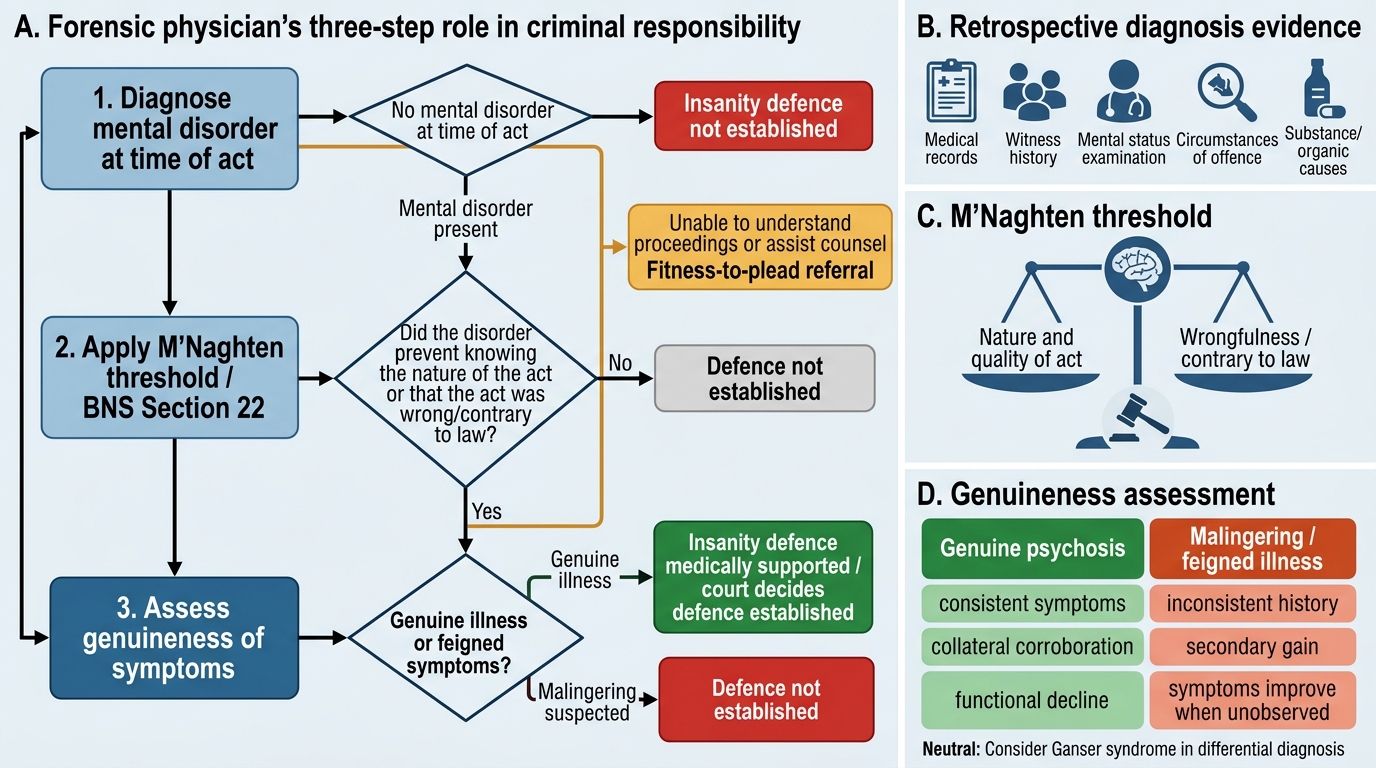
Criminal Responsibility Assessment: Three-Step Forensic Role
McNaughten's Rules and BNS Section 22
McNaughten's Rules are the foundational legal test for criminal insanity in most common-law jurisdictions, including India. They originated from the case of Daniel McNaughten (1843), in which McNaughten shot and killed Edward Drummond, the secretary of the British Prime Minister Sir Robert Peel, under the paranoid delusion that he was being persecuted by the government. He was acquitted on grounds of insanity. The public outcry prompted the House of Lords to consult fifteen judges and formulate a clear legal standard, producing what are now known as McNaughten's Rules.
The Rules state — translated into their operative legal form — that to establish a defence on the ground of insanity, it must be clearly proved that, at the time of committing the act, the accused was labouring under such a defect of reason, from disease of the mind, as not to know the nature and quality of the act being done; OR if he did know it, that he did not know that what he was doing was wrong.This is atwo-pronged test— either prong alone, if established, is sufficient for the defence: -Prong 1 (nature of the act): The accused did not know what they were physically doing. Example: a man in a psychotic episode strangles his wife believing he is squeezing water from a wet cloth.
- Prong 2 (wrongness of the act): The accused knew the physical nature of the act but did not know it was legally or morally wrong. Example: a man with a grandiose religious delusion kills a neighbour believing he is fulfilling a divine command and that the act is therefore not wrong.
BNS Section 22 codifies this standard in Indian law. The exact wording: "Nothing is an offence which is done by a person who, at the time of doing it, by reason of unsoundness of mind, is incapable of knowing the nature of the act, or that he is doing what is either wrong or contrary to law."
Several points are critical for the forensic physician applying this test:
- "Disease of the mind" is a legal construct, not identical to clinical psychiatric diagnosis. It must be a pathological condition affecting cognitive functioning — not mere intoxication, not mere bad character, not mere passion.
- Voluntary intoxication does NOT establish the McNaughten defence. If the accused voluntarily consumed alcohol or drugs and became unaware of the nature of the act, the insanity defence is unavailable. (This connects to Delirium Tremens in SDL fpsy3 — the key distinction is voluntary vs pathological basis.)
- The test is cognitive, not volitional — "did not know," not "could not control." An accused who knew what they were doing and knew it was wrong but was compelled by an "irresistible impulse" does NOT satisfy the McNaughten test under Indian law. The irresistible impulse rule is not part of Indian jurisprudence.
- The assessment is explicitly retrospective to the time of the act — not the accused's current mental state. A person may be well at the time of the examination but was in a florid psychotic episode at the time of the act.
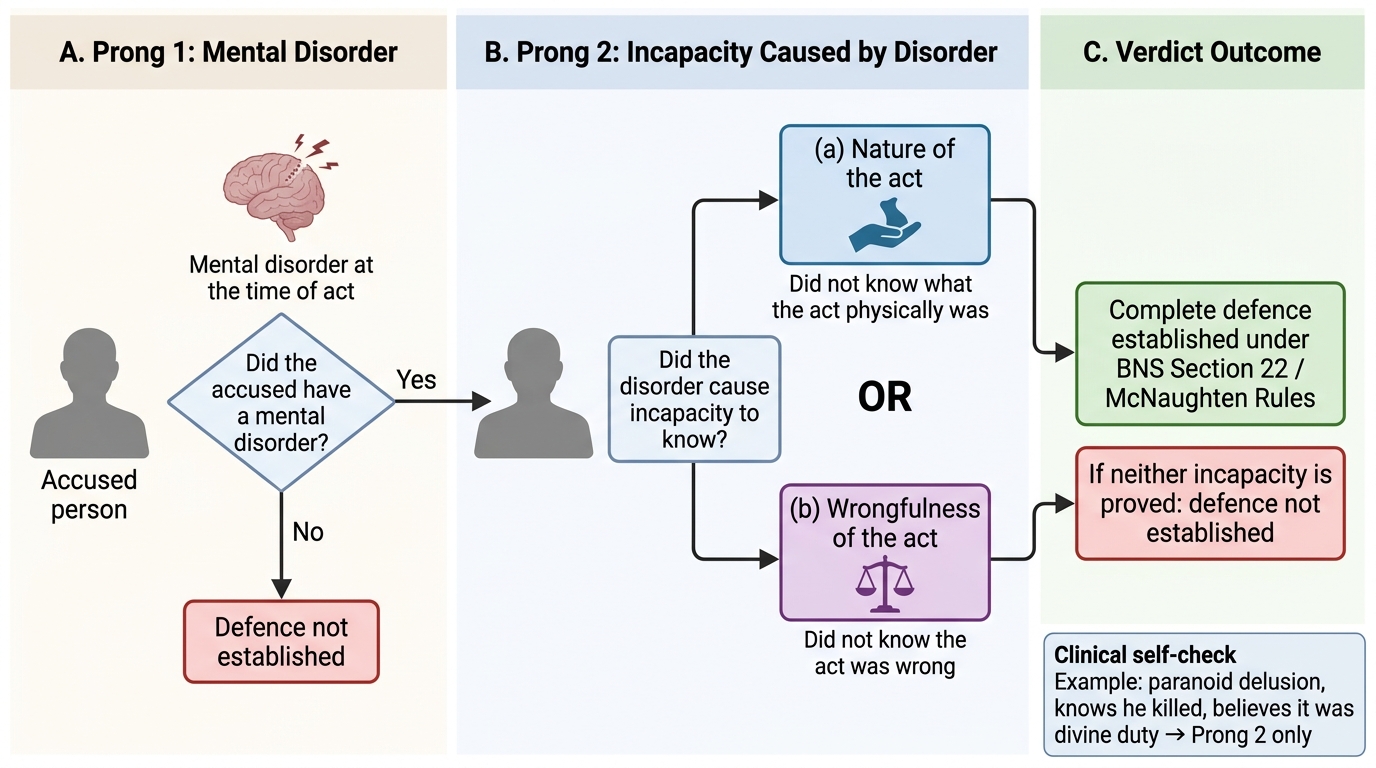
McNaughten Two-Pronged Test for Insanity Defence
SELF-CHECK
A man with paranoid schizophrenia kills his brother, believing with absolute conviction that his brother is a demon sent to destroy his family and that it is his religious duty to kill him. After the act, he calls the police himself and says 'I have done what was necessary.' He knew he had physically killed his brother. Under BNS Section 22, which prong of McNaughten's Rules would his defence most likely rely on?
A. Prong 1 only — he did not know the nature of the act (that it was killing)
B. Prong 2 only — he knew the nature of the act but did not know it was wrong
C. Both prongs — he knew neither the nature of the act nor that it was wrong
D. Neither prong — voluntary act with awareness of consequences negates the defence
Reveal Answer
Answer: B. Prong 2 only — he knew the nature of the act but did not know it was wrong
He clearly knew the physical nature of the act (he knew he was killing his brother — he called the police and acknowledged it). Therefore Prong 1 (nature of the act) is not available. However, because of his grandiose religious delusion that he had a divine duty to perform this act, he genuinely believed the act was not wrong — indeed, that it was morally obligatory. This satisfies Prong 2. The defence would rely on Prong 2 of the McNaughten test, now codified at BNS Section 22.
Civil Responsibility of a Mentally Ill Person
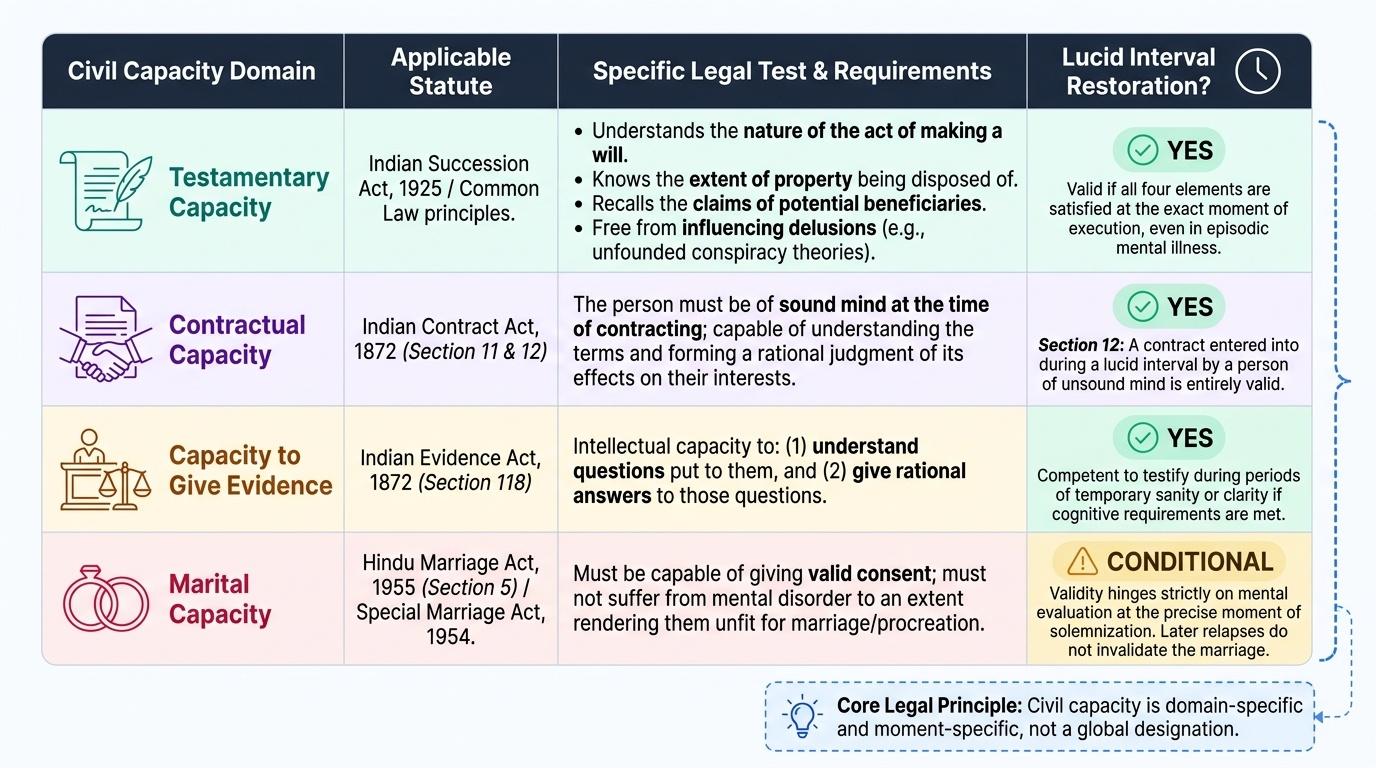
While criminal responsibility is an all-or-nothing determination at the time of the criminal act, civil responsibility is a domain-specific, moment-specific assessment. A person with a mental disorder is not globally stripped of all civil rights and capacities. The key principle is that civil capacity must be assessed separately for each domain and specifically for the moment at which the legally relevant act was performed. A person who lacks testamentary capacity may still be capable of giving valid evidence; a person with intermittent psychosis may validly contract during a lucid interval.
Testamentary capacity (will-making): For a will to be valid, the testator must, at the time of execution, satisfy all four elements of testamentary capacity: (1) know the nature of the act of making a will, (2) know the extent of the property being disposed of, (3) know the claims of potential beneficiaries (who might reasonably expect to inherit), and (4) be free from any delusion that influences the disposition of the estate. A delusion that directs the testator to disinherit a child who is perceived to be conspiring against them — when no such conspiracy exists — voids the will because a delusion is directly influencing a testamentary choice. However, a will made during a lucid interval by a person with episodic mental illness is entirely valid, provided all four elements are satisfied at the time of execution.
Contracts: Under the Indian Contract Act 1872, a contract with a person of unsound mind is void, but a contract entered into during a lucid interval is valid. The assessment of mental state at the time of contract execution follows the same forensic principles as will validity.
Capacity to give evidence: A witness's competency to give evidence is determined by Section 118 of the Indian Evidence Act — all persons are competent to testify unless they are prevented from understanding questions or giving rational answers by reason of tender age, extreme old age, disease of mind, or any other cause. A person with mental illness may be competent to give evidence if they were in a lucid interval at the time of the relevant events and are capable of coherent testimony at the time of deposition.
Marriage: A marriage is voidable under the Hindu Marriage Act 1955 (and similar provisions in other personal laws) if, at the time of the marriage, either party was of unsound mind, was suffering from a mental disorder of such a kind and to such an extent as to be unfit for marriage and procreation of children, or was subject to recurrent attacks of insanity.
Guardianship and custody: Courts may appoint a guardian for a person with mental illness who is unable to manage their affairs. The National Trust Act 1999 provides guardianship provisions for persons with specific disabilities. The Mental Healthcare Act 2017 addresses the role of a nominated representative — a person appointed by the patient in an Advance Directive to make treatment decisions on their behalf when they lack capacity.
Provided image