Page 3 of 20
FM6.1 | Firearms: Types, Ammunition & Terminology — SDL Guide (Part 3)
Medicolegal Inference from Firearm Type and Ammunition
The forensic physician's ultimate role is to translate physical findings into a medico-legal opinion that assists the court. In firearm cases this means integrating weapon type, ammunition, and residue findings into a coherent narrative about the circumstances of the shooting.
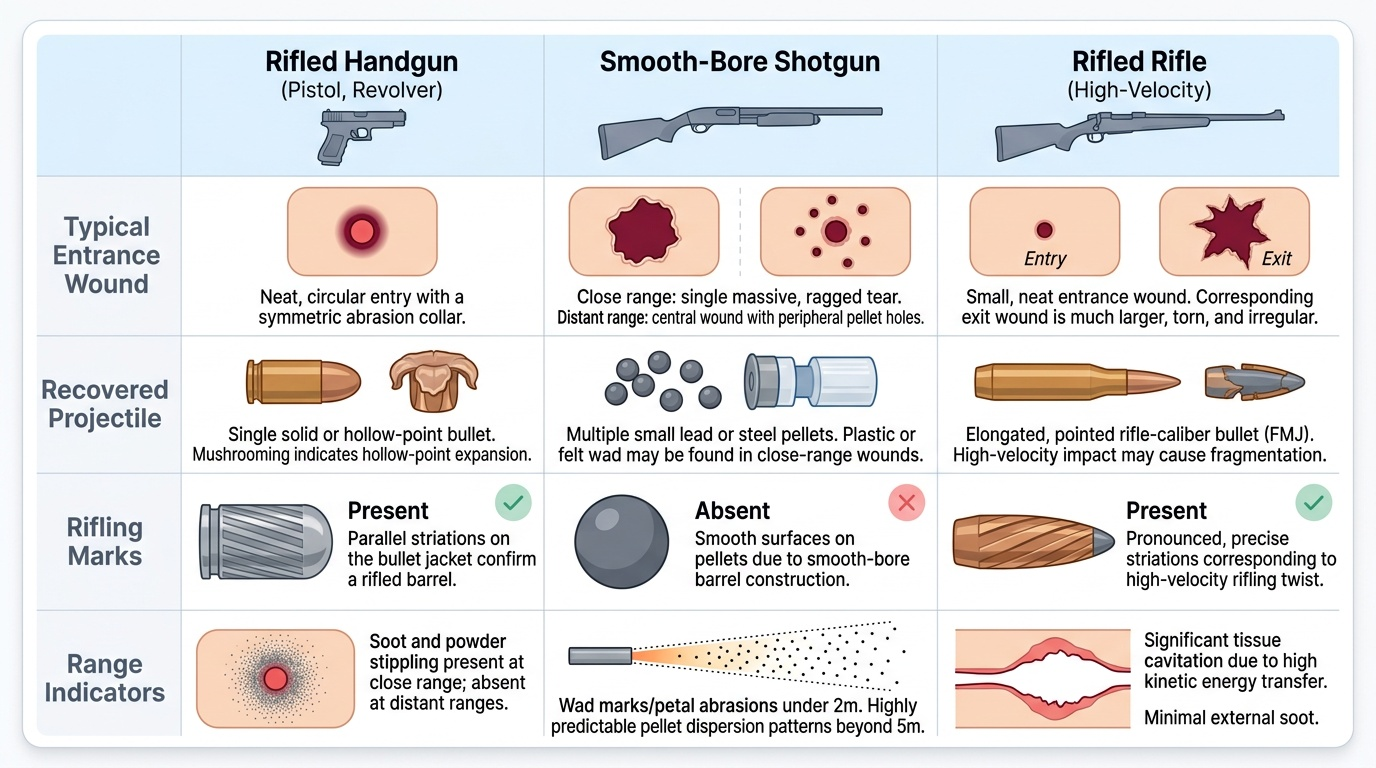
The type of weapon constrains what injuries are possible. A revolver or pistol at close range produces a single entrance wound with abrasion collar; a shotgun produces a single large wound or multiple pellet holes depending on range; a rifle typically produces through-and-through wounds with larger exit than entrance (because of high velocity and FMJ design). When the weapon has not been recovered, the physician can infer the likely class of weapon from wound morphology, bullet caliber (if a bullet was recovered), and the rifling marks on the bullet (consistent with a rifled barrel or absent in a smooth-bore weapon).
The cartridge type and bullet design inform the severity of tissue destruction. A recovered hollow-point bullet at autopsy — with mushroomed nose and expanded diameter — explains a large permanent cavity and massive haemorrhage. A FMJ bullet passing through soft tissue without significant mushrooming explains a smaller wound track. The bullet's caliber, weighed against wound dimensions, can confirm or exclude specific weapon calibers.
Provided image
Under the Arms Act 1959, possession of a firearm without licence is an offence; possession of prohibited ammunition (e.g. hollow-point rounds for individuals with standard licences) is separately offenceable. The forensic physician's opinion regarding weapon type and ammunition feeds directly into the police investigation of Arms Act violations alongside IPC charges. When the death is suspected as culpable homicide or murder (IPC 299–304), the nature of the weapon (its lethality), the range of fire (which informs intent and premeditation), and the number of shots (which indicates whether there was opportunity to stop) are all medico-legal issues to which the physician's opinion on weapon type and ammunition contributes.
In court, the physician should state clearly: 'In my opinion, based on the wound morphology, residue findings, and the characteristics of the recovered projectile, the injury was caused by [class of weapon — rifled handgun / smooth-bore shotgun / rifled rifle], fired from [range category], using [type of ammunition].' Uncertainty should be acknowledged explicitly rather than hidden behind a false precision.
SELF-CHECK
At autopsy, a bullet is recovered with a clearly mushroomed, expanded nose and diameter approximately twice the caliber stamped on the cartridge case. What bullet design does this indicate, and what is its significance for the wound pattern?
A. Full metal jacket; produces a larger wound because the bullet has more mass
B. Armour-piercing; penetrates deep tissues without deforming, creating a narrow wound track
C. Hollow-point; expansion increases bullet diameter on impact, producing a larger permanent wound cavity
D. Tracer; the pyrotechnic compound causes expanding combustion in tissue
Reveal Answer
Answer: C. Hollow-point; expansion increases bullet diameter on impact, producing a larger permanent wound cavity
A mushroomed bullet with expanded diameter is a hollow-point projectile. The hollow nose cavity causes the bullet to deform and expand (mushroom) on striking tissue, dramatically increasing its cross-sectional area and therefore the size of the permanent wound cavity. Hollow-point bullets cause significantly more tissue destruction than FMJ bullets of the same caliber and are considered more lethal.
SELF-CHECK
The serial number on a recovered .32 revolver has been filed off. Under which Indian statute is the obliteration of a firearm serial number an offence, and what other forensic step should be taken with the weapon?
A. IPC Section 304A; the weapon should be test-fired and the muzzle velocity measured
B. Arms Act 1959; the weapon should be submitted for serial number restoration (acid etching or magnetic particle inspection)
C. NDPS Act 1985; the weapon should be swabbed for narcotic residue
D. Motor Vehicles Act 1988; no further forensic step is needed
Reveal Answer
Answer: B. Arms Act 1959; the weapon should be submitted for serial number restoration (acid etching or magnetic particle inspection)
Obliteration of a firearm serial number is an offence under the Arms Act 1959. The weapon should be submitted to the forensic science laboratory for serial number restoration. Manufacturers stamp or engrave serial numbers, which cause underlying metal deformation; even when the surface is filed, acid etching or magnetic particle inspection can often recover the original number from the subsurface deformation.
Self-Assessment
Test your understanding with these self-check questions:
Q1. A country-made firearm is recovered at a scene. The weapon has no rifling and uses black powder. A bullet is recovered from the body. Can rifling marks on this bullet be matched to the weapon? What type of GSR test is most appropriate, and why?
Answer: No — a smooth-bore barrel leaves no rifling striations on the bullet. Matching is impossible through ballistic comparison. For black powder residue, traditional chemical spot tests (Griess test for nitrites, sodium rhodizonate for lead) remain useful, though modern SEM-EDX can also detect the unique elemental composition of black powder combustion products.
Q2. Explain the forensic significance of choke in a shotgun, and describe what wound pattern you would expect from a cylinder-bore shotgun fired at approximately 3 metres.
Answer: Choke controls pellet spread — full choke maintains a tighter pattern at any given range. A cylinder-bore (no choke) shotgun at approximately 3 metres will show individual pellet holes beginning to separate, with the central wound plus satellite holes in a spread approximately 15–20 cm in diameter. The wad may separate and lodge separately near the wound. At this range, the physician can estimate range from the spread diameter and wad position.
Q3. A recovered bullet has a caliber of 9 mm. List three firearm types that could use this caliber, and identify one structural feature that would help distinguish wound patterns between a 9 mm fired from a pistol versus the same caliber fired from a semi-automatic carbine.
Answer: 9 mm caliber is used by semi-automatic pistols (Glock, Beretta), semi-automatic carbines/sub-machine guns (MP5), and some revolvers. The most useful distinguishing feature is muzzle velocity — a pistol barrel (10–15 cm) produces ~350–380 m/s; a carbine barrel (20–40 cm) produces ~400–450 m/s from the same cartridge. Higher velocity produces a more extensive temporary cavity and more tissue destruction. Exit wounds are more likely from the carbine. Residue patterns may also differ due to more complete powder combustion in a longer barrel.