Page 1 of 15
FM4.1 | Identification Basics: Corpus Delicti, Race, Sex & Stature — SDL Guide
Learning Objectives
- Define corpus delicti and distinguish it from the physical cadaver in medicolegal contexts
- Describe the biological parameters used to establish identity: race, complexion, sex, and stature
- Explain the skeletal basis of sex determination with reliability ranking of anatomical sites
- Apply Pearson's regression formula for stature estimation from long bones
- Describe how biological findings are translated into a medicolegal identity report
INSTRUCTIONS
Forensic identification — determining who a person is — sits at the intersection of biology, law, and clinical examination. Every forensic medical officer will encounter cases where a living person's age or identity is legally disputed, or where an unidentified body must be linked to a missing person. This module builds the scientific and legal vocabulary that underpins all such work: from the foundational legal concept of corpus delicti to the practical biological parameters of race, sex, complexion, and stature. Mastery here is prerequisite for the more complex identification methods (teeth, bones, fingerprints, superimposition) covered in subsequent modules.
References
- KSN Reddy — Essentials of Forensic Medicine & Toxicology, Ch 4 (textbook)
- BV Subrahmanyam — Modi's Medical Jurisprudence and Toxicology, Ch 3 (textbook)
Version 2.0 | NMC CBUC 2024
CLINICAL SCENARIO
A 45-year-old man is found dead under a railway bridge with no documents on his person. The police officer who brings the case to you asks two separate questions: 'Was this a crime?' and 'Who is this person?' You realise these are legally distinct questions. Answering the first requires establishing corpus delicti — proof that a crime occurred at all. Answering the second requires a systematic assessment of the dead body's biological characteristics: race, sex, complexion, stature, and individualising features. How you approach both questions, and in what order, will determine whether a prosecution can succeed or a family can claim their loved one.
WHY THIS MATTERS
Forensic identification is one of the most commonly demanded medicolegal skills in India. Police requisitions for identity reports arrive in government hospitals daily — for unidentified road traffic deaths, railway fatalities, decomposed bodies, as well as living persons whose age is contested in criminal or matrimonial proceedings. A doctor who cannot systematically assess biological identity parameters, or who confuses corpus delicti with the body itself, will produce reports that are either legally inadequate or factually unreliable. Proficiency in identification basics is therefore not an academic exercise but a professional necessity for any doctor working in a public health or medicolegal setting.
RECALL
Before proceeding, recall the following from Year-1 Anatomy: the major bones of the pelvis (ilium, ischium, pubis), the subpubic angle as a sex-linked anatomical feature, and the growth plates (epiphyses) of the long bones. From Physiology, recall that secondary sexual characteristics (voice, hair distribution, breast development) emerge during puberty and provide soft-tissue sex indicators. These anatomical foundations are the raw material for forensic biological assessment.
The Medicolegal Scenario: When Identity Is Uncertain
Forensic identity problems arise in two broad clinical-medicolegal scenarios that any doctor in India can encounter without warning. The first is the unknown dead body — a corpse brought by police from a public place, a railway track, a body of water, or a disaster scene, with no documents and no witness identification. In these cases the doctor must extract identity from the body itself, working systematically through biological parameters to generate a profile that can be matched against missing person reports or later compared with antemortem records. The second scenario is the living person with disputed identity — an accused whose age determines criminal responsibility (juvenile vs adult under the Juvenile Justice Act), a person claiming a specific age for marriage, employment, or insurance purposes, or a refugee or asylum seeker with no documents. In both categories the doctor functions as a scientific witness: the findings must be defensible under cross-examination.
The medicolegal framework for identity work begins with a police requisition (Form MLC in most Indian states) specifying what is to be determined. The doctor must understand the legal purpose of the examination before beginning, because the parameters assessed — and the precision expected — differ between a death investigation and a living-person age estimate. In death investigations, the goal is to create a biological profile sufficient for family identification or, in unidentified cases, for registration under the Registration of Deaths Act. In living-person cases, the goal is usually a written opinion on age that can be placed before a magistrate. Understanding these contextual differences is the foundation of professional forensic practice.
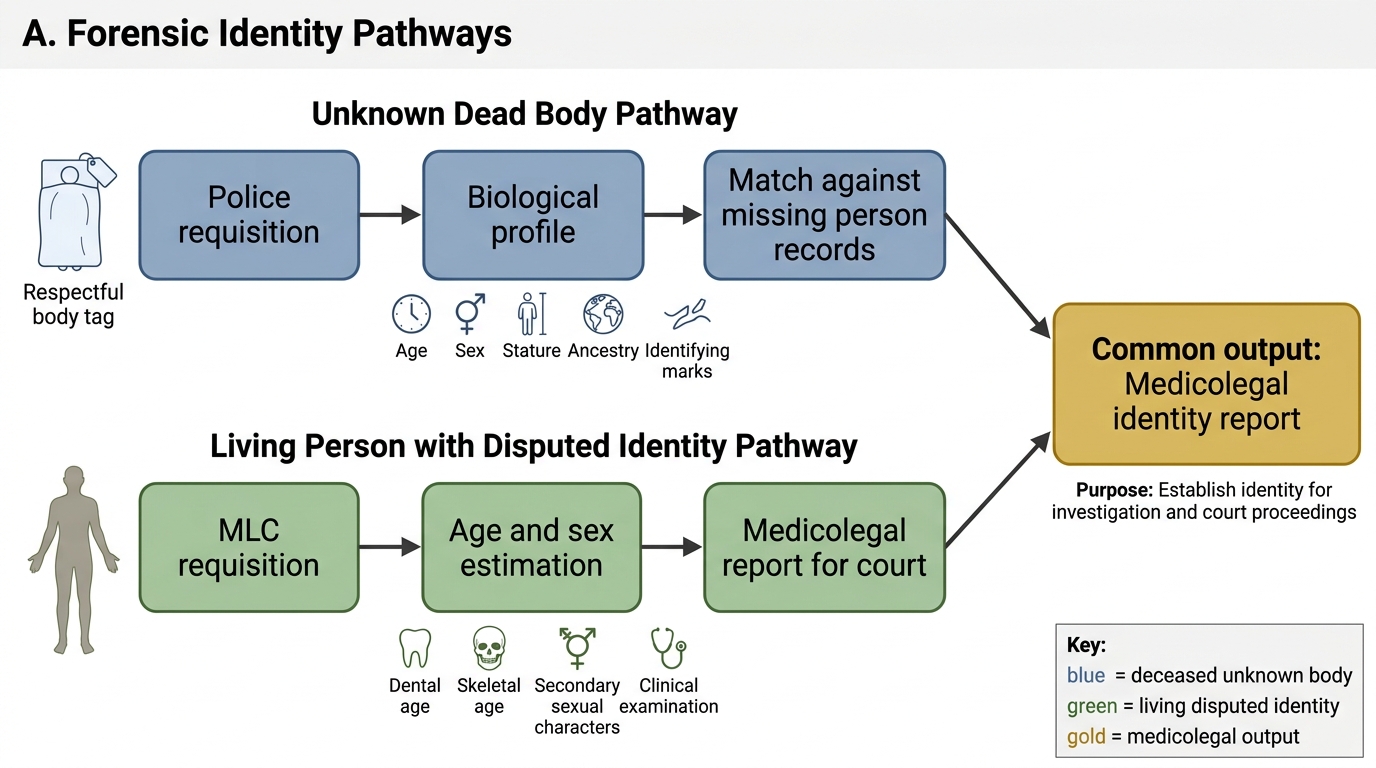
Forensic Identity Pathways
Corpus Delicti: The Legal Foundation
Corpus delicti — from the Latin, 'body of the crime' — is one of the most frequently misunderstood legal concepts in forensic medicine. It does NOT mean the physical cadaver. It is a legal doctrine stating that before a prosecution can succeed, the prosecution must prove that a crime actually occurred. In a homicide case, corpus delicti requires proving two elements: (1) that a death occurred, and (2) that the death was the result of criminal agency rather than natural causes, accident, or suicide. The physical body is the most common type of evidence used to establish corpus delicti, but corpus delicti is the proof, not the body itself — and in exceptional cases (partial remains, complete destruction, drowning without recovery) corpus delicti can be established through circumstantial evidence even without a physical cadaver.
The forensic medical officer's role in establishing corpus delicti is central. The post-mortem report must state the cause of death with sufficient precision to allow a court to determine whether criminal agency was involved. A report that says 'death due to injuries' contributes directly to corpus delicti. A report that lists multiple possible causes without opining on mechanism is legally weak. Understanding corpus delicti also shapes how the doctor interprets the scene: if a person is found dead with injuries, the first question is whether the injuries are ante-mortem, peri-mortem, or post-mortem — because only ante/peri-mortem injuries contribute to the cause of death and therefore to corpus delicti. This distinction has direct implications for IPC sections: a charge under IPC Section 302 (murder) or 304A (negligence causing death) can only stand once corpus delicti is established.
Key medicolegal principle: The absence of a body does not necessarily mean corpus delicti cannot be established — courts have convicted in cases where the body was never found, provided other evidence proved the death and its criminal nature. Conversely, finding a body does not automatically establish corpus delicti — if the death was natural, there is no crime.
SELF-CHECK
A person is found dead with no apparent injuries and a natural-appearing death. The family suspects foul play. Which statement about corpus delicti is MOST accurate?
A. Corpus delicti is automatically established because a dead body is present
B. Corpus delicti requires proof that a crime occurred, not merely that a death occurred
C. Corpus delicti cannot be established without a signed confession from the accused
D. Corpus delicti requires the physical body to be present in court
Reveal Answer
Answer: B. Corpus delicti requires proof that a crime occurred, not merely that a death occurred
Corpus delicti means 'body of the crime' — proof that a crime occurred, not the physical cadaver. A death can be natural and still produce a body, so the body's presence alone does not establish corpus delicti. The forensic doctor must provide evidence of criminal agency (e.g., injuries, poison) to help establish corpus delicti. The other options are common misconceptions.
Biological Parameters: Race and Complexion
Establishing the racial/ethnic background of an unknown individual is a valuable narrowing tool in identification — it reduces the pool of potential matches. The scientific basis of racial identification in forensic medicine rests on the fact that human populations show statistically different skeletal and soft-tissue features that reflect millennia of geographic adaptation. Reddy's classification recognises four major racial groups relevant to forensic practice:
| Racial Group | Skull Features | Nasal Index | Hair | Orbit |
|---|---|---|---|---|
| Caucasoid | Mesocephalic/dolichocephalic, orthognathous | Leptorrhine (<47) | Straight/wavy | Rectangular |
| Mongoloid | Brachycephalic, flat face, epicanthic fold | Mesorrhine (47-51) | Straight, coarse | Slanted |
| Negroid | Dolichocephalic, prognathous | Platyrrhine (>51) | Curly, woolly | Round |
| Australoid | Dolichocephalic, supraorbital ridges prominent | Platyrrhine | Wavy/curly | Oval |
In practice, the cephalic index (breadth/length × 100) and nasal index (nasal breadth/nasal height × 100) are the standard skeletal measurements. Long bones also show population-specific regression equations for stature, which is why Reddy's Indian tables must be used for Indian populations rather than Western atlases.
Complexion in a living person is documented using standard descriptors: very fair, fair, wheatish, dark, very dark — or using Fitzpatrick skin type classification (Types I–VI) in more systematic assessments. Complexion is an individualising characteristic that aids in matching to family descriptions or photographs. In decomposed bodies, complexion cannot be assessed from soft tissue but may be inferred from regional background and skeletal racial classification.
An important forensic caveat: racial classification from skeletal features carries probabilistic uncertainty, especially in admixed populations. It should be stated as 'most likely consistent with' a racial group, not as a definitive assignment.
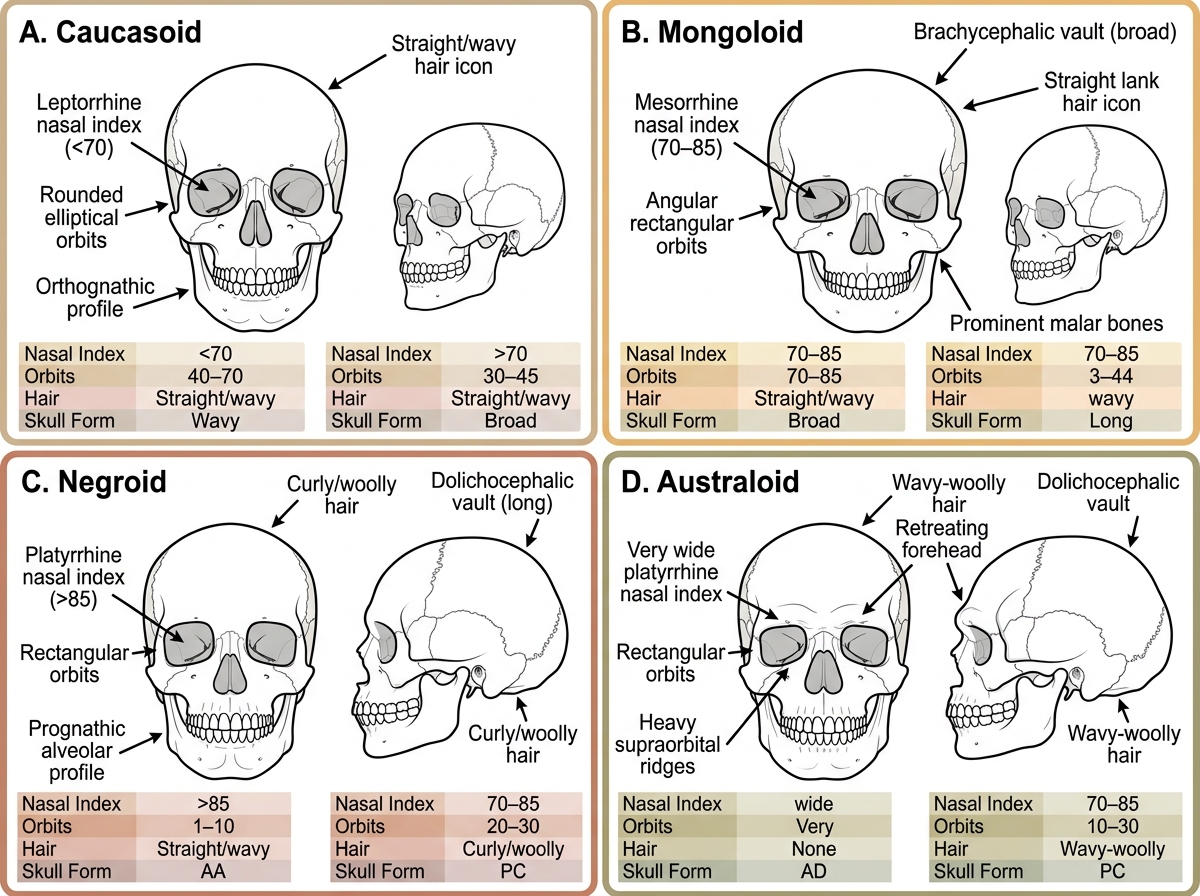
Racial Classification in Forensic Identification: Comparative Skeletal Markers