Page 2 of 15
FM4.1 | Identification Basics: Corpus Delicti, Race, Sex & Stature — SDL Guide (Part 2)
Sex Determination in Forensic Practice
Sex determination from a living person is straightforward when secondary sexual characteristics are present. In forensic cases involving skeletal or partially decomposed remains, sex must be inferred from bony anatomy, with a clear reliability hierarchy that every forensic doctor must know. The gold standard is the pelvis, followed by the skull, and then the long bones — in that order of discriminating power.
The pelvis is the most sexually dimorphic region of the human skeleton, shaped by the functional demands of parturition in females. Key features distinguishing female from male pelvis include:
- Subpubic angle: >90° (obtuse) in females; <70° (acute) in males
- Greater sciatic notch: wide and shallow in females; narrow and deep in males
- Pubic arch: broad, rounded in females; narrow, peaked in males
- Sacrum: broader and more curved in females
- Pelvic inlet: oval/rounded in females; heart-shaped in males
These features together achieve >90% accuracy in sex determination when the pelvis is complete.
The skull provides secondary sex markers: males typically show more pronounced supraorbital ridges, more prominent mastoid processes, a more squared chin (mentum), and a more rugged general morphology. Females show smoother surfaces and smaller overall dimensions. Skull-based sex determination has approximately 80% accuracy when used alone.
Long bones are the weakest sex discriminator, relying on absolute dimensions (femur head diameter >45 mm is typically male; <42 mm typically female) — but there is significant overlap, especially in populations of smaller stature, making long-bone sex determination approximately 80% accurate and population-dependent.
For a living person, sex is assessed from primary sexual characteristics (genitalia), secondary sexual characteristics (breast development, pubic/axillary hair, voice, fat distribution), and if needed, chromosomal or hormonal analysis. Forensically, for persons with intersex conditions or those who have undergone gender-affirming interventions, the report must document observed anatomical features explicitly, state what was examined, and avoid making categorical assignments beyond the clinical evidence.
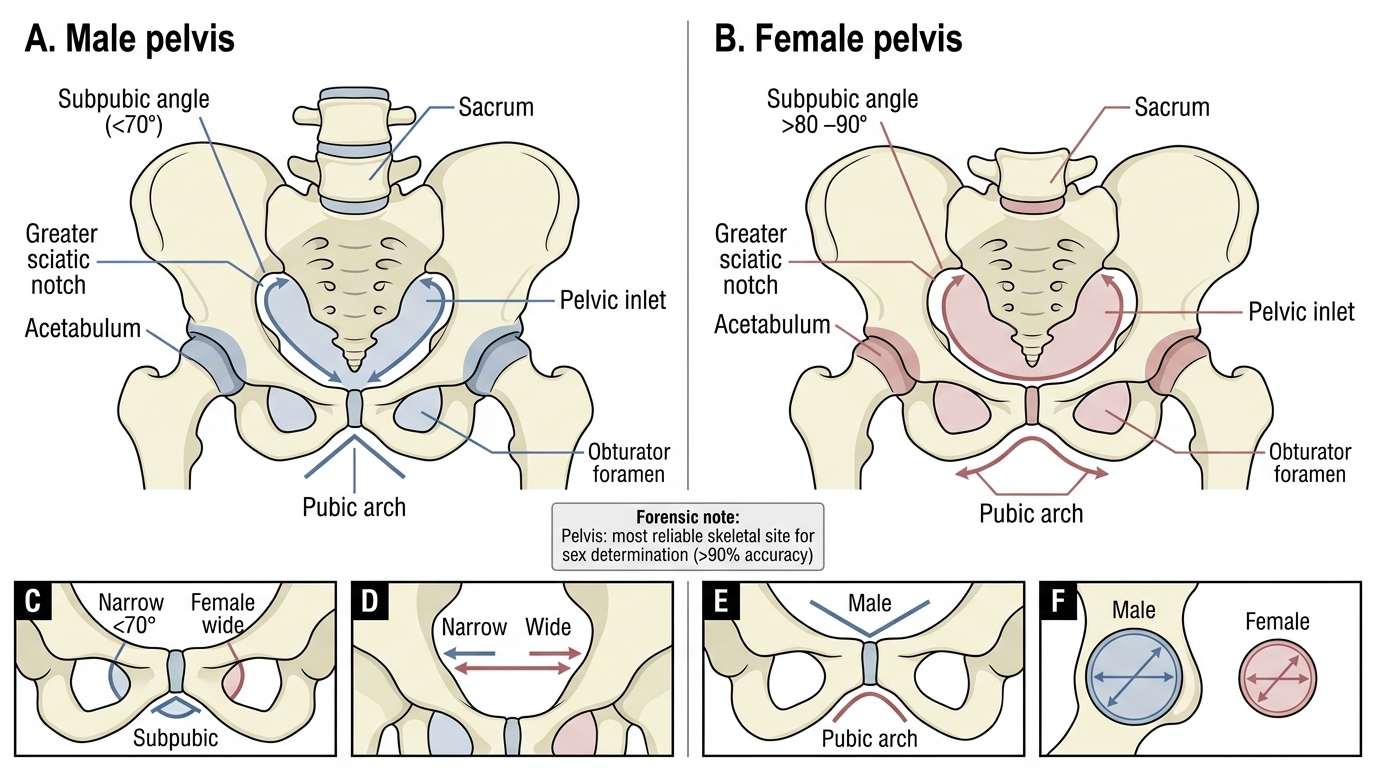
Forensic Sex Determination from the Pelvis
SELF-CHECK
An unidentified complete skeleton is submitted for sex determination. Which single anatomical site is MOST reliable for this purpose?
A. Femur head diameter
B. Skull morphology (supraorbital ridges, mastoid process)
C. Pelvis (subpubic angle, sciatic notch)
D. Clavicle length
Reveal Answer
Answer: C. Pelvis (subpubic angle, sciatic notch)
The pelvis is the most sexually dimorphic region in the human skeleton and achieves the highest accuracy (>90%) in sex determination. The skull provides secondary support (~80% accuracy). Long bones including the femur are the least reliable due to overlap in dimensions across populations. Clavicle length is not used for sex determination in standard practice.
Stature Estimation
Stature estimation from skeletal remains is based on the well-established relationship between long bone lengths and total body height. The most widely used method is Pearson's regression formula, which provides separate equations for each long bone in males and females. These equations were derived from European cadaver studies, but Indian forensic practice uses regionally calibrated tables (published by Reddy's and others from Indian population studies) because South Asian populations show lower body proportions than European populations for the same bone lengths — using European formulas on Indian bones would systematically overestimate height.
For forensic practice in India, the standard approach when calculating stature from a single long bone is to use the Pearson-derived Indian tables. The most reliable single bone is the femur, followed by the tibia, fibula, humerus, radius, and ulna — in that order. General Pearson formula structure (European reference, modified for Indian populations in practice):
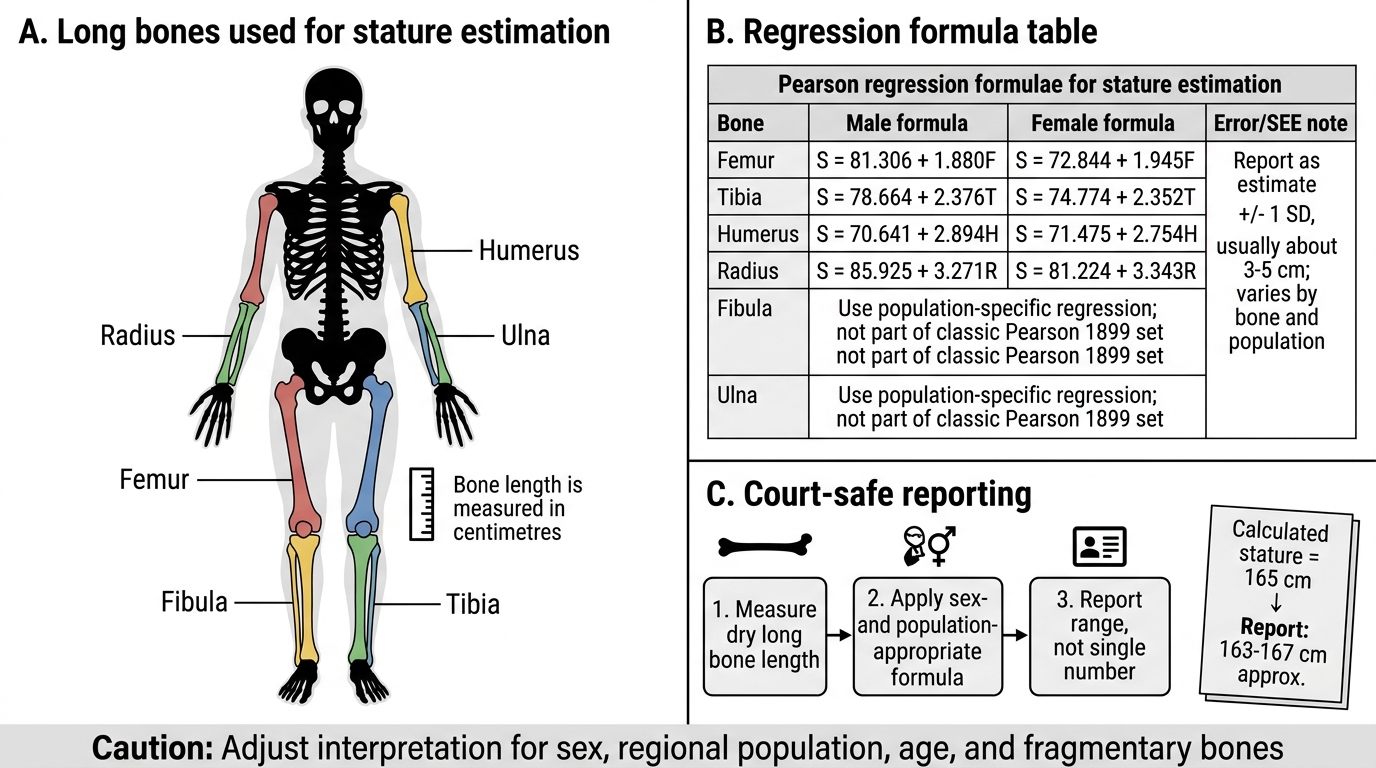
Forensic Stature Estimation From Long Bones
In all reports, the estimated stature should be expressed as a range (point estimate ± 1 standard deviation), not a single number, because these equations carry inherent statistical error (typically ±3–5 cm depending on the bone and formula). For example, a calculated femur-based estimate of 165 cm would be reported as '163–167 cm (approximate)', conveying appropriate epistemic humility to the court.
For a living person, stature is measured directly (standing height with a stadiometer). The forensic significance is in matching recorded physical descriptions. For partial remains where bones are fragmentary, regression equations based on bone fragment lengths (e.g., Steele's formula for femur fragments) can be applied, with wider confidence intervals.
Stature norms vary by regional population, sex, and age (stature decreases slightly after age 40 due to intervertebral disc compression), and these factors must be noted in any report that compares estimated stature to a specific individual's described height.
CLINICAL PEARL
The 'pelvis + skull + two long bones' rule: When estimating sex from skeletal remains, always examine and record findings from at least three anatomical regions before concluding. A pelvis that appears female combined with a skull that appears male should prompt consideration of pathological conditions (e.g., hyperandrogenism) or more sophisticated analysis (DNA). Single-feature conclusions are forensically weak. Similarly, stature estimates from multiple bones that show concordance (e.g., femur, tibia, and humerus all giving estimates within 3 cm of each other) greatly increase the confidence of the final reported range. Discordant bone estimates suggest either measurement error, pathological shortening of a bone, or post-mortem damage — all of which must be explicitly noted in the report.
Medicolegal Inference and Documentation
Translating biological findings into a defensible medicolegal report requires both technical accuracy and legal precision. The forensic identity report for an unknown person should follow a systematic format that mirrors the logical structure of the biological assessment: each parameter (sex, estimated age, race, stature, complexion, individualising features) should be reported separately with the evidence cited, the method used, and the confidence range.
For police requisitions (the most common context), the report answers specific questions posed in the requisition form: 'Estimate the age and sex of the person.' The doctor must not go beyond the questions asked without noting that additional observations are volunteered. For court purposes, the report may be read aloud — it must therefore be written in plain language with technical terms explained parenthetically.
Statutory framework governing identity work in India:
- Code of Criminal Procedure (CrPC) Section 174 — empowers police to request post-mortem examination in cases of sudden/suspicious death; the PM report is the primary corpus delicti document
- Indian Evidence Act (IEA) Section 45 — allows a doctor's expert opinion on age, sex, or cause of death to be admitted as evidence in court
- Registration of Deaths and Births Act — requires registration even of unidentified bodies; the forensic doctor's report is used for the 'unknown' death certificate
- Juvenile Justice (Care and Protection of Children) Act 2015 — mandates medical examination for age determination when documentary evidence is absent; the doctor's report determines whether the accused is tried as a juvenile (<18 yr) or adult
In all identity reports, avoid absolute language where uncertainty exists. 'Consistent with a male of approximately 35–45 years, stature 162–167 cm, most likely Dravidian/South Indian ancestry' is more defensible than 'This is a 40-year-old South Indian male of 165 cm.' The former acknowledges the probabilistic nature of biological inference; the latter will be challenged — and may be discredited — under cross-examination.
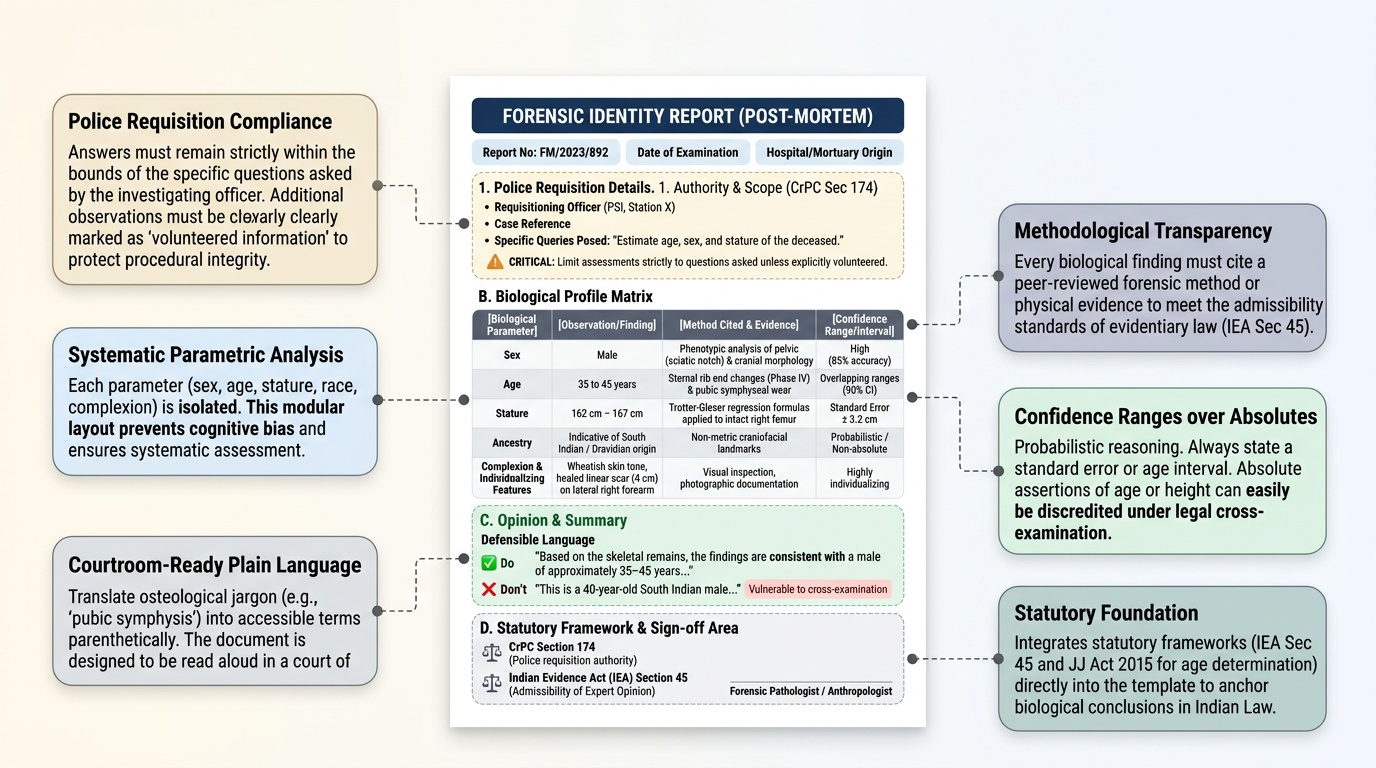
Provided image
Self-Assessment: Applying Identification Principles
Test your understanding with the following case-based questions before reviewing the answers.
Case scenario: A decomposed body is found in a field. Soft tissue is largely absent. The skeleton is intact. Police require a biological profile.
Q1. The subpubic angle measures approximately 65°. What does this indicate?
Q2. The femur length is 46 cm. Using the approximation that stature ≈ 2.24 × femur length + 69 cm (for male), what is the estimated stature range?
Q3. If the skull shows dolichocephalic form with marked prognathism and a platyrrhine nasal index of 55, which racial group is most consistent with these findings?
Q4. What is the difference between establishing corpus delicti and establishing identity, and which takes legal precedence in a homicide prosecution?
Answers:
1. Subpubic angle 65° (< 70°) is consistent with a male pelvis.
2. Stature ≈ 2.24 × 46 + 69 = 103.04 + 69 = 172 cm; reported range ≈ 169–175 cm (±3–5 cm SD).
3. Dolichocephalic + prognathous + platyrrhine nasal index 55 is most consistent with Negroid.
4. Corpus delicti (proof a crime occurred) must be established before identity becomes relevant to prosecution — the court cannot try anyone for a crime that has not been proved to have occurred. Identity determines who is tried; corpus delicti determines whether a trial is warranted at all.