Page 8 of 18
FM10.{25-27,29} | Research Ethics & Ethics Committees — SDL Guide
Learning Objectives
- Define clinical research and human experimentation; distinguish research from clinical care
- Explain the ethical principles governing research involving human participants
- Describe the constitution, functions, and powers of an Institutional Ethics Committee (IEC)
- Summarise the ICMR National Ethical Guidelines for Biomedical and Health Research Involving Human Participants (2017)
- Apply research ethics principles to ethical review scenarios and clinical trial governance
INSTRUCTIONS
Every clinician who reads, appraises, or participates in research must understand the ethical and regulatory framework that governs human research. The history of research ethics is written in catastrophic abuses — from Nazi experimentation to the Tuskegee syphilis study — and the safeguards built in response are essential knowledge for any doctor who interacts with research findings, consents participants, or sits on an ethics committee.
References
- KSN Reddy — Essentials of Forensic Medicine & Toxicology (textbook)
- BV Subrahmanyam — Modi's Medical Jurisprudence and Toxicology (textbook)
Version 2.0 | NMC CBUC 2024
CLINICAL SCENARIO
A pharmaceutical company approaches a third-year resident in a government teaching hospital with an offer: enrol 30 patients admitted to the medicine ward in a Phase III clinical trial of a new antihypertensive drug. The company offers a per-patient enrollment fee paid to the department and a conference invitation to the resident. The trial protocol has been approved by a distant, private IEC that has no institutional link to the hospital. The hospital's own Institutional Ethics Committee has not reviewed the protocol.
Is this trial ethically permissible? What are the regulatory requirements for clinical trials in India? Who should have reviewed this protocol? And what is the resident's personal ethical obligation before enrolling even the first patient?
WHY THIS MATTERS
Research ethics sits at the intersection of clinical medicine, law, and human rights. The ICMR National Ethical Guidelines for Biomedical and Health Research Involving Human Participants (2017) is India's primary regulatory document for human research, and compliance is mandated for all research conducted in Indian institutions. The Central Drugs Standard Control Organisation (CDSCO) regulates clinical trials under the Drugs and Cosmetics Act 1940 (amended 2019). Violations — such as enrolling participants without IEC approval, conducting trials without valid informed consent, or not reporting serious adverse events — carry criminal, civil, and professional consequences. As a future clinician and potential researcher, understanding these obligations is a regulatory necessity.
RECALL
Recall from earlier sessions and ethics teaching:
- Nuremburg Code (1947) — first international standard: voluntary informed consent is absolutely essential in human experimentation; arose from the Nuremberg Doctors' Trial.
- Declaration of Helsinki (WMA, 1964, revised 2013) — guiding principles for medical research; distinguishes therapeutic from non-therapeutic research; requires IEC review.
- Belmont Report (US, 1979) — identified three principles: respect for persons, beneficence, and justice. Note: Belmont is an American document; it is NOT the primary Indian reference.
- Tuskegee syphilis study (1932–1972) — emblematic research abuse: Black men with syphilis were denied penicillin after it became available; the case exemplifies justice violations in research.
- Informed consent — covered in SDL ml3; applies equally in the research context with additional safeguards (right to withdraw without penalty).
Clinical Research: Legal and Professional Context
Clinical research is the systematic investigation of human subjects — their biology, disease, behaviour, or response to interventions — with the intent to develop generalisable knowledge. It encompasses observational studies, clinical trials, genetic research, social science research, and quality improvement projects that involve identifiable human data. The ethical framework recognises a fundamental difference between clinical research and clinical care: in clinical care, the clinician's primary obligation is the individual patient's benefit; in research, the primary goal is the generation of knowledge, which may or may not benefit the individual participant. This tension is the reason research requires independent ethical oversight.
Human experimentation specifically refers to any procedure performed on a living human being that goes beyond established treatment — it includes the administration of experimental drugs or devices, novel surgical techniques tested for the first time, and physiological studies on healthy volunteers. The history of research ethics is punctuated by catastrophic abuses: the Nazi physicians who conducted lethal experiments on concentration camp prisoners (leading to the Nuremberg Code 1947), the Tuskegee syphilis study (1932–1972, where treatment was withheld from Black men to observe disease progression), and unethical clinical drug trials in India (including the controversial Hyderabad oral contraceptive trials in the 1970s) that galvanised the ICMR to develop India-specific guidelines.
The regulatory framework in India governing human research includes:
- ICMR National Ethical Guidelines for Biomedical and Health Research Involving Human Participants (2017) — the primary ethical regulatory document.
- Drugs and Cosmetics Act 1940 (and Rules, amended New Drugs and Clinical Trials Rules 2019) — governs clinical trials of drugs and medical devices.
- CDSCO (Central Drugs Standard Control Organisation) — the national drug regulatory authority that approves Phase I–IV clinical trials.
- Schedule Y of the Drugs and Cosmetics Rules — specifies requirements for clinical trials including informed consent, IEC registration, and SAE (serious adverse event) reporting.
- Indian Council of Medical Research (ICMR) — develops ethical guidelines and funds research; maintains the Clinical Trials Registry – India (CTRI).
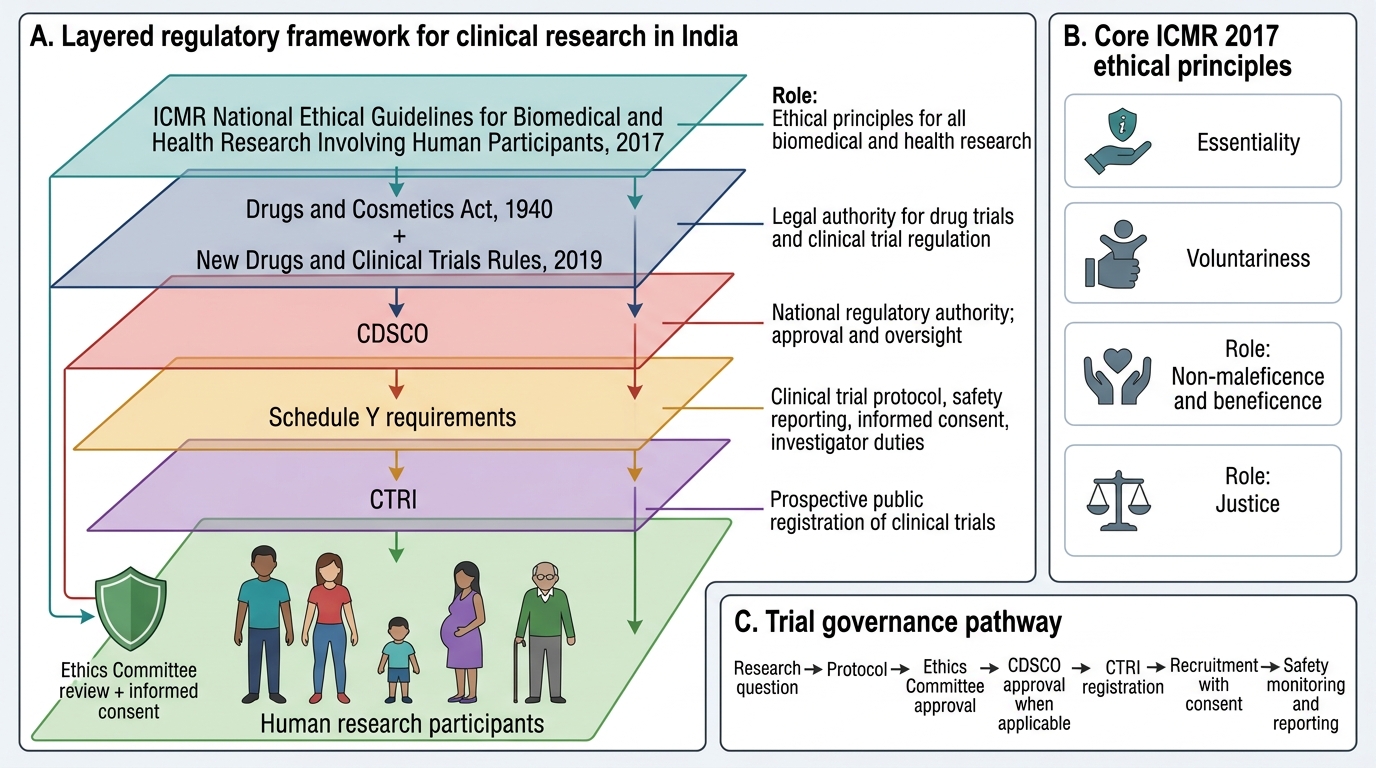
Clinical Research Governance in India
Governing Principles of Research Ethics
The ICMR National Ethical Guidelines for Biomedical and Health Research Involving Human Participants (2017) — the title and year of this document must be known precisely; it is NOT the Belmont Report (an American document) — articulate twelve principles that govern all biomedical research involving human participants in India. The most important for clinical practice are:
- Essentiality — research should only be conducted if the question cannot be answered by any other means; unnecessary exposure of participants to risk is ethically unjustifiable.
- Voluntariness — participation must be entirely voluntary; no coercion, undue inducement, or pressure. Participants must be free to withdraw at any time without penalty or loss of any benefit to which they are otherwise entitled.
- Non-maleficence and beneficence — the research must minimise risks and maximise benefits; the potential benefits to society must justify the risks imposed on participants.
- Justice — fair selection of participants; vulnerable populations (children, prisoners, pregnant women, economically disadvantaged) must not be disproportionately burdened by research risks while benefits accrue to others.
- Privacy and confidentiality — participant data must be protected; identifiable information disclosed only as specified in the protocol and consented to.
- Precaution and risk minimisation — all precautions to minimise harm must be incorporated in the design.
- Professional competence — research must be conducted by qualified personnel.
- Accountability and transparency — researchers must be accountable for their conduct and findings; data must be accurately reported.
Additional ICMR 2017 principles: Maximisation of public interest, Institutional responsibility, Totality of responsibility, and Non-discrimination.
The framework for research ethics consent in the ICMR guidelines is more stringent than ordinary clinical consent: it requires disclosure that the participant is being enrolled in research (not ordinary care), that participation is voluntary, that withdrawal will not affect their clinical care, what the nature and duration of the research is, and whether biological specimens will be stored or data shared beyond the study.
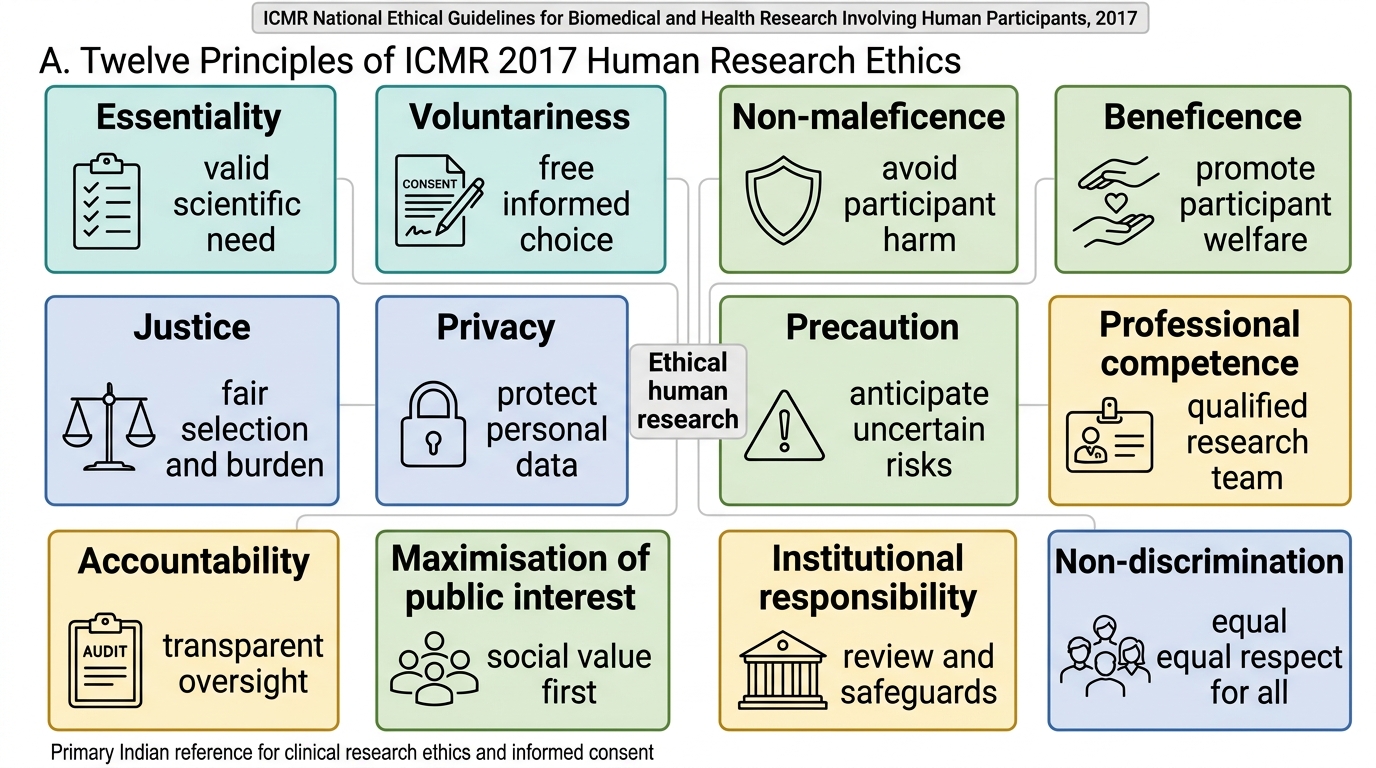
ICMR 2017 Principles of Human Research Ethics
SELF-CHECK
A researcher designing a clinical trial in India must obtain the participants' informed consent. Which document is the PRIMARY Indian reference for the ethical guidelines governing this process?
A. Belmont Report (1979)
B. Declaration of Helsinki (2013)
C. ICMR National Ethical Guidelines for Biomedical and Health Research Involving Human Participants (2017)
D. Nuremberg Code (1947)
Reveal Answer
Answer: C. ICMR National Ethical Guidelines for Biomedical and Health Research Involving Human Participants (2017)
The ICMR National Ethical Guidelines for Biomedical and Health Research Involving Human Participants (2017) is the primary Indian regulatory reference for ethical conduct of research involving human participants. The Belmont Report is an American document (National Commission for Protection of Human Subjects, 1979) and is not the Indian primary reference — though its three principles (respect for persons, beneficence, justice) are widely cited internationally. The Declaration of Helsinki and Nuremberg Code are foundational international documents but the ICMR 2017 guidelines are the operationally applicable national standard in India.
Ethics Committees: Constitution and Functions
An Institutional Ethics Committee (IEC) is an independent multidisciplinary body constituted at a research institution to provide ethical oversight of all research involving human participants conducted at or under the auspices of that institution. The IEC is the operational gatekeeper of research ethics — no human research should begin without IEC approval of the protocol.
Constitution of an IEC (as per ICMR 2017 guidelines and New Drugs and Clinical Trials Rules 2019):
An IEC should have a minimum of 7 members comprising a diverse, multidisciplinary group:
- Chairperson — should be from outside the institution to ensure independence; can be an eminent person from the scientific community.
- One or two basic medical/biomedical scientists (can be pharmacologist, physiologist, biochemist).
- One clinician (medical specialist) with research experience in the relevant field.
- One social scientist or psychologist.
- One legal expert or person familiar with law and human rights.
- One philosopher, ethicist, or theologian (representing ethical and moral considerations).
- One community/lay representative (NGO member, patient advocate, person from a local community organisation) — essential to ensure community perspective.
- One representative from the institution's administration (can be member-secretary).
All members should be trained in research ethics. The committee must have gender diversity. External members (non-employees of the institution) must constitute at least one-third of the IEC. The IEC must be registered with the DCGI (Drug Controller General of India) and the Indian Council of Medical Research for oversight.
Functions of an IEC:
1. Protocol review and approval: review research proposals for scientific validity, ethical justifiability, and adequacy of informed consent. Approval is mandatory before initiation.
2. Informed consent form review: ensure the consent form and process meet the required standards including language, comprehension, voluntary withdrawal clause.
3. Ongoing monitoring: follow-up review of approved studies; review of annual progress reports, protocol amendments, deviations, and continuations.
4. Serious Adverse Event (SAE) review: receive and review expedited reports of unexpected serious adverse events; may suspend or terminate a study if safety signals emerge.
5. Post-trial responsibilities: review of end-of-study reports; ensure participants receive appropriate post-trial access to beneficial treatments where applicable.
6. Training and education: provide guidance on ethical conduct of research to investigators.
CDSCO registration and oversight: Under the New Drugs and Clinical Trials Rules 2019, all IECs reviewing clinical trials of drugs and devices must be registered with CDSCO. CDSCO may inspect IEC records, audit approved trials, and take regulatory action for non-compliance.
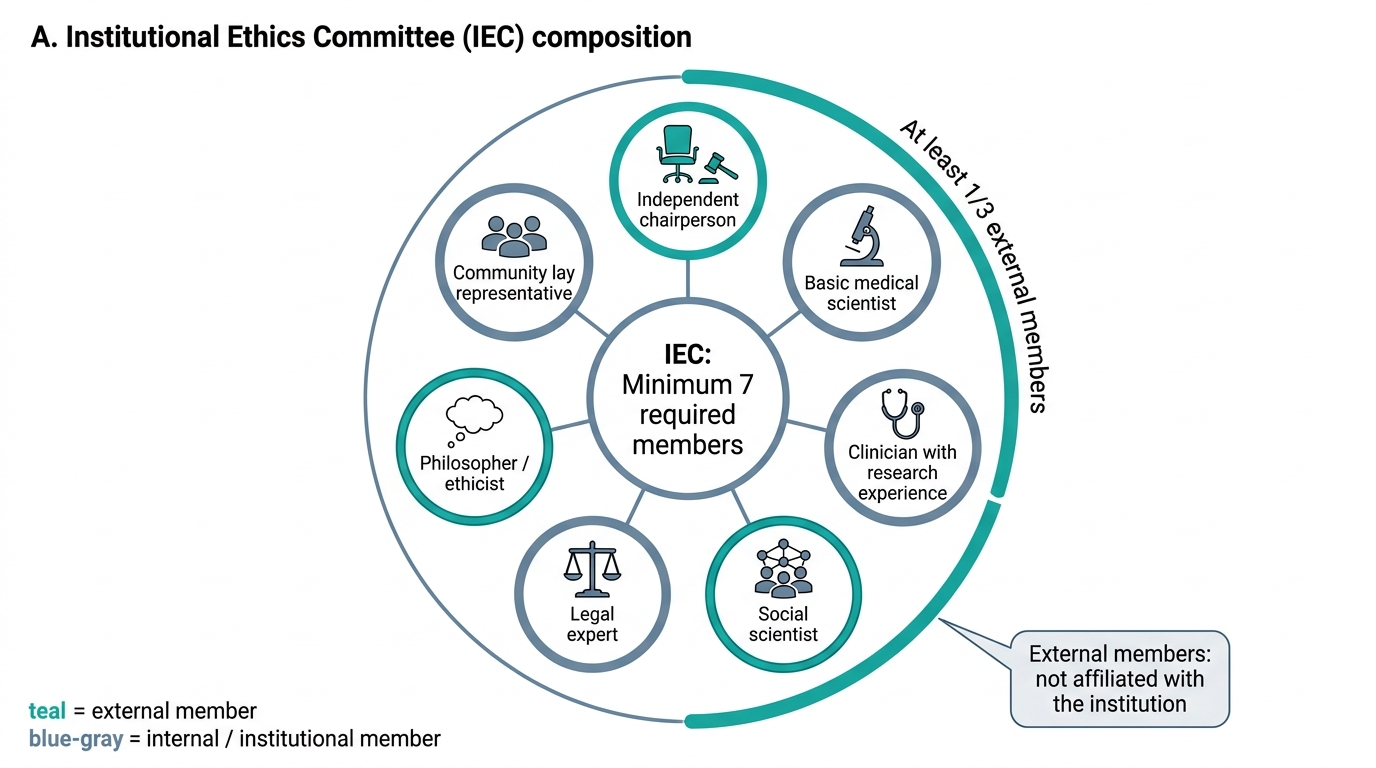
Institutional Ethics Committee Composition