Page 5 of 17
FM8.7 | Virginity, Legitimacy & Unscientific Tests — SDL Guide
Learning Objectives
- Define legitimacy and state its medicolegal importance
- Explain why 'virginity tests' (including the finger/two-finger test) are unscientific and have no medico-legal validity
- State the position of the Supreme Court of India and the WHO on virginity testing
- Describe how a doctor should respond when asked to perform a 'virginity test' or when courts seek opinion on virginity
- Distinguish what hymenal examination can and cannot prove
INSTRUCTIONS
This module addresses two topics that frequently arise in medico-legal practice but rest on entirely unscientific foundations: the concept of 'virginity testing' and the historical practice of using hymenal findings as evidence of prior sexual activity. Both are condemned by science, by the highest courts of India, and by international health bodies — yet they continue to be requested by police, courts, and families. This module equips you to refuse these requests correctly, explain why they are invalid, and report your legitimate examination findings accurately.
References
- KSN Reddy — Essentials of Forensic Medicine & Toxicology (textbook)
- BV Subrahmanyam — Modi's Medical Jurisprudence and Toxicology (textbook)
Version 2.0 | NMC CBUC 2024
CLINICAL SCENARIO
A 20-year-old rape survivor is brought to the forensic medicine department. The investigating officer presents a court order asking the examining doctor to determine whether the survivor is 'habituated to sexual intercourse' and to perform a 'two-finger test.' The junior resident asks the consultant, 'Should I do it?' The consultant's answer — and the legal and scientific reasoning behind it — is the core of this module.
WHY THIS MATTERS
The two-finger test (or 'finger test') was for decades routinely conducted on rape survivors in India, with examiners opining that 'laxity' of the vagina or 'absence of hymen' indicated prior sexual experience — and by implication, consent. This practice violates basic anatomy, re-traumatises survivors, is scientifically unfounded, and has been explicitly banned by the Supreme Court of India. A doctor who performs this test today risks criminal prosecution and disciplinary action. Every medical graduate must understand why the test is invalid and be able to articulate this to a court.
RECALL
From your anatomy Year 1: the hymen is a mucous membrane fold at the vaginal introitus; its form is highly variable (annular, fimbriated, septate, microperforate, imperforate); it may be absent, stretched, or have old tears from non-sexual causes (vigorous physical activity, tampon use, gynaecological examination). From your FM8.2 SDL: the examination of the genitalia in rape cases records findings precisely, without concluding whether rape occurred. Recall that absence of injury does not mean absence of sexual assault.
Legitimacy: Definition and Medicolegal Importance
Legitimacy in the medicolegal context refers to the legal status of a child as having been born within a valid marriage — or within a legally presumed timeframe of that marriage. The concept arises in disputes over inheritance, succession rights, custody, and, historically, in matrimonial disputes where the paternity of a child was contested.
Under the Indian Evidence Act (Section 112), a child born during a valid marriage, or within 280 days (approximately 9 months) of the dissolution of a marriage, is presumed to be legitimate — meaning the husband is presumed to be the father. This presumption is not rebuttable simply by blood group analysis; the Supreme Court has held that DNA evidence may rebut the Section 112 presumption only where there is compelling reason (e.g., proven impossibility of access between the parties). The presumption exists to protect the child's legal interests — a child should not be rendered illegitimate on the basis of mere allegations.
The medicolegal role in legitimacy disputes is therefore: (1) provide clinical information about gestation (foetal age, gestational dating) so a court can assess whether birth within the marriage timeframe is biologically plausible; (2) advise on the interpretation of DNA parentage test results if ordered; and (3) never opine that a child is 'illegitimate' — that is a legal determination, not a medical one. The doctor's report provides factual biological data; the court applies the legal presumptions.
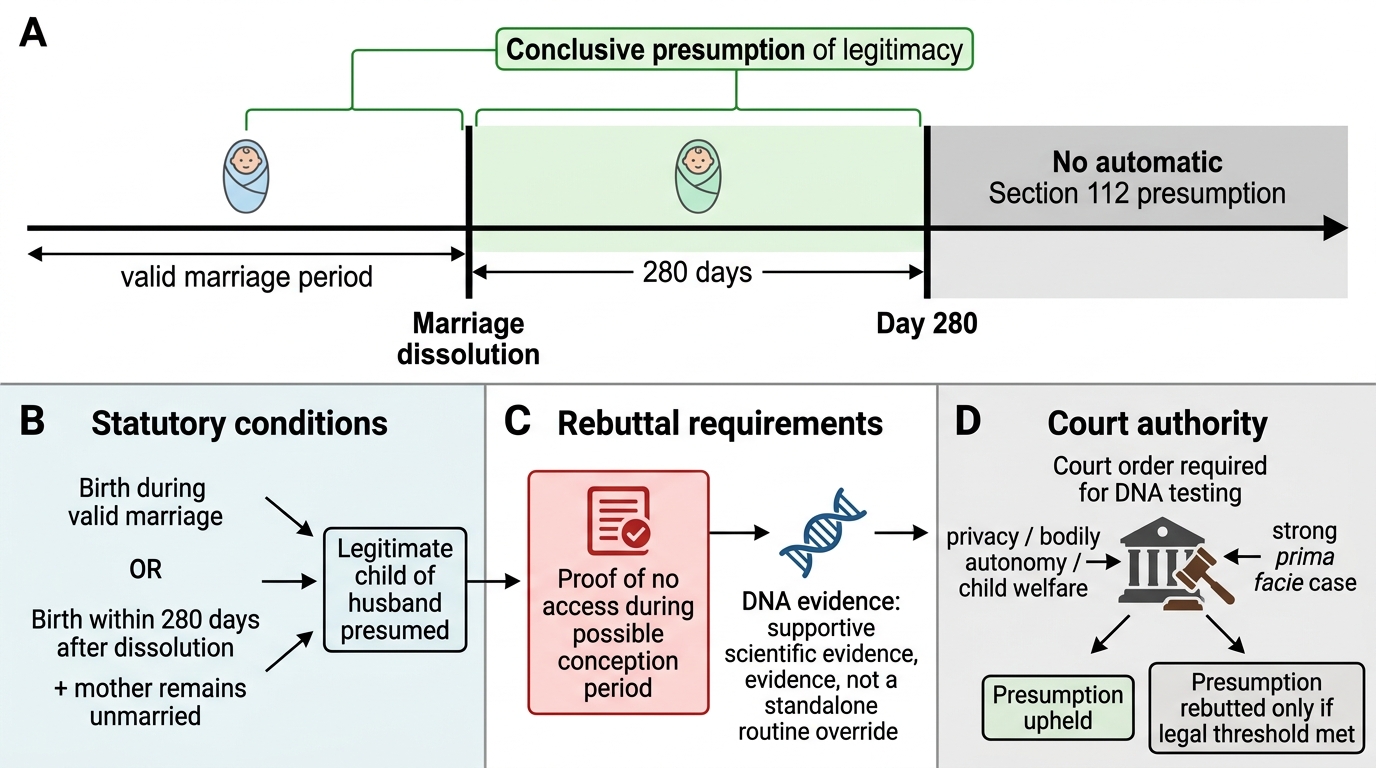
Section 112 Legitimacy Presumption Timeline
Why the Hymen Cannot Prove Virginity: The Anatomy
The premise of 'virginity testing' is that the hymen is an intact membrane that ruptures on first sexual intercourse, and that its condition is therefore evidence of prior sexual activity. This premise is anatomically false on multiple grounds, and every doctor must be able to articulate these grounds clearly.
First, hymenal anatomy is highly variable. The hymen exists in many forms — annular, fimbriated (with fringe-like projections), crescentic, septate, microperforate, and naturally imperforate. A fimbriated hymen may appear 'absent' or 'incomplete' to an inexperienced examiner even in a person who has never been sexually active. Conversely, an annular hymen may remain intact even after repeated sexual intercourse.
Second, hymens do not always rupture with intercourse. The hymenal tissue in many women is sufficiently elastic that sexual penetration does not produce visible tearing. Conversely, hymenal tears or changes can occur from non-sexual causes: vigorous athletics, horseback riding, use of tampons or menstrual cups, digital self-examination, gynaecological procedures, and even constipation.
Third, healed tears are impossible to age reliably. A 'healed tear' observed on examination could have occurred weeks, months, or years ago from any cause. There is no histological or clinical method to determine whether a healed hymenal tear resulted from sexual intercourse versus non-sexual trauma versus congenital variant.
Fourth, vaginal tone (used in the 'two-finger test') has no evidential value. Vaginal laxity varies between women based on age, parity, pelvic floor muscle tone, and hormonal status — none of which are determined by sexual history. The practice of inserting one or two fingers to assess 'laxity' has no scientific basis for inferring prior intercourse.
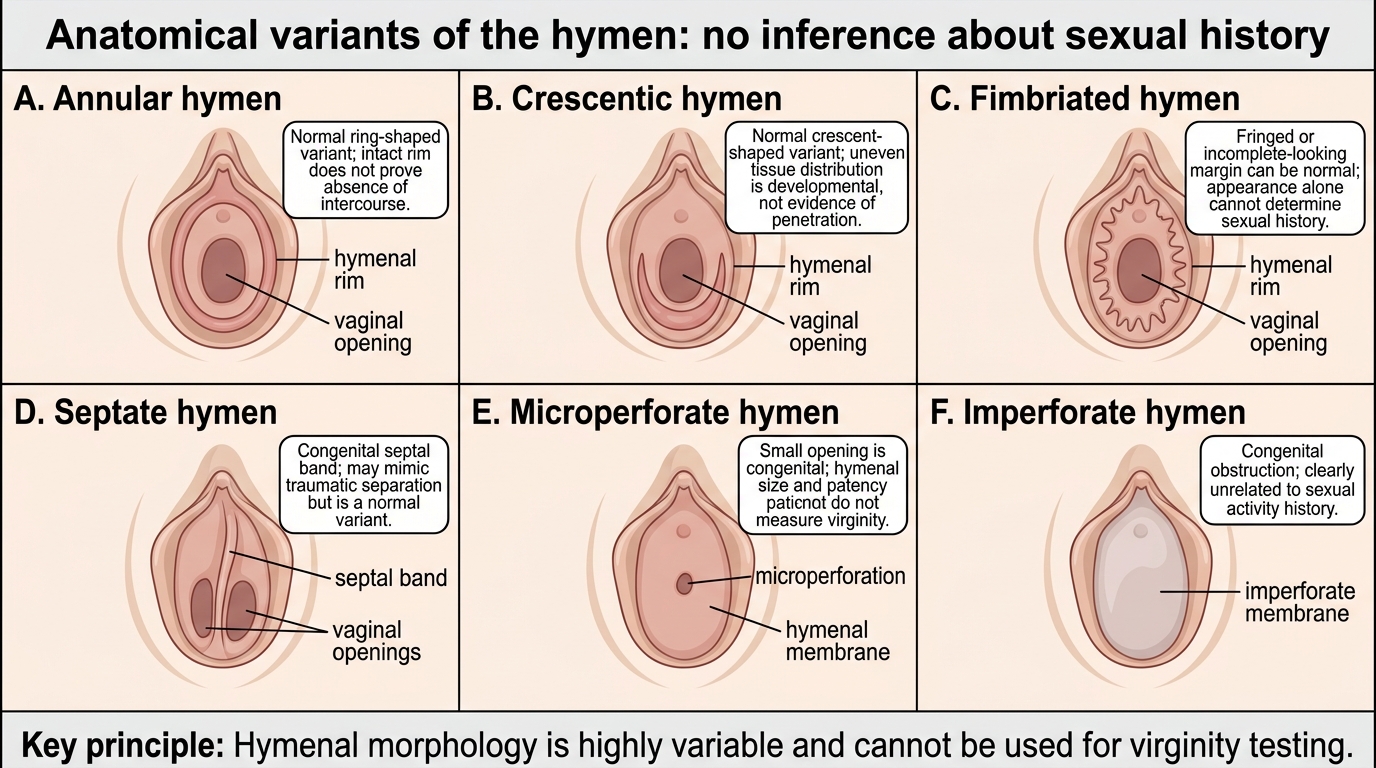
Hymenal Variants and the Invalidity of Virginity Testing
SELF-CHECK
A 22-year-old woman claims she has never had sexual intercourse. On hymenal examination, she has a fimbriated hymen with a narrow band anteriorly and apparent absence of hymenal tissue posteriorly. What is the most appropriate interpretation?
A. The hymenal appearance is consistent with habitual intercourse
B. The findings indicate at least one prior penetrative act
C. Hymenal appearance is a normal anatomical variant and cannot be used to make any inference about sexual history
D. The findings rule out the claim of virginity
Reveal Answer
Answer: C. Hymenal appearance is a normal anatomical variant and cannot be used to make any inference about sexual history
Hymenal form is highly variable and has no reliable relationship to sexual activity history. A fimbriated or 'incomplete' hymen is a normal anatomical variant in sexually inactive individuals. No inference about sexual history can be drawn from hymenal appearance.
Legal Position: Supreme Court, WHO, and Duty to Refuse
The medicolegal and legal framework on virginity testing in India is unambiguous, and the doctor's duty is clear.
Supreme Court of India — Lillu @ Rajesh and Another v. State of Haryana (2013): The Supreme Court declared the two-finger test (per vaginum examination to assess laxity) unconstitutional and directed it to be stopped immediately. The Court held that the test violates the rape survivor's right to privacy and dignity under Article 21, constitutes re-victimisation, and has no scientific validity. The court directed: the medical examination of rape survivors must be conducted per MoHFW guidelines, which do not include any assessment of 'habituation to sexual intercourse.'
MoHFW Guidelines (2014, reaffirmed 2022): The guidelines explicitly state that the two-finger test 'is not to be conducted'; that the condition of the hymen 'does not prove or disprove sexual activity or rape'; and that any finding related to hymen should be described neutrally without any opinion about virginity or prior sexual history.
World Health Organisation (WHO): The WHO joint interagency statement (UNFPA-UNICEF-WHO, 2018) on virginity testing states that the practice has 'no scientific validity,' is not a reliable indicator of whether a woman has had sex, and constitutes gender discrimination and a violation of human rights. WHO calls for the elimination of virginity testing globally.
The doctor's duty when asked to perform a virginity test or certify virginity: The examining doctor must decline. The correct response is: 'I cannot perform a virginity test because no such test exists. The examination of the hymen cannot determine whether a person has had sexual intercourse. I will perform a complete, MoHFW-compliant examination and report my findings accurately.' If the request comes from a court, the doctor must submit a written response explaining the scientific basis for declining that specific component — courts are entitled to the doctor's honest expert opinion, and that opinion is that virginity testing is scientifically invalid.
What the doctor may legitimately report: Hymenal findings are reported neutrally (form, any fresh tears with description, any old healed tears). No inference about virginity, sexual history, or consent is to be drawn from these findings.
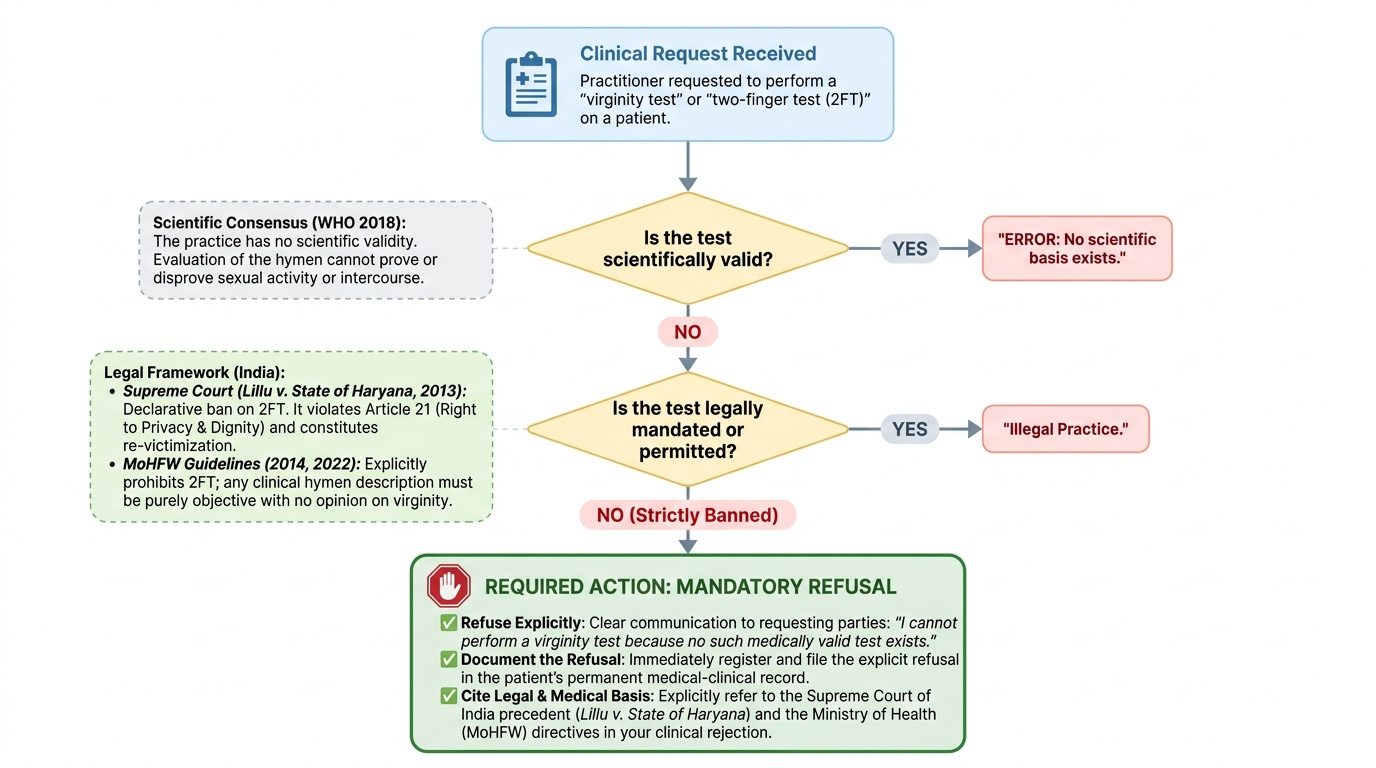
Provided image
CLINICAL PEARL
When a court order demands a 'two-finger test' or an opinion on 'habituation to sexual intercourse,' the correct response is not silent compliance and not outright disobedience — it is an expert written explanation. Submit your findings and a one-paragraph scientific explanation of why virginity testing is invalid, citing the Supreme Court judgment. Courts generally accept expert refusals when properly explained. Performing the test to avoid conflict with the court is both illegal and professionally sanctionable.
SELF-CHECK
An investigating officer requests you to perform a 'two-finger test' on a rape survivor and certify whether she is 'habituated to sexual intercourse.' Your most appropriate response is:
A. Perform the test as ordered by the investigating officer
B. Perform the test but do not record the opinion in your report
C. Decline to perform the two-finger test, explain its scientific invalidity in writing, and conduct a standard MoHFW-compliant examination recording only objective findings
D. Refer the survivor to a senior forensic medicine specialist to perform the test
Reveal Answer
Answer: C. Decline to perform the two-finger test, explain its scientific invalidity in writing, and conduct a standard MoHFW-compliant examination recording only objective findings
The two-finger test is prohibited by the Supreme Court (Lillu judgment 2013) and MoHFW guidelines. The correct response is to decline the test, document the refusal and its legal/scientific basis, and conduct a standard, guideline-compliant examination. No doctor — regardless of seniority — should perform this test.
SELF-CHECK
Under the Indian Evidence Act Section 112, a child born 8 months after the dissolution of a marriage is:
A. Conclusively illegitimate — born after the marriage ended
B. Presumed legitimate under the 280-day rule, and this presumption can only be rebutted by proof of impossibility of access between the parties
C. Required to undergo DNA paternity testing to establish legitimacy
D. Classified as illegitimate until the father makes a declaration
Reveal Answer
Answer: B. Presumed legitimate under the 280-day rule, and this presumption can only be rebutted by proof of impossibility of access between the parties
Indian Evidence Act Section 112 presumes legitimacy for children born within 280 days (~9 months) of the dissolution of a marriage, provided the parties had access to each other. This presumption exists to protect the child's interests and can be rebutted only by proving impossibility of access — not merely by blood group or suspicious timing.
KEY TAKEAWAYS
Legitimacy is the legal status of a child born within a marriage or within 280 days of its dissolution; the Indian Evidence Act presumes legitimacy, rebuttable only by proof of impossibility of access. Virginity testing — including the two-finger test — has no scientific validity: hymenal anatomy is highly variable, tears can result from non-sexual causes, and vaginal laxity bears no relationship to sexual history. The Supreme Court (Lillu 2013), MoHFW guidelines, and WHO have all condemned and banned virginity testing. When asked to perform such a test, the doctor must decline in writing with a scientific explanation and conduct only a standard, MoHFW-compliant examination. Hymenal findings are reported descriptively and neutrally, without any inference about prior sexual activity.
REFLECT
You are an expert witness in a rape trial. The defence counsel asks you: 'Doctor, you found that the hymen had healed tears. Does that not indicate prior sexual activity?' How would you respond in court, using scientifically accurate language, to ensure the court is properly informed about the limitations of hymenal findings?