Page 11 of 25
PA20.1 | Coagulation Factor Disorders — Haemophilia & vWD — SDL Guide (Part 2)
Von Willebrand Disease — The Dual-Defect Disorder

Von Willebrand Disease: The Dual-Defect Disorder
Von Willebrand disease (vWD) is the commonest inherited bleeding disorder overall, affecting ~1% of the population, though most cases are mild and underdiagnosed.
vWF has two critical functions:
1. Bridges platelets to subendothelial collagen (primary haemostasis — GPL adhesion)
2. Acts as a carrier protein for factor VIII in plasma, protecting it from proteolytic degradation
When vWF is deficient or dysfunctional, BOTH mechanisms fail: platelet adhesion is impaired AND factor VIII levels fall (because unprotected VIII is rapidly degraded). This gives vWD its unique dual bleeding pattern.
Types of vWD:
| Type | Defect | Frequency | Bleeding |
|---|---|---|---|
| Type 1 | Quantitative reduction (partial) | 75–80% | Mild mucocutaneous |
| Type 2 | Qualitative dysfunction (subtypes 2A/2B/2M/2N) | 15–20% | Mild-moderate |
| Type 3 | Near-total absence of vWF | Rare, ~1% | Severe: both mucocutaneous + deep |
Genetics: Type 1 is autosomal dominant; Type 3 is autosomal recessive. In contrast to haemophilia, females are equally affected.
Laboratory features:
• Bleeding time / PFA-100 — prolonged (platelet adhesion impaired)
• aPTT — variable (prolonged when factor VIII falls significantly; may be normal in mild type 1)
• PT — normal
• Platelet count — normal
• Ristocetin cofactor assay — reduced (key diagnostic test: ristocetin normally causes vWF-dependent platelet agglutination; reduced agglutination indicates vWF deficiency or dysfunction)
• vWF antigen level and multimer analysis for subtyping

Von Willebrand Factor: Dual Function and Treatment Strategy
Treatment:
• Type 1 (mild): Desmopressin (DDAVP) — releases endogenous vWF stores from Weibel-Palade bodies of endothelial cells; useful for minor procedures
• Types 2 and 3: vWF concentrate (Humate-P); desmopressin contraindicated in Type 2B (causes thrombocytopenia by releasing abnormal vWF multimers)
CLINICAL PEARL
The DDAVP clue in examinations: Desmopressin is useful in BOTH mild Haemophilia A AND Type 1 vWD — in Haemophilia A it releases vWF-bound factor VIII (raising VIII levels transiently); in vWD it releases endogenous vWF from endothelial storage granules. If an MCQ mentions desmopressin as treatment, the patient has either mild Haemophilia A or Type 1 vWD — not severe disease. Desmopressin is ineffective in Haemophilia B (no endogenous factor IX stores to release).
SELF-CHECK
A 22-year-old woman has a lifelong history of heavy menstrual periods and gum bleeding. Her platelet count and PT are normal. PFA-100 closure time is prolonged and aPTT is mildly elevated. Ristocetin cofactor assay shows reduced platelet agglutination. Which diagnosis best fits?
A. Haemophilia A (factor VIII deficiency)
B. Immune thrombocytopenic purpura
C. Von Willebrand disease
D. Haemophilia B (factor IX deficiency)
Reveal Answer
Answer: C. Von Willebrand disease
The combination of mucocutaneous bleeding (heavy menses, gum bleeding), prolonged PFA-100, mildly elevated aPTT with normal PT and platelet count, and a reduced ristocetin cofactor assay is the classic profile of von Willebrand disease. Haemophilias A and B cause isolated aPTT prolongation without PFA-100 abnormality and affect males preferentially. ITP would show thrombocytopenia.
The Mixing Study — Distinguishing Deficiency from Inhibitor
The mixing study is a critical diagnostic test when a prolonged aPTT (or PT) is discovered. It answers one question: is the prolongation due to a missing factor, or is there an antibody blocking the pathway?
Principle:
• Mix patient plasma 1:1 with pooled normal plasma
• Normal plasma contains all factors at 100% — it will 'top up' a deficiency to at least 50% of normal, which is enough to correct the clotting time
Interpretation:
| Result | Interpretation | Examples |
|---|---|---|
| aPTT corrects to normal | Factor deficiency present | Haemophilia A, Haemophilia B, liver disease |
| aPTT does NOT correct | Inhibitor present | Haemophilia A with inhibitor, lupus anticoagulant, acquired haemophilia |

Mixing Study Results: Factor Deficiency vs Inhibitor
Immediate vs. incubated mixing: Some inhibitors (notably factor VIII inhibitors) are time- and temperature-dependent — they may not be detected immediately. The mix should therefore also be incubated at 37°C for 1–2 hours. An aPTT that corrects immediately but becomes prolonged after incubation suggests a time-dependent inhibitor.
Lupus anticoagulant is a phospholipid-dependent inhibitor that prolongs aPTT in vitro but paradoxically causes thrombosis in vivo — a classic exam distinction. It does not correct on mixing.
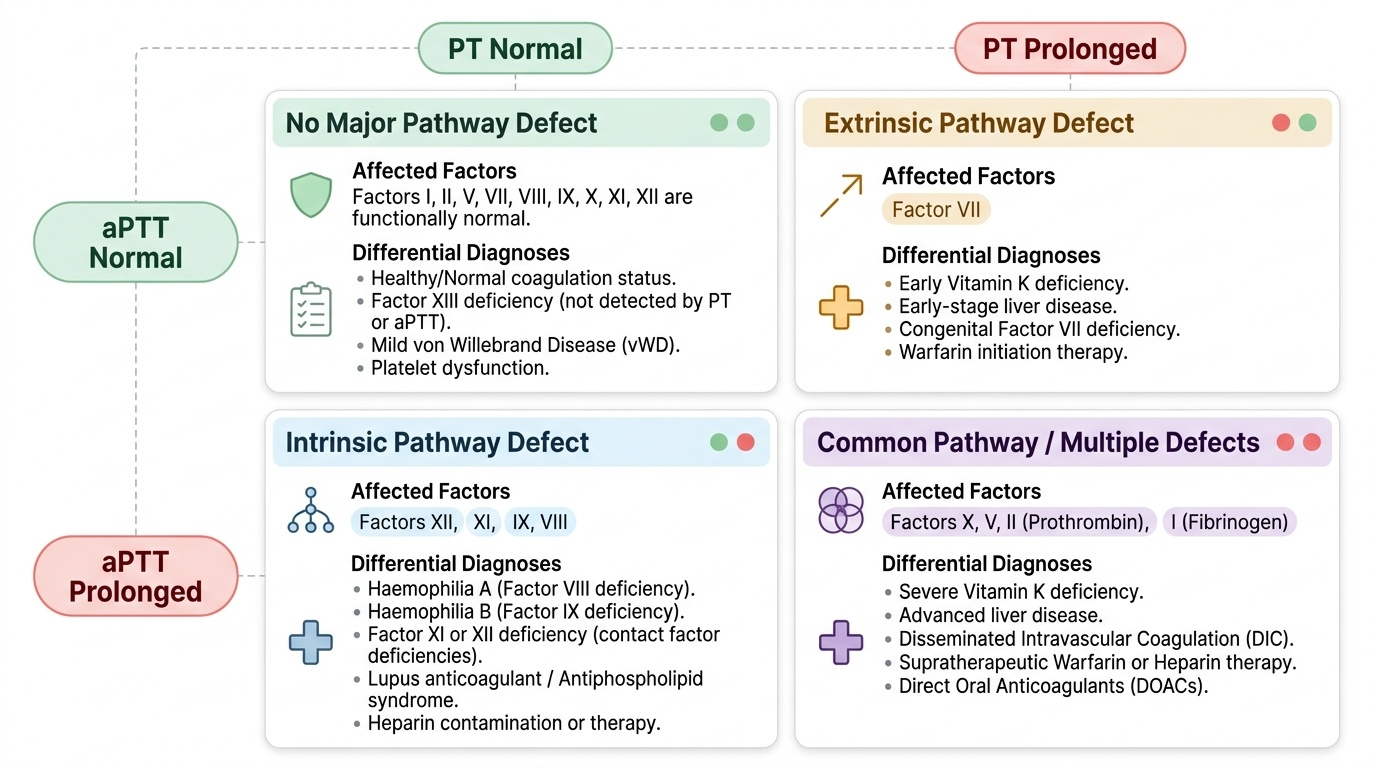
PT vs aPTT Patterns — Pathway Localisation
Provided image
Systematic interpretation of the coagulation screen is an essential clinical skill. The PT and aPTT together localise the defect to a specific pathway:
| PT | aPTT | Pathway affected | Key differential |
|---|---|---|---|
| Normal | Prolonged | Intrinsic only (XII, XI, IX, VIII) | Haemophilia A/B; contact factor deficiency |
| Prolonged | Normal | Extrinsic only (Factor VII) | Early vitamin K deficiency; Factor VII deficiency |
| Both prolonged | Both prolonged | Common pathway (X, V, II, fibrinogen) OR multiple factors | Liver disease; warfarin; DIC; severe vit K deficiency |
| Normal | Normal | Primary haemostasis defect | Platelet disorder, vWD type 1 (mild) |

PT and aPTT Interpretation Decision Table
Factor VII has the shortest half-life (~4–6 hours) of all vitamin K–dependent factors. In early vitamin K deficiency or early warfarin effect, factor VII falls first → isolated prolonged PT. As deficiency deepens, factors IX, X, and II also fall → both PT and aPTT become prolonged.
Remember: Factor VIII is the ONLY coagulation factor that is NOT synthesised by hepatocytes and is NOT vitamin K–dependent. Liver disease therefore lowers all factors except factor VIII (which may actually be elevated as an acute-phase reactant).