Page 12 of 25
PA20.1 | Coagulation Factor Disorders — Haemophilia & vWD — SDL Guide (Part 3)
Acquired Coagulation Factor Deficiencies
⚑ AI image — pending faculty review (auto-QA score 7/10; best of 3 attempts)
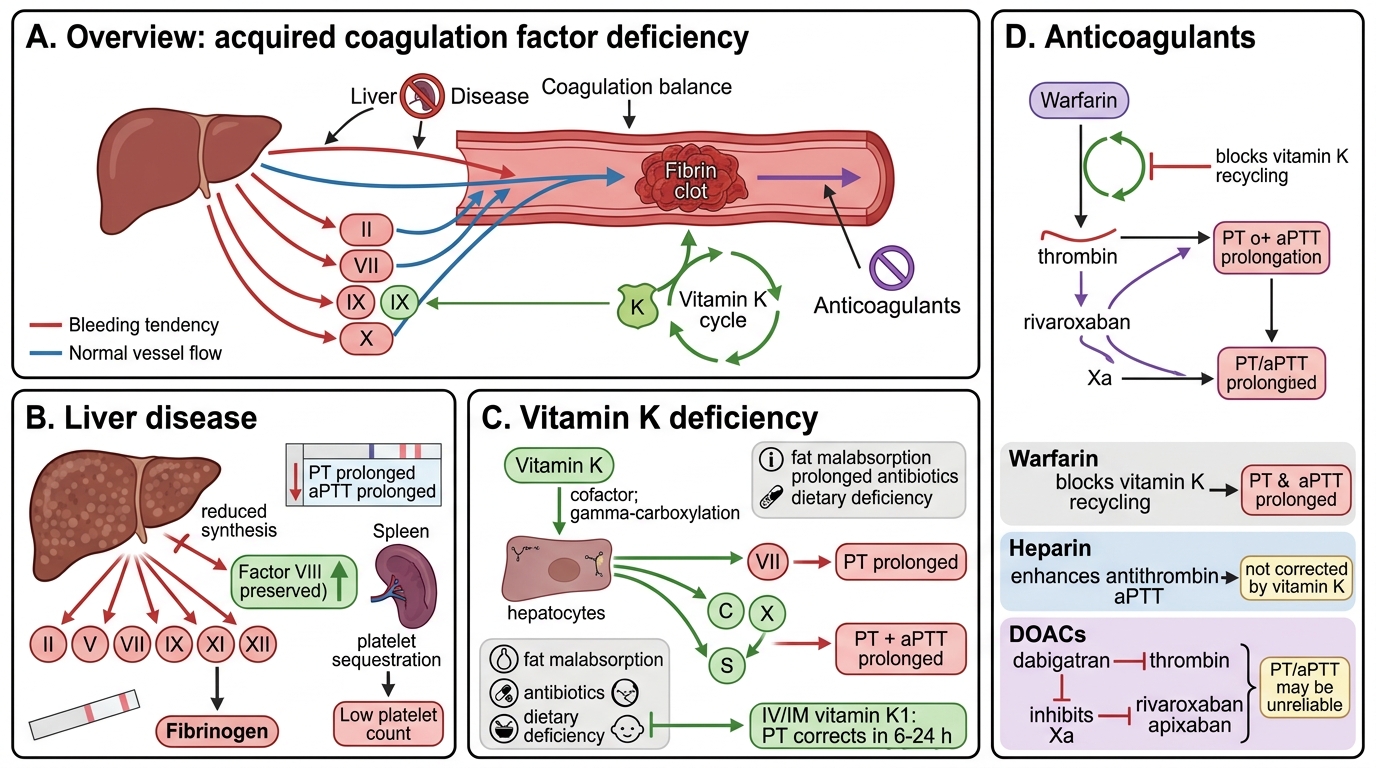
Acquired Coagulation Factor Deficiencies
Acquired deficiencies are far more common in clinical practice than inherited haemophilias.
Liver disease:
The liver synthesises all coagulation factors except factor VIII and von Willebrand factor. In cirrhosis or acute liver failure:
• Factors II, V, VII, IX, X, XI, XII, fibrinogen are all reduced
• Factor VIII is preserved (or elevated)
• Both PT and aPTT are prolonged
• Thrombocytopenia co-exists (splenic sequestration + reduced thrombopoietin)
• Vitamin K–dependent factors (II, VII, IX, X) fall first and furthest
Vitamin K deficiency:
Vitamin K is essential for gamma-carboxylation of factors II, VII, IX, and X (and anticoagulant proteins C and S). Deficiency causes:
• Early: isolated prolonged PT (factor VII falls first)
• Late: both PT and aPTT prolonged
• Causes: dietary deficiency, fat malabsorption (cholestasis, coeliac), prolonged antibiotic use (destroys gut bacteria that synthesise menaquinone), neonatal haemorrhagic disease
• Treatment: parenteral (IV/IM) vitamin K₁ (phytomenadione); corrects PT within 6–24 h
Anticoagulants (therapeutic and accidental):
• Warfarin (vitamin K antagonist) → both PT and aPTT prolonged
• Heparin → aPTT prolonged (PT may also be prolonged at high doses); not corrected by vitamin K
• Direct oral anticoagulants (DOACs) — dabigatran (thrombin inhibitor), rivaroxaban/apixaban (Xa inhibitors) — may not be detected on standard PT/aPTT; require specific assays
CLINICAL PEARL
The liver vs. vitamin K trap: Both liver disease and vitamin K deficiency reduce factors II, VII, IX, and X. The key differentiating laboratory test is factor V level: factor V requires no vitamin K for synthesis (it is not gamma-carboxylated). In liver disease, factor V is LOW (hepatocytes cannot produce it). In vitamin K deficiency, factor V is NORMAL. This single test distinguishes the two in a critically ill jaundiced patient.
Haemarthrosis and Haemophilic Arthropathy

Haemarthrosis to Haemophilic Arthropathy
Haemarthrosis is the most characteristic complication of severe haemophilia and the leading cause of disability in affected patients.
Pathogenesis of joint damage:
1. Repeated bleeding → blood accumulates in the synovial space
2. Synovitis: Iron (haemosiderin) deposits in the synovium → chronic inflammatory synovitis; synovial proliferation (pannus)
3. Cartilage destruction: Proteases released by activated macrophages and synovial cells degrade articular cartilage
4. Subchondral bone erosion → loss of joint space → ankylosis
5. End-stage: fixed, deformed joint — haemophilic arthropathy
Target joints in haemophilia: knees, elbows, ankles (weight-bearing + highly mobile joints subjected to repeated minor trauma).

Haemophilic Arthropathy: Progressive Joint Destruction in Three Stages
Prophylactic factor replacement (primary prophylaxis starting before the first joint bleed, at age 1–2 years) is the current standard of care for severe haemophilia — it prevents arthropathy entirely if started early. This is a major advance over on-demand treatment, which waits until bleeds occur.
SELF-CHECK
In a patient with severe liver cirrhosis and a coagulopathy, which of the following coagulation factor levels would most likely be NORMAL or even ELEVATED?
A. Factor II (prothrombin)
B. Factor V
C. Factor VII
D. Factor VIII
Reveal Answer
Answer: D. Factor VIII
Factor VIII is the only major procoagulant factor NOT synthesised by hepatocytes — it is produced primarily by vascular endothelial cells (Weibel-Palade bodies) and can act as an acute-phase reactant, remaining normal or elevated in liver disease. All other listed factors (II, V, VII) are hepatically synthesised and fall in liver failure. This is also the key to distinguishing liver disease (low factor V) from vitamin K deficiency (normal factor V).
SELF-CHECK
A patient's mixing study shows that the prolonged aPTT corrects immediately on 1:1 mixing with normal plasma but fails to correct after 2 hours of incubation at 37°C. What is the most likely explanation?
A. Time-dependent (warm-reacting) factor VIII inhibitor
B. Lupus anticoagulant
C. Factor XII deficiency
D. Severe factor IX deficiency
Reveal Answer
Answer: A. Time-dependent (warm-reacting) factor VIII inhibitor
Immediate correction followed by prolongation after warm incubation is the hallmark of a time-dependent (warm-reacting) inhibitor, most classically the acquired IgG factor VIII inhibitor seen in acquired haemophilia A. Lupus anticoagulant does not correct even on immediate mixing. Factor deficiencies (XII, IX) correct immediately and remain corrected after incubation.
Laboratory Summary — Distinguishing Factor Disorders at a Glance

Laboratory Patterns in Factor and vWF Disorders
| Disorder | PT | aPTT | Platelets | BT/PFA | Key specific test |
|---|---|---|---|---|---|
| Haemophilia A | N | ↑ | N | N | Factor VIII assay ↓ |
| Haemophilia B | N | ↑ | N | N | Factor IX assay ↓ |
| vWD Type 1 | N | N / ↑ | N | ↑ | Ristocetin cofactor ↓; vWF antigen ↓ |
| vWD Type 3 | N | ↑ | N | ↑ | vWF antigen markedly ↓; Factor VIII also ↓ |
| Liver disease | ↑ | ↑ | ↓ | Variable | Factor V ↓; Factor VIII N/↑ |
| Vitamin K def. (early) | ↑ | N | N | N | Factor VII ↓; Factor V N |
| Vitamin K def. (late) | ↑ | ↑ | N | N | Factors II, VII, IX, X ↓ |
| Haemophilia A + inhibitor | N | ↑ (no correction) | N | N | Mixing study: no correction |
N = Normal; ↑ = prolonged/elevated; ↓ = reduced
This table is the key discriminator for long-case presentations and USMLE-style single-best-answer questions. Commit the PT/aPTT column to memory — then the specific test column follows logically from pathway anatomy.