Page 2 of 25
PA14.1 | Iron Metabolism: Absorption, Transport, Storage, Regulation — SDL Guide (Part 2)
Storage: Ferritin, Hemosiderin, and the Body's Iron Reserve
Iron storage protects the body from two threats simultaneously: iron deficiency (stores buffer daily supply fluctuations) and iron toxicity (free Fe²⁺ generates hydroxyl radicals via Fenton chemistry → oxidative cell damage). The storage system is designed to keep free iron at near-zero.
Ferritin:
- Structure: 24 protein subunits (L-chains for storage, H-chains with ferroxidase activity) form a hollow shell that can accommodate up to 4,500 Fe³⁺ atoms per molecule
- Location: cytoplasm of hepatocytes (largest total store), splenic and bone marrow macrophages (reticuloendothelial store — mobilised fastest), intestinal enterocytes (small operational buffer)
- A small amount of ferritin leaks into plasma — this serum ferritin is the standard laboratory marker
- 1 ng/mL serum ferritin ≈ 8 mg total body iron stores (approximate rule — useful for rough estimation)
Hemosiderin:
- Formed when ferritin is overwhelmed (iron overload states) or by lysosomal digestion of ferritin aggregates
- Insoluble, golden-brown granules visible on standard H&E
- Confirmed by Perls' Prussian Blue stain (iron + potassium ferrocyanide → bright blue granules) — essential skill for reading bone marrow biopsy and sputum in pulmonary haemosiderosis
- Less readily mobilised than ferritin iron (important in transfusion-dependent thalassaemia where hemosiderin accumulates in liver, heart, endocrine glands → organ dysfunction)
The iron stores buffer — why ferritin falls first in deficiency:
When iron intake is inadequate or losses exceed intake, the body draws first from storage ferritin (Stage 1 depletion — see next block). Serum ferritin begins to fall before serum iron or haemoglobin changes. This is why a low ferritin is the earliest and most sensitive marker of iron deficiency — even before anaemia develops.
Regulation: Hepcidin — The Master Switch
The question of how the body knows how much iron to absorb and how much to release from stores is answered by a single 25-amino-acid peptide hormone: hepcidin, produced by hepatocytes.
Mechanism of action:
Hepcidin binds ferroportin on enterocytes, macrophages, and hepatocytes → ferroportin is internalised and degraded → iron export from these cells is blocked.
- ↑ Hepcidin → ferroportin destroyed → iron trapped in enterocytes (shed without absorption) + iron trapped in macrophages (cannot be recycled) → less iron in plasma → less available for erythropoiesis
- ↓ Hepcidin → ferroportin expressed → iron freely exits enterocytes and macrophages → more iron in plasma
What regulates hepcidin?
| Signal | Hepcidin direction | Physiological result |
|---|---|---|
| ↑ Body iron stores | ↑ Hepcidin | Block absorption — prevent overload |
| ↓ Body iron stores | ↓ Hepcidin | Open gates — absorb more |
| ↑ Erythropoietic drive (EPO, blood loss, haemolysis) | ↓ Hepcidin | Liberate iron for RBC production |
| Inflammation (IL-6) | ↑ Hepcidin | Lock iron in macrophages — pathogen defence (also the mechanism of anaemia of chronic disease) |
| Hypoxia | ↓ Hepcidin | Increase iron availability for erythropoiesis |
Erythroferrone (ErFe) — a brief mention:
Erythroblasts, when stimulated by EPO (e.g., after haemorrhage), secrete erythroferrone, which suppresses hepcidin production. This is the mechanism by which increased erythropoietic demand rapidly liberates stored iron. This pathway is pathologically overactive in β-thalassaemia major — the massive erythropoietic drive suppresses hepcidin → excessive iron absorption → iron overload even without transfusion.
The inflammation-hepcidin connection — bridge to ACD:
In rheumatoid arthritis, tuberculosis, malignancy, chronic kidney disease — any chronic inflammatory state — IL-6 (the key driver) stimulates hepatic hepcidin production via the JAK-STAT3 pathway. High hepcidin → ferroportin degraded → iron sequestered in macrophages → iron unavailable for erythropoiesis → anaemia despite adequate or even excess total body iron. This is anaemia of chronic disease (ACD). The serum iron is low (because it cannot be exported from macrophages), but — critically — ferritin is high (iron trapped in storage). This is the polar opposite of IDA, and understanding this distinction is what makes microcytic anaemia diagnosis logical rather than memorised.
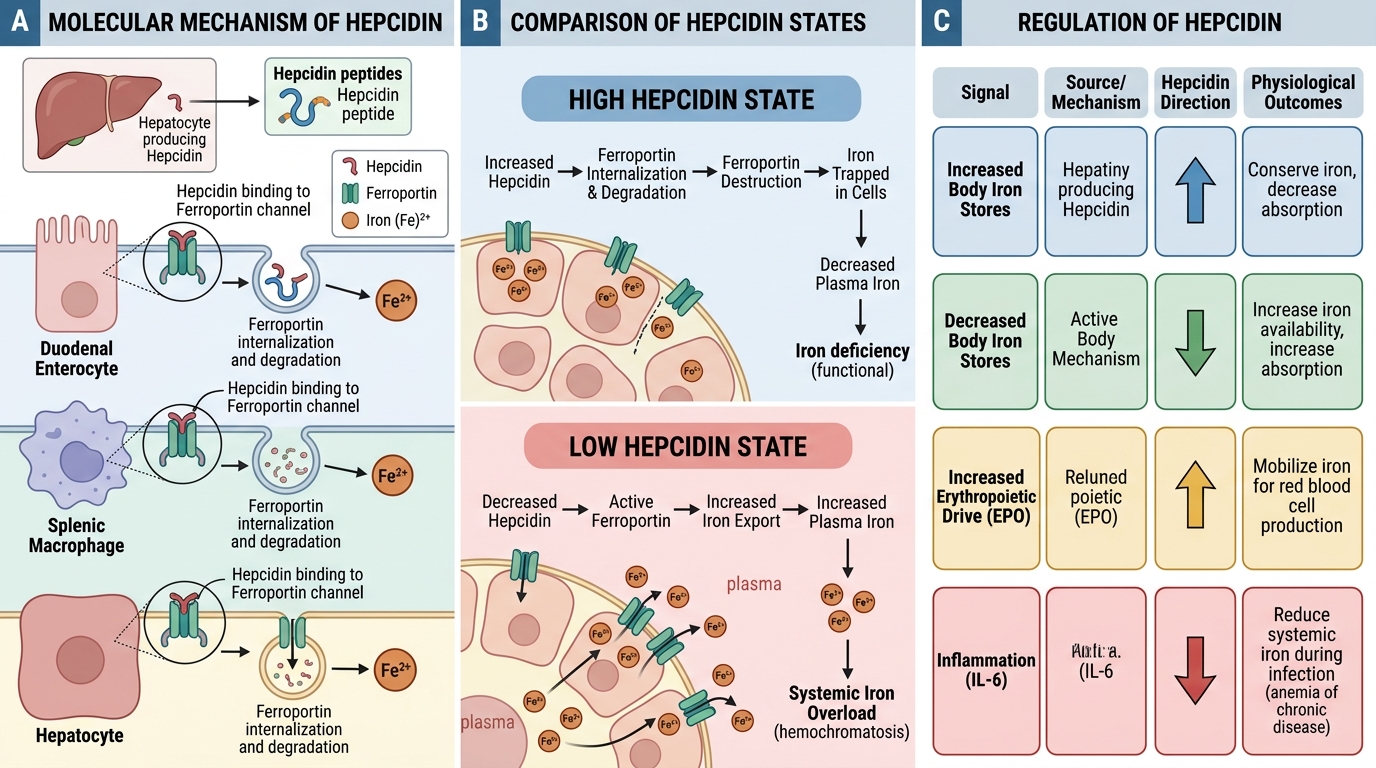
Hepcidin: The Master Regulator of Iron Homeostasis
SELF-CHECK
A 45-year-old woman with rheumatoid arthritis on methotrexate has: Hb 9.8 g/dL, MCV 74 fL, serum iron 45 µg/dL (low), TIBC 260 µg/dL (low-normal), transferrin saturation 17% (low), serum ferritin 280 ng/mL (elevated). What is the most likely mechanism of her anaemia?
A. A. Dietary iron deficiency causing depletion of the storage pool
B. B. IL-6-driven hepcidin excess sequestering iron in macrophages despite adequate body iron stores
C. C. Methotrexate inhibiting folate metabolism, impairing RBC maturation
D. D. Haemolysis of RBCs by autoantibodies triggered by methotrexate
Reveal Answer
Answer: B. B. IL-6-driven hepcidin excess sequestering iron in macrophages despite adequate body iron stores
This is classic anaemia of chronic disease (ACD). The key clues are: (1) low serum iron (iron cannot exit macrophages due to hepcidin-mediated ferroportin degradation), (2) low-to-normal TIBC — unlike true IDA where TIBC rises, in ACD transferrin synthesis is also suppressed by inflammation, (3) HIGH ferritin — the iron is trapped in macrophages, inflating ferritin levels — this is the discriminating feature from IDA where ferritin is low. Chronic inflammation from RA drives IL-6 → hepatic hepcidin production ↑ → ferroportin degraded on macrophages and enterocytes → iron sequestration. Option C (folate) would cause macrocytic, not microcytic anaemia. Option D (haemolysis) would typically produce normocytic or macrocytic anaemia with elevated reticulocytes and LDH.
Stages of Iron Depletion: Why Ferritin Falls First
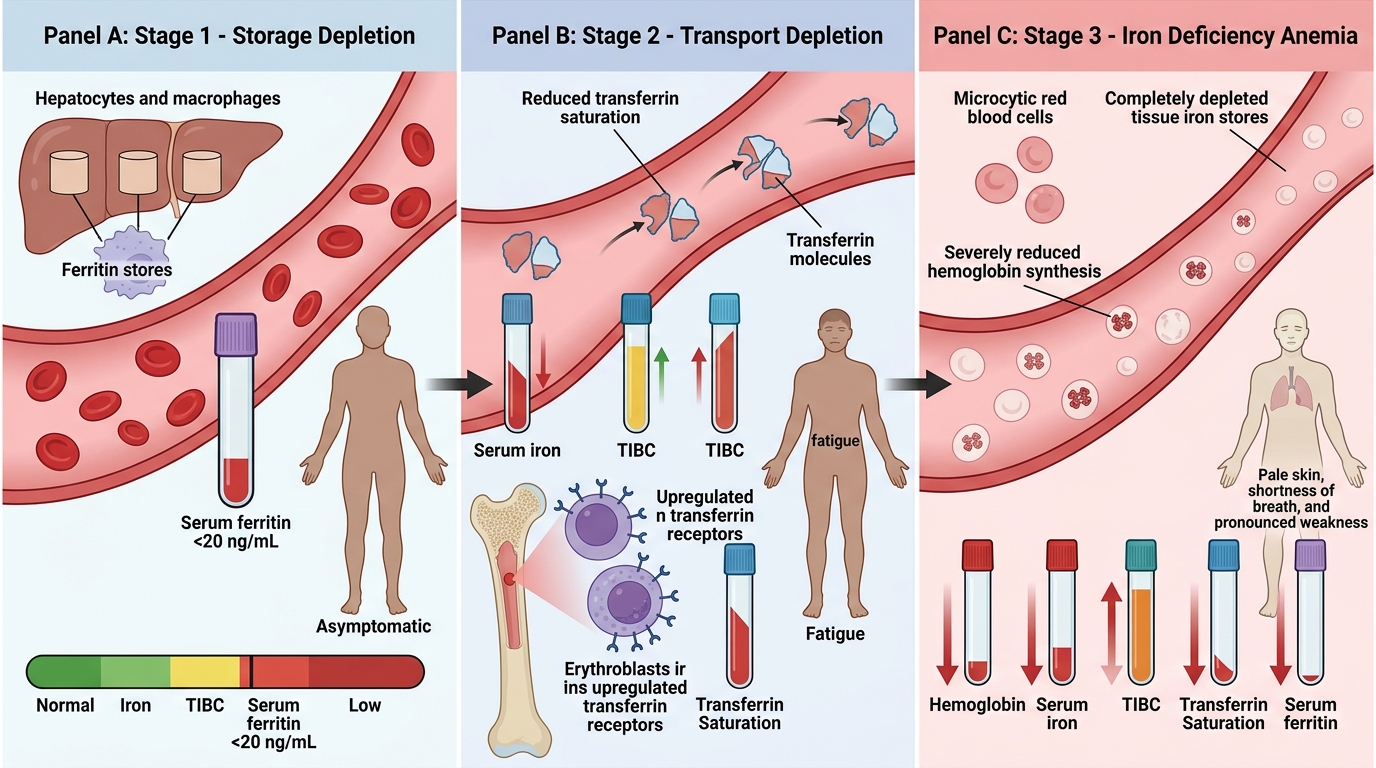
Sequential Stages of Iron Depletion: From Storage to Anemia
Iron deficiency is not a binary event. It progresses through three sequential stages, each reflecting a different level of depletion:
Stage 1 — Storage Depletion (Pre-latent iron deficiency)
- What's depleted: Storage ferritin in hepatocytes and macrophages
- Laboratory findings: ↓ Serum ferritin (<20 ng/mL) | Normal serum iron | Normal TIBC | Normal Hb | Normal MCV
- Clinical findings: None (asymptomatic) — but this is the most treatable stage
- Why detected: Serum ferritin falls before transport iron is affected because the body first draws on storage reserves before compromising the transport pool
Stage 2 — Transport Depletion (Iron-deficient erythropoiesis / latent iron deficiency)
- What's depleted: Transport iron (transferrin saturation falls as plasma iron drops)
- Laboratory findings: ↓↓ Serum ferritin | ↓ Serum iron | ↑ TIBC | ↓ Transferrin saturation (<15%) | Normal Hb | Normal or low-normal MCV | ↑ Soluble transferrin receptor (sTfR) | ↑ Free erythrocyte protoporphyrin (FEP)
- Why sTfR rises: Erythroblasts, starved of iron, upregulate TfR1 expression to try to capture more transferrin — a fragment of TfR1 is cleaved into plasma as sTfR. Unlike ferritin, sTfR is NOT an acute-phase reactant — useful in distinguishing IDA from ACD in inflamed patients
Stage 3 — Iron Deficiency Anaemia (IDA)
- What's depleted: All three pools — storage exhausted, transport iron inadequate, haemoglobin synthesis impaired
- Laboratory findings: ↓↓↓ Serum ferritin | ↓↓ Serum iron | ↑↑ TIBC | ↓↓ Transferrin saturation (<10%) | ↓ Hb | ↓ MCV (<80 fL) | ↓ MCHC | Microcytic hypochromic RBCs on smear
- Clinical findings: Pallor, fatigue, breathlessness, palpitations (functional), and specific features of iron deficiency: koilonychia (spooning of nails), glossitis, angular cheilitis, dysphagia (Plummer-Vinson syndrome in severe cases)
Comparison table — Iron studies in key conditions:
| Parameter | Normal | Stage 1 IDA | Stage 3 IDA | ACD | Iron Overload |
|---|---|---|---|---|---|
| Serum Iron | 60–170 | Normal | ↓↓ | ↓ | ↑ |
| TIBC | 240–450 | Normal/↑ | ↑↑ | ↓ or N | ↓ |
| Transferrin Sat. | 20–50% | Normal | <10% | <20% | >70% |
| Serum Ferritin | 20–200 | ↓ | ↓↓↓ | ↑ | ↑↑↑ |
| MCV | 80–100 | Normal | ↓ | N or ↓ | Normal |
This table is your clinical compass for the rest of the microcytic anaemia cluster.
SELF-CHECK
A 32-year-old man with chronic kidney disease on haemodialysis has: Hb 8.4 g/dL, MCV 71 fL, serum iron 38 µg/dL, TIBC 260 µg/dL, transferrin saturation 14%, serum ferritin 680 ng/mL. Which iron parameter most reliably indicates true iron deficiency in this patient?
A. A. Serum ferritin — because it reflects storage iron independently of inflammation
B. B. Serum iron — because it measures the immediately available transport fraction
C. C. Transferrin saturation — the functional indicator of iron delivery to erythroblasts
D. D. TIBC — because it is not an acute-phase reactant and reflects true transferrin synthesis
Reveal Answer
Answer: C. C. Transferrin saturation — the functional indicator of iron delivery to erythroblasts
In a patient with chronic kidney disease (a chronic inflammatory state), serum ferritin is an unreliable marker because it is an acute-phase reactant — it is elevated here (680 ng/mL) due to inflammation, potentially masking true iron deficiency. Option A is therefore wrong. Serum iron is diurnal, meal-dependent, and also falls in ACD (not specific). Option D — TIBC — does fall in inflammation (ACD) and is low-to-normal here (260 µg/dL) but is also non-specific. Transferrin saturation (<20%, here 14%) represents the fraction of transferrin actually loaded with iron at the time of collection — it directly reflects iron delivery to erythroblasts and is considered the best functional indicator of iron availability for erythropoiesis in dialysis patients. Current guidelines use transferrin saturation <20% + ferritin <500 ng/mL as criteria for functional iron deficiency in CKD. Soluble transferrin receptor (sTfR) or sTfR:log ferritin ratio (Thomas plot) is the gold standard in this scenario — not asked here, but worth knowing.