Page 10 of 21
PA18.2 | Chronic Leukaemias — CML & CLL — SDL Guide (Part 2)
CML Treatment Principle: Imatinib and TKIs
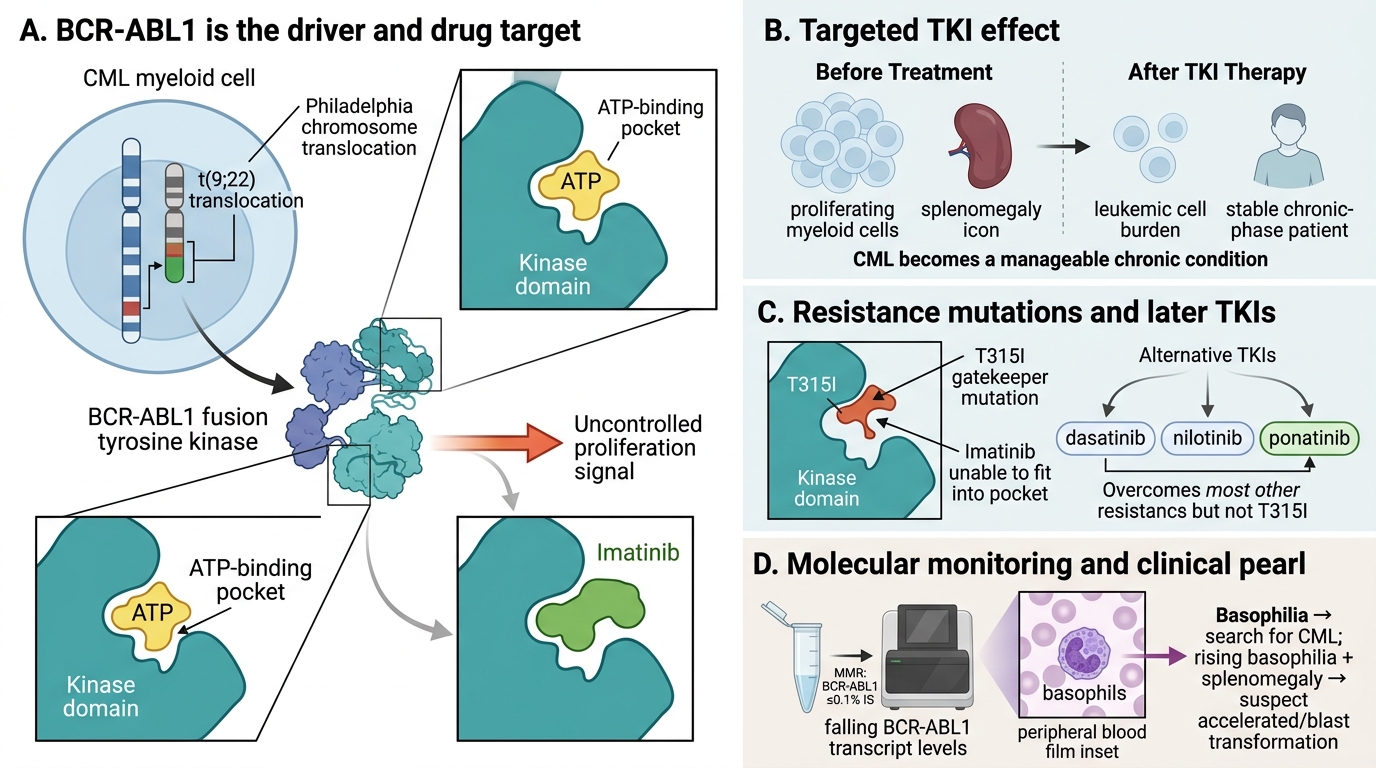
CML Targeted Therapy: Imatinib and TKIs
The BCR-ABL1 tyrosine kinase is both the driver and the drug target. Imatinib (Gleevec/Glivec) is a small-molecule tyrosine kinase inhibitor (TKI) that competes with ATP at the BCR-ABL1 kinase domain, blocking phosphorylation and switching off the oncogenic signal.
Imatinib transformed CML from a fatal disease to a manageable chronic condition — 10-year survival exceeds 80% in the chronic phase. It is the prototype of targeted molecular therapy.
Resistance develops via point mutations in the kinase domain (most commonly T315I — the 'gatekeeper mutation', resistant to imatinib). Second- and third-generation TKIs (dasatinib, nilotinib, ponatinib) overcome most resistance mutations.
Key monitoring: molecular response is tracked by quantitative PCR for BCR-ABL1 transcript levels. A 'major molecular response' (MMR) means BCR-ABL1 ≤0.1% on the international scale.
CLINICAL PEARL
Basophilia in a blood film should always trigger a search for CML. Basophils release histamine; very high basophil counts in blast crisis can cause pruritus and peptic ulceration from histamine-driven gastric acid hypersecretion. If a patient with known CML develops sudden worsening of splenomegaly and rising basophilia, suspect accelerated/blast transformation — not just inadequate treatment.
CLL: Pathogenesis and Molecular Biology

CLL Pathogenesis and Molecular Biology
Chronic lymphocytic leukaemia (CLL) is the commonest leukaemia in the Western elderly population (median age at diagnosis: ~70 years). It is uncommon in Asia and rare in India, but important for exam purposes and for understanding lymphoproliferative disorders globally.
CLL is a clonal proliferation of mature, functionally incompetent B lymphocytes that co-express CD5 (a T-cell marker) and CD23, along with B-cell markers CD19, CD20. This aberrant CD5/CD19 co-expression is the diagnostic flow-cytometry signature.
The cell of origin is a naïve B lymphocyte (pre-germinal centre) that has escaped normal apoptosis. Key molecular drivers include:
• Mutations in TP53, ATM, NOTCH1, SF3B1
• Deletion 13q (most common, favourable prognosis)
• Deletion 17p (TP53) — worst prognosis, resistant to standard chemotherapy
• Trisomy 12 — intermediate prognosis
Pathogenesis summary: defective apoptosis → accumulation of long-lived, non-functional mature B cells → progressive lymphocyte accumulation in blood, marrow, lymph nodes, and spleen.
CLL: Clinical Features and Complications

Clinical Features and Complications of CLL
CLL is often incidentally discovered on a routine CBC showing lymphocytosis. Many patients are asymptomatic at diagnosis.
Progressive disease causes:
• Lymphadenopathy — generalised, non-tender, rubbery
• Hepatosplenomegaly (splenomegaly less dramatic than CML)
• Constitutional symptoms — fatigue, weight loss, night sweats
• Immune dysfunction — the accumulated B cells are non-functional
- Hypogammaglobulinaemia: CLL B cells do not produce adequate normal immunoglobulins → recurrent bacterial infections (especially Streptococcus pneumoniae, Haemophilus influenzae)
- Autoimmune haemolytic anaemia (AIHA): warm IgG autoantibodies coat red cells → positive direct Coombs test → extravascular haemolysis
- Immune thrombocytopenia (ITP) may also occur
Blood film hallmarks of CLL:
• Absolute mature lymphocytosis (lymphocytes >5 × 10⁹/L, often >30 × 10⁹/L)
• Lymphocytes look normal (mature, small, round, dark nucleus, scant cytoplasm)
• Smudge cells (also called smear cells or Gumprecht shadows) — lymphocytes crushed during film preparation due to their fragile cytoskeleton. Their presence is pathognomonic of CLL.

CLL Peripheral Blood Smear: Lymphocytes and Smudge Cells
SELF-CHECK
Which of the following blood film findings is MOST characteristic of CLL, distinguishing it from a reactive lymphocytosis?
A. Lymphocytes with prominent nucleoli and basophilic cytoplasm
B. Crushed lymphocyte remnants (smudge cells) on the film
C. Large granular lymphocytes with azurophilic granules
D. Blast cells with Auer rods
Reveal Answer
Answer: B. Crushed lymphocyte remnants (smudge cells) on the film
Smudge cells (Gumprecht shadows) are the pathognomonic finding in CLL — they result from the mechanical fragility of the neoplastic B lymphocytes during smear preparation. Reactive lymphocytes are larger with irregular nuclei and basophilic cytoplasm but do not form smudge cells. Large granular lymphocytes suggest T-LGL leukaemia or NK-cell disorders. Auer rods are found in AML, not CLL.