Page 11 of 21
PA18.2 | Chronic Leukaemias — CML & CLL — SDL Guide (Part 3)
CLL: Rai and Binet Staging, and Richter Transformation
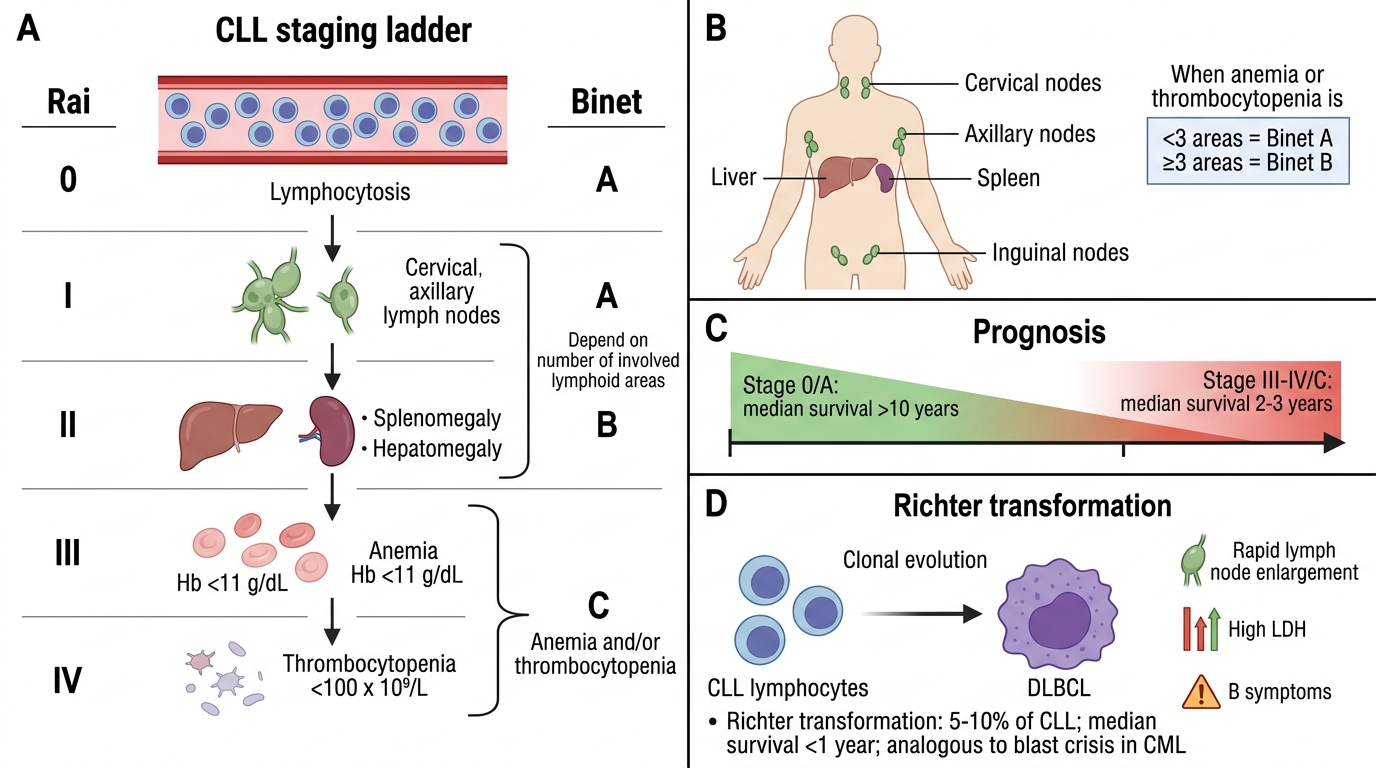
CLL Staging and Richter Transformation
Rai Staging (USA):
• Stage 0: Lymphocytosis only
• Stage I: + Lymphadenopathy
• Stage II: + Splenomegaly/hepatomegaly
• Stage III: + Anaemia (Hb <11 g/dL)
• Stage IV: + Thrombocytopenia (platelets <100 × 10⁹/L)
Binet Staging (Europe — simpler for MCQs):
• Stage A: <3 lymphoid areas involved, no anaemia/thrombocytopenia
• Stage B: ≥3 lymphoid areas involved, no anaemia/thrombocytopenia
• Stage C: Anaemia and/or thrombocytopenia (regardless of lymphoid areas)
Prognosis correlates with stage: Stage 0/A → median survival >10 years; Stage III-IV/C → 2-3 years.
Richter transformation: In ~5-10% of CLL cases, the clone transforms into an aggressive large B-cell lymphoma (diffuse large B-cell lymphoma — DLBCL). This presents as sudden rapid enlargement of a lymph node, markedly elevated LDH, and constitutional symptoms. Prognosis after Richter transformation is very poor (median survival <1 year). It represents clonal evolution — similar in concept to blast crisis in CML.
CML vs CLL: A Direct Comparison

CML vs CLL: Direct Comparison
| Feature | CML | CLL |
|---|---|---|
| Cell of origin | Myeloid stem cell | Mature B lymphocyte |
| Age | Middle-aged (40-60 yr) | Elderly (>60 yr) |
| Key mutation | BCR-ABL1 / t(9;22) | del13q, del17p, TP53, etc. |
| Blood film | Full myeloid spectrum + basophilia | Mature lymphocytosis + smudge cells |
| LAP score | Low | Normal |
| Splenomegaly | Massive | Moderate |
| Immune dysfunction | Rare | Common (hypogammaglobulinaemia, AIHA) |
| Key complication | Blast crisis (→ AML/ALL) | Richter transformation (→ DLBCL) |
| Targeted therapy | Imatinib (TKI) | Ibrutinib (BTK inhibitor), venetoclax |
For the exam: CML = myeloid + low LAP + BCR-ABL1 + massive spleen. CLL = mature lymphocytes + smudge cells + immune dysfunction + elderly.
Other Chronic Myeloproliferative Neoplasms and JAK2 V617F

JAK2 V617F in Non-CML Chronic Myeloproliferative Neoplasms
Beyond CML, three other chronic myeloproliferative neoplasms (CMPNs) share the theme of clonal myeloid proliferation but affect different lineages:
Polycythaemia vera (PV): Clonal erythroid (RBC) proliferation. Presents with hyperviscosity symptoms (headache, plethora, thrombosis, pruritus after hot bath). Raised Hb, raised haematocrit, raised RBC mass.
Essential thrombocythaemia (ET): Clonal megakaryocyte/platelet proliferation. Presents with thrombosis and paradoxically also bleeding (platelet dysfunction). Very high platelet count.
Primary myelofibrosis (PMF): Clonal proliferation with reactive fibrosis of the marrow. Presents with massive splenomegaly (extramedullary haematopoiesis), leucoerythroblastic blood picture (nucleated RBCs + immature granulocytes), and teardrop-shaped red cells (dacrocytes).
The unifying molecular lesion in PV (>95%), ET (~60%), and PMF (~60%) is the JAK2 V617F point mutation — a gain-of-function mutation in the Janus kinase 2 signalling protein that mimics constitutive cytokine-receptor stimulation. Testing for JAK2 V617F is the first-line molecular test when a CMPN is suspected and BCR-ABL1 is negative.
Key memory hook: CML = BCR-ABL1 (Ph chromosome). All other CMPNs = JAK2 V617F.
SELF-CHECK
A 65-year-old woman has haematocrit 58%, splenomegaly, and pruritus after a warm bath. BCR-ABL1 PCR is negative. Which molecular test should be ordered next?
A. TP53 sequencing
B. JAK2 V617F mutation analysis
C. FISH for t(15;17) PML-RARA
D. del(13q) by FISH
Reveal Answer
Answer: B. JAK2 V617F mutation analysis
The raised haematocrit, splenomegaly, and aquagenic pruritus strongly suggest polycythaemia vera (PV). PV is BCR-ABL1-negative (ruling out CML). The next step is JAK2 V617F mutation testing, positive in >95% of PV cases. PML-RARA is the APL translocation. del(13q) is associated with CLL and myeloma. TP53 sequencing is relevant in CLL with high-risk features or therapy planning.
CLINICAL PEARL
The aquagenic pruritus of PV — itching triggered specifically by warm water or bathing — is caused by histamine release from the increased mast cells and basophils in the skin. It is one of the most specific symptoms in haematology. If a patient says they itch after a shower but not from dry skin, think polycythaemia vera and check the haematocrit.
Putting It Together: A Diagnostic Framework

Diagnostic Framework for Leukocytosis
When you encounter leucocytosis on a blood film, use this stepwise approach:
Step 1 — What type of cells are increased?
• Neutrophils/myeloid series → CML vs Leukaemoid Reaction vs AML
• Mature lymphocytes → CLL vs Reactive lymphocytosis vs Viral infection
Step 2 — Apply the discriminating tests:
• LAP score low → CML (check BCR-ABL1 to confirm)
• LAP score high → Leukaemoid Reaction (find the cause: sepsis, TB, carcinoma)
• Smudge cells + mature lymphocytes + CD5/CD19 co-expression → CLL
Step 3 — Assess phase/stage for prognosis:
• CML: Blast percentage → Chronic / Accelerated / Blast crisis
• CLL: Rai or Binet staging → low-risk / intermediate / high-risk
Step 4 — Targeted therapy:
• CML → BCR-ABL1 TKI (imatinib first-line, monitor by PCR)
• CLL → Watch-and-wait if asymptomatic; BTK inhibitor (ibrutinib) or BCL-2 inhibitor (venetoclax) for symptomatic/high-risk disease