Page 8 of 14
RD3.4 | PC-PNDT Act for Primary Care Practice — SDL Guide (Part 2)
Clinical and Applied Significance — The Primary-Care Physician's Duties and Pitfalls
The applied core of this competency is knowing exactly how the Act shapes your own conduct as a primary-care physician, because the law reaches you both when you refer a woman for imaging and, if you perform ultrasound yourself, as an operator. Most prosecutions arise not from dramatic conspiracies but from ordinary lapses — a disclosure made to placate an anxious family, a Form F left half-filled on a busy day, a clinic operating before its registration was completed. Knowing your duties and the common pitfalls turns abstract legal knowledge into safe daily practice, and lets you handle the inevitable request to reveal foetal sex with both legal correctness and human tact.
Provided image
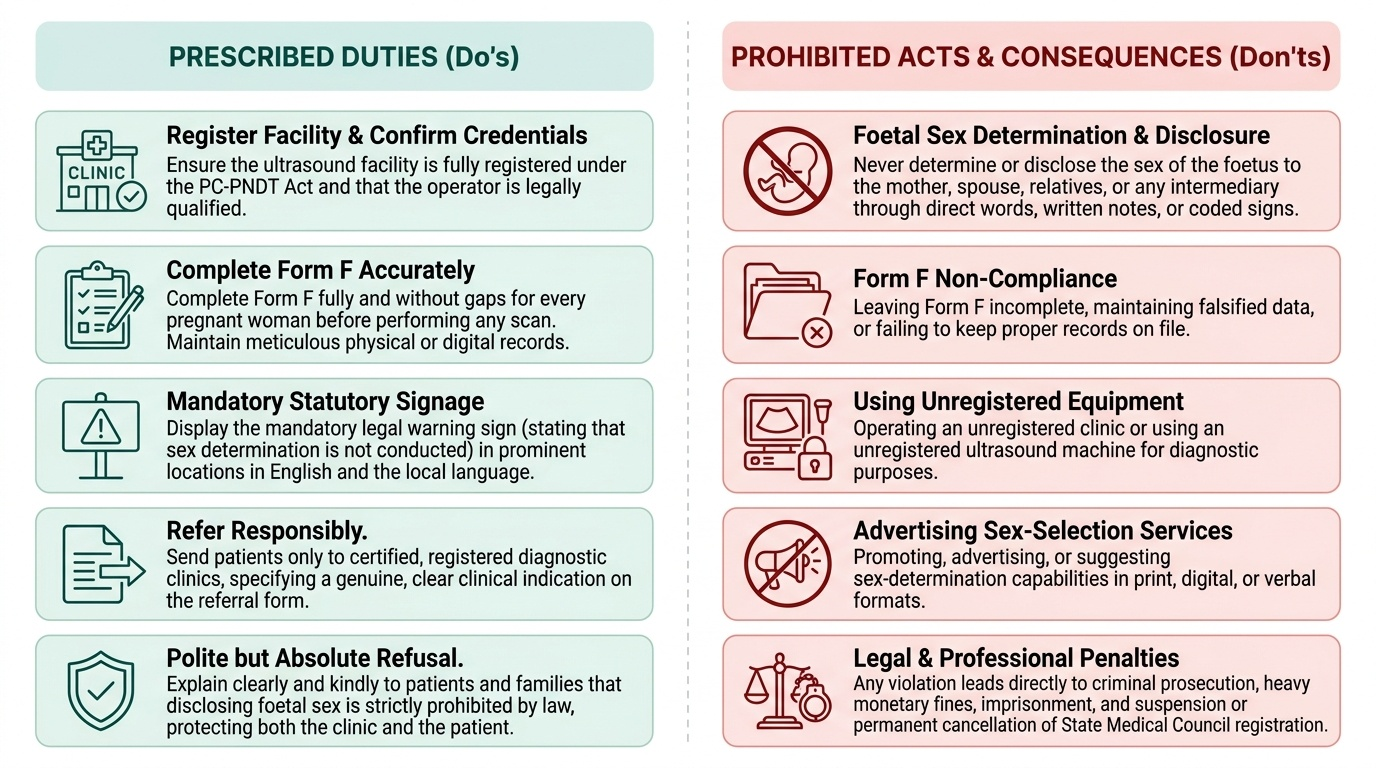
Your duties and the conduct expected of you are:
- If you perform prenatal ultrasound: ensure the facility is registered, that you are qualified to perform it, that Form F is completed accurately for every pregnant woman, and that the statutory signage is displayed. Maintain records meticulously.
- Never determine or disclose foetal sex — to the woman, her husband, her relatives, or anyone — by any direct or indirect means. This holds even when the sex is known incidentally (e.g. from a karyotype) and even when the family insists it is 'only to prepare'.
- Refer responsibly: send women only to registered facilities, and provide a clear, genuine clinical indication for the scan.
- Refuse unlawful requests lawfully and kindly: when asked to reveal foetal sex, explain plainly that the law prohibits it for everyone's protection; do not become complicit, and do not be drawn into coded hints.
- Recognise and avoid the common violations: operating/using an unregistered facility; incomplete or falsified Form F; any disclosure of foetal sex; and advertising sex-determination services. Any of these can lead to imprisonment, fines and loss of medical registration.
The positive framing matters too: by complying fully — referring appropriately, documenting honestly, and refusing disclosure — you continue to deliver the genuine benefits of prenatal diagnosis (detecting treatable or important foetal conditions) while standing firmly against its misuse. That dual stance — protecting the legitimate use while denying the illegitimate one — is precisely the professional judgement RD3.4 asks you to demonstrate.
CLINICAL PEARL
Pearl 1 — Full name and dates: the PC-PNDT Act = Pre-Conception and Pre-Natal Diagnostic Techniques (Prohibition of Sex Selection) Act, enacted 1994 (in force 1996), amended 2003 to add pre-conception techniques. Knowing the full name and the 2003 amendment is high-yield.
Pearl 2 — Permitted vs prohibited is about PURPOSE, not technique: prenatal diagnosis to detect chromosomal/genetic/congenital disease is permitted; using the same scan to determine sex for selection is criminal. The disclosure ban is absolute — it applies even when sex is found incidentally during a legitimate test.
Pearl 3 — Form F is the operational heart: a mandatory record for every pregnant woman undergoing prenatal ultrasound; improperly maintained Form F is one of the commonest grounds for prosecution. Combine with compulsory registration, statutory signage, the Appropriate Authority, and criminal penalties (up to 3 yr + Rs 10,000 first offence; 5 yr + Rs 50,000 thereafter). Note this Act regulates the social misuse of imaging — it is entirely separate from AERB radiation regulation, and applies even though ultrasound is non-ionising.
Self-Assessment — PC-PNDT in Practice
Use these scenarios to test your command of the PC-PNDT Act as it applies to real practice. Answer each before reading the discussion — working through concrete cases is what fixes the permitted-versus-prohibited line and the documentation rules in memory.
Scenario A: A family pressures you, a primary-care doctor, to 'just hint' at the foetal sex after a routine anomaly scan, promising it will stay between you. They argue that since they have no intention of terminating, no harm is done. How do you respond, and why?
Discussion: You must refuse, clearly and kindly. The PC-PNDT Act prohibits determination or disclosure of foetal sex by any means, to anyone, regardless of intent — a 'hint' is a disclosure and is a criminal offence; the family's stated intentions are legally irrelevant and cannot be verified anyway. Explain that the law forbids it to protect girl children across society, that it binds you personally with criminal penalties and loss of registration, and that you cannot make an exception. The legitimate anomaly scan itself is entirely proper; only the sex disclosure is forbidden.
Scenario B: A colleague opens a new ultrasound clinic and begins scanning antenatal patients immediately, intending to 'sort out the paperwork later'. He also keeps only brief notes rather than the full statutory form. What is wrong, in PC-PNDT terms?
Discussion: Two distinct violations. First, an ultrasound facility using prenatal diagnostic techniques must be registered with the Appropriate Authority before it operates — scanning before registration is an offence. Second, Form F must be completed accurately for every pregnant woman; brief notes do not satisfy this, and incomplete or absent Form F is itself a common ground for prosecution. He must register the facility, ensure he is qualified, maintain Form F for every patient, and display the statutory signage. 'Sorting it out later' is not a defence.
Scenario C: In a viva, you are asked: 'What is the full name of the PC-PNDT Act, when was it amended and why, and name two permitted uses of prenatal diagnostic techniques.' Give a model answer.
Discussion: The full name is the Pre-Conception and Pre-Natal Diagnostic Techniques (Prohibition of Sex Selection) Act, 1994; it was amended in 2003 to extend the prohibition to pre-conception sex-selection techniques and to strengthen regulation (hence the addition of 'Pre-Conception' to the title). Two permitted uses of prenatal diagnostic techniques are the detection of chromosomal abnormalities (e.g. Down syndrome) and the detection of genetic/metabolic disorders or congenital structural anomalies — legitimate diagnostic purposes, as opposed to the prohibited purpose of sex determination for selection.