Page 3 of 9
FM12.6 | Recent Advances: DNA, Virtual Autopsy & Lie Detection — SDL Guide
Learning Objectives
- Describe the indications and principles of DNA profiling (STR method) and its forensic applications (FM12.6)
- Explain the principles of facial reconstruction from skeletal remains
- Describe the indications, principles, and techniques of digital autopsy / virtual autopsy including relevant imaging technologies (FM12.6)
- Describe the principles of polygraph, narcoanalysis, and brain mapping, and state their legal status in Indian courts with reference to Selvi v State of Karnataka (2010) (FM12.6)
- Identify the appropriate forensic technology for a given investigative scenario
INSTRUCTIONS
Forensic science has undergone profound technological transformation in the past three decades. Where earlier generations of forensic practitioners relied primarily on gross morphology and conventional chemical analysis, today's practice incorporates molecular identification by DNA profiling, three-dimensional imaging autopsies, and neuroscientific techniques aimed at detecting deception. For the medical student, the critical task is not merely to describe these technologies but to understand their principles, their appropriate indications, and — crucially for Indian practice — their legal status. Some of the most powerful-sounding forensic technologies are, in fact, legally constrained in significant ways. This module covers all six advance technologies specified in FM12.6 with emphasis on both their scientific basis and their medicolegal applicability.
References
- KSN Reddy — Essentials of Forensic Medicine & Toxicology (textbook)
- BV Subrahmanyam — Modi's Medical Jurisprudence and Toxicology (textbook)
Version 2.0 | NMC CBUC 2024
CLINICAL SCENARIO
A body is recovered from a river — skeletonised, unidentifiable by visual means. No documents, no fingerprints, no witnesses. The investigating officer asks the forensic medical officer: can this body be identified? Can we determine if this was a homicide? Simultaneously, the same investigation has a suspect in custody who claims to have no knowledge of the case. The police wish to administer a narcoanalysis test. Three questions define this scenario: which technologies can scientifically identify the remains, which can image cause-of-death findings without dissection, and which deception-detection technique can legally be applied — and under what conditions? The answers to these three questions constitute FM competency 12.6.
WHY THIS MATTERS
As a physician in India, you will encounter advanced forensic technologies as both a practitioner and as a citizen. You may be asked to collect specimens specifically for DNA profiling, or to explain to a court how DNA evidence was obtained. You may work in a jurisdiction where post-mortem imaging is being introduced, and you will need to know when conventional autopsy remains essential alongside virtual techniques. You may be consulted — or asked to give evidence — about whether narcoanalysis or brain mapping results are legally valid. In all three areas, your competence protects both the administration of justice and the rights of individuals who may be subjected to these procedures. The legal constraints on lie-detection technologies are not administrative technicalities — they are constitutional safeguards, and a physician who facilitates coerced narcoanalysis is potentially liable for violating a person's fundamental rights.
RECALL
From earlier sessions and from lab1-specimens in this cluster, recall:
- The biological specimens that yield DNA — blood, semen, saliva, skin cells, hair roots, tooth pulp, nails. DNA is present in nucleated cells; mature red blood cells have no nucleus and are not a DNA source, but white blood cells in blood samples are.
- The distinction between nuclear DNA (unique to each individual except identical twins; inherited from both parents) and mitochondrial DNA (maternally inherited; less variable than nuclear DNA; useful for skeletal/hair-shaft identification when nuclear DNA is degraded).
- The constitutional provision against self-incrimination (Article 20(3) of the Indian Constitution: no person accused of an offence shall be compelled to be a witness against themselves) — the foundational legal basis for restricting lie-detection technologies.
- The role of imaging technologies (CT, MRI, X-ray) from clinical medicine — now applied to post-mortem examination in virtual autopsy.
The Medicolegal Need for Scientific Advances in Forensic Identification
Conventional forensic methods — visual identification, fingerprinting, physical anthropology, chemical toxicology — provide powerful tools in most cases. However, a distinct category of medicolegal scenarios exposes the limits of conventional approaches and drives the adoption of advanced technologies. These scenarios share a common feature: the biological evidence is present, but it cannot be interpreted with adequate certainty using conventional means.
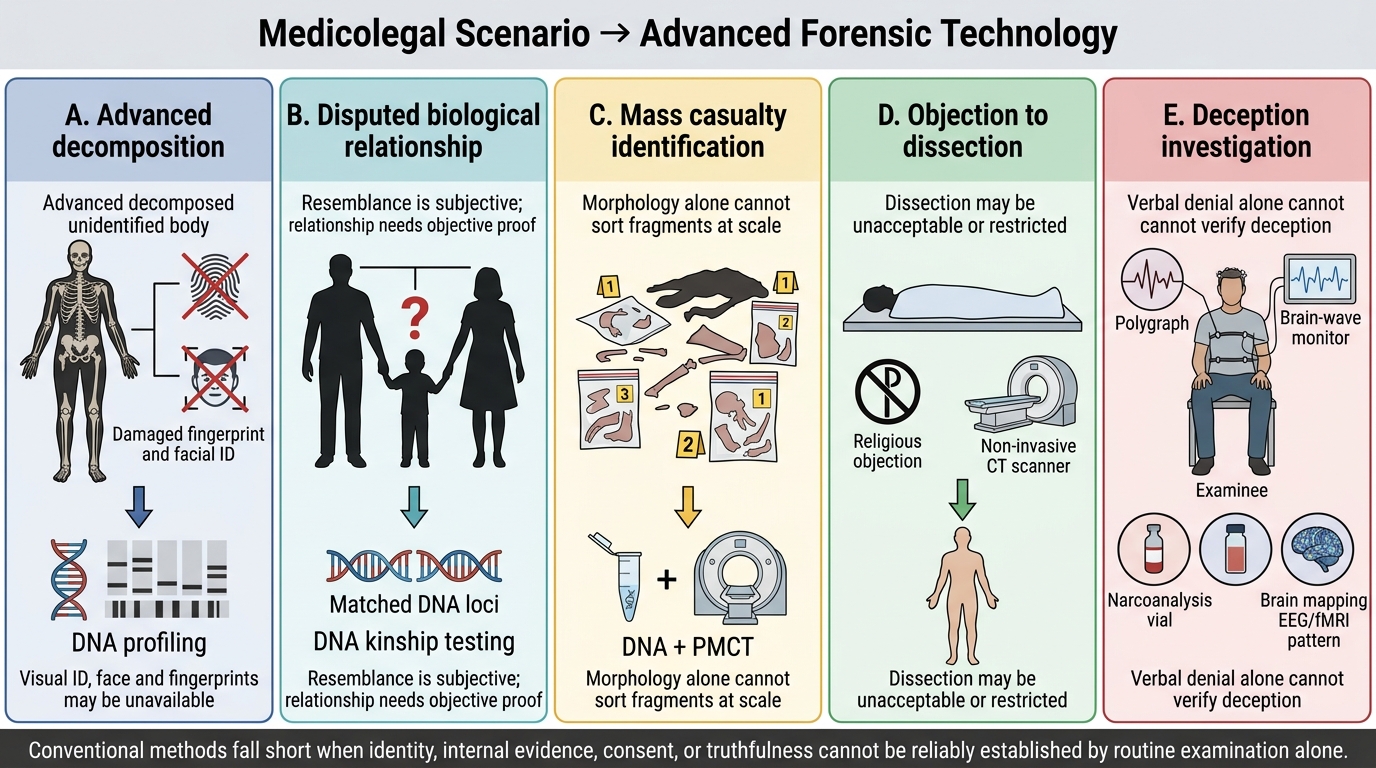
Medicolegal Scenarios and Advanced Forensic Technologies
The most common such scenarios are:
• Advanced decomposition: When a body has been exposed to the elements, submerged in water, or interred for months or years, conventional visual identification is impossible. Fingerprinting requires intact skin; facial recognition requires intact facial tissue. DNA profiling and skeletal morphology become the primary investigative tools.
• Disputed biological relationships: Paternity, maternity, and kinship disputes — including those arising from civil family law, immigration, inheritance, and criminal investigations involving family members — require objective biological proof that cannot be fabricated or denied on the basis of visual resemblance.
• Mass casualty events: Aircraft disasters, explosions, and natural disasters produce fragmentary, commingled remains. Matching fragments to a specific individual requires molecular identification; conventional morphological methods cannot distinguish between similarly injured individuals at scale.
• Internal injuries without surface trauma: A victim who appears externally uninjured but died from intracranial haemorrhage, tension pneumothorax, or blunt abdominal trauma presents a scenario where the conventional autopsy achieves its full diagnostic purpose — but in settings where conventional autopsy is restricted (religious objections, resource constraints), virtual autopsy using cross-sectional imaging may reveal the fatal pathology without requiring dissection.
• Investigating deception: When a suspect denies knowledge of a crime and no other witnesses are available, the investigating agency may seek to use technologies that purport to detect deception through physiological or neurophysiological measurements. The scientific validity and legal status of these technologies is the most contested area in modern forensic practice.
Each of these scenarios corresponds to a distinct technological approach, and each technology has defined indications, scientific limits, and legal constraints within the Indian system.
DNA Profiling and Facial Reconstruction — Scientific Basis
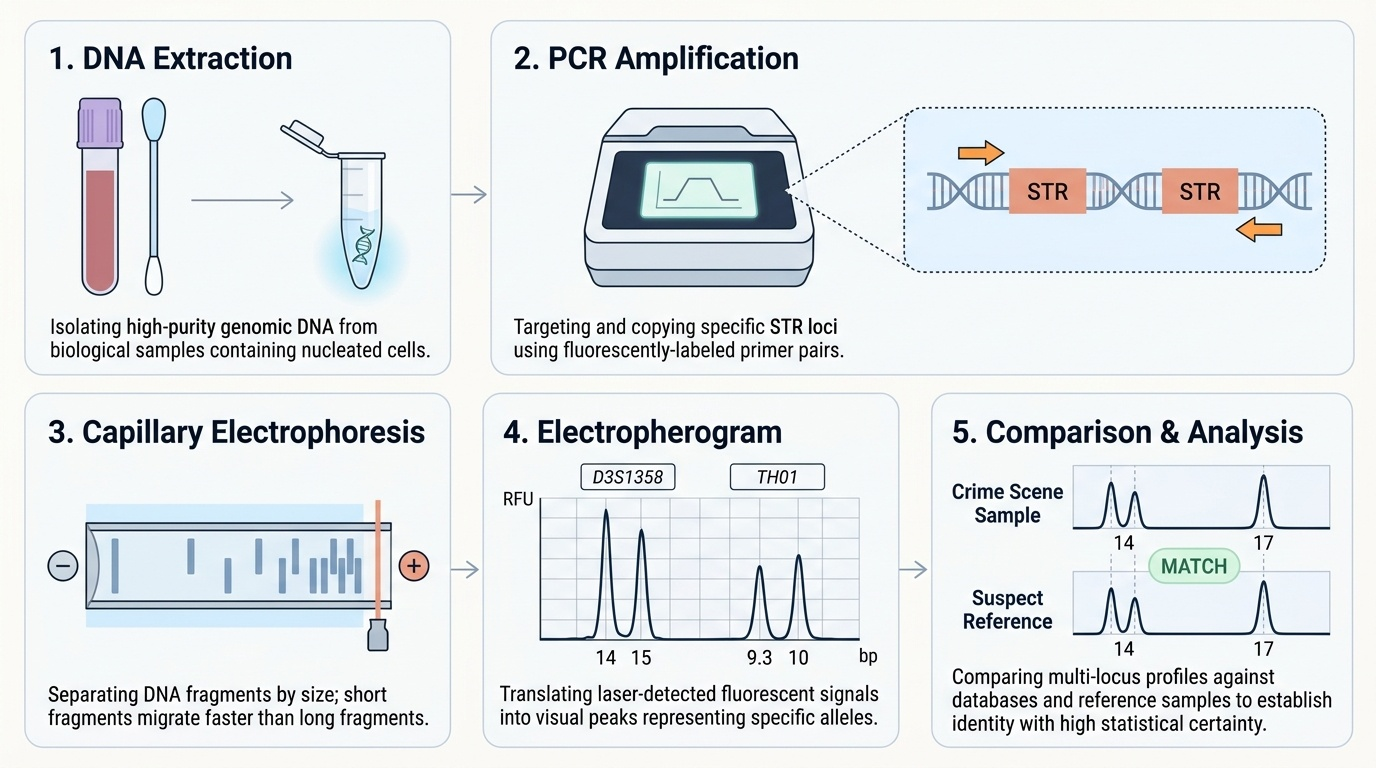
DNA profiling (also called DNA fingerprinting — a term coined by Sir Alec Jeffreys in 1984, though the method he originally used, RFLP, has been largely superseded) is the process of generating a unique molecular profile from an individual's genomic DNA for the purposes of identification or biological relationship determination. The standard modern method is Short Tandem Repeat (STR) profiling, which analyses specific genomic loci where a short nucleotide sequence (typically 2-6 base pairs) is repeated in tandem. The number of repeats at each locus varies between individuals; by typing the allele sizes at 13-20 independent loci simultaneously, a combined profile is generated whose probability of matching an unrelated individual is vanishingly small (typically 1 in several billion or more, depending on the population database).
The STR profiling process follows these steps:
1. DNA extraction from the biological specimen (blood, semen, saliva, hair root, skin cells, tooth pulp — any nucleated cell source). Degraded specimens may yield partial profiles.
2. PCR amplification of the target STR loci using locus-specific primers. PCR can amplify DNA from extremely small or degraded samples — a single nanogram is often sufficient.
3. Capillary electrophoresis separates the amplified fragments by size; each locus generates a peak pattern representing the two alleles (one from each chromosome).
4. Electropherogram analysis compares the peak pattern at each locus between the crime-scene sample and the reference sample (suspect's blood or buccal swab, or reference profiles from a database).
5. Statistical interpretation of the match — the significance of a matching profile is expressed as a likelihood ratio or probability against the relevant population database.
Provided image
Forensic applications of DNA profiling include:
• Individualisation — proving that a biological sample (semen, blood, skin cells) found at a scene came from a specific person
• Exclusion — proving that a biological sample did NOT come from a suspect
• Kinship determination — paternity, maternity, full sibship, partial kinship (relevant in mass disaster victim identification)
• Identification from degraded remains — using tooth pulp or bone marrow, which are among the most DNA-stable tissues
In India, the use of DNA profiling in criminal investigations is governed by the DNA Technology (Use and Application) Regulation Bill, which was passed by the Lok Sabha but had not received full parliamentary enactment as of the knowledge cutoff. The Bill proposes establishing a national DNA database (NDNA) with tiered access, governed by a DNA Regulatory Board, and specifies consent and privacy safeguards. Until the Bill becomes law, DNA profiling is used under general forensic science procedures without a specific legislative framework.
Facial reconstruction is a technique used when skeletal remains must be identified but DNA reference samples for comparison are unavailable. Using the skull as a scaffold, a forensic artist or specialist builds up clay or digital layers of approximated soft tissue based on reference data correlating skull morphology with facial features (tissue depth tables from population studies, muscle attachment points, orbital morphology). The resulting face is a probabilistic reconstruction — it may resemble the individual enough to generate leads for identification, but it cannot be used as definitive proof of identity. Facial reconstruction is an investigative tool, not an identification standard; it generates leads for investigation, not evidence for conviction.
SELF-CHECK
The standard method for DNA profiling in modern forensic casework is:
A. Restriction Fragment Length Polymorphism (RFLP) analysis — the original method introduced by Alec Jeffreys
B. Short Tandem Repeat (STR) profiling — analyses repeat allele sizes at multiple independent loci simultaneously
C. Mitochondrial DNA sequencing — the primary method for fresh samples from identified individuals
D. Y-chromosome typing — the standard method for any forensic identification
Reveal Answer
Answer: B. Short Tandem Repeat (STR) profiling — analyses repeat allele sizes at multiple independent loci simultaneously
STR profiling is the current standard method for forensic DNA analysis. RFLP (option A) was the original method (Jeffreys, 1984) but requires a larger, high-quality DNA sample and has been largely superseded by STR because STR works with smaller and more degraded specimens. Mitochondrial DNA sequencing (option C) is used specifically for degraded specimens or when nuclear DNA is insufficient — it is maternally inherited and less discriminating, so it is not the primary method for fresh identified samples. Y-chromosome typing (option D) is a supplementary tool in sexual assault cases to detect the male contributor, not a general identification standard.
Virtual Autopsy and Imaging Technologies — Principles and Documentation
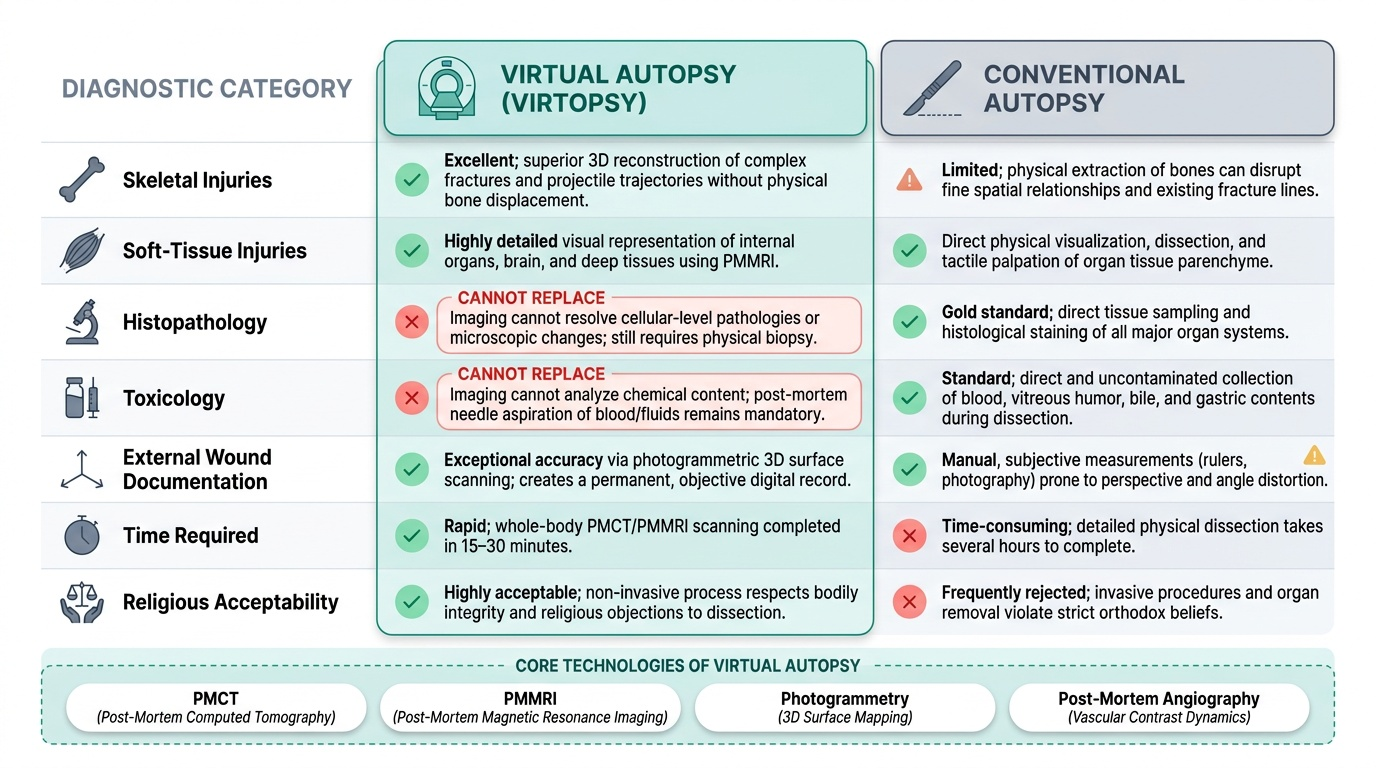
Virtual autopsy (also termed digital autopsy or virtopsy — the latter trademarked by the Bern group led by Michael Thali, who pioneered its systematic development in the early 2000s) is a suite of non-invasive post-mortem examination techniques that use medical imaging to visualise internal structures without conventional dissection.
Provided image
The principles underlying virtual autopsy reflect two convergent insights: first, that cross-sectional imaging technologies developed for clinical medicine can be applied to post-mortem bodies without modification; and second, that the three-dimensional spatial relationships between internal structures — critical for understanding wounding, trauma mechanics, and natural disease — are better preserved and more precisely measurable in a PMCT scan than in a conventional autopsy where structures are physically removed and disrupted during examination.
Indications for virtual autopsy:
• Religious or cultural objections to conventional autopsy — virtual techniques allow examination where families object to dissection; however, histopathological sampling may still require biopsies
• Forensic injury pattern analysis — three-dimensional reconstruction of fractures, projectile trajectories, and blunt-force injury distributions; PMCT provides superior bone detail compared to conventional autopsy
• Post-mortem interval estimation — gas distribution, decomposition pattern, and stomach content displacement are visible on CT
• Scene-to-autopsy documentation continuity — photogrammetric surface scanning at the scene creates a permanent 3D record that can be revisited after the body is removed
• Mass disaster identification — rapid screening of multiple bodies for distinctive ante-mortem skeletal features (old fractures, implants, dental work) that match ante-mortem medical records
Limitations of virtual autopsy — the critical knowledge point:
Virtual autopsy does NOT replace conventional autopsy in most forensic contexts. Its limitations include:
• Soft tissue injury — many injuries to parenchymatous organs (liver lacerations, mesenteric haemorrhage, bowel injury) are poorly visualised on CT without contrast injection
• Histopathology — cellular and tissue architecture assessment requires physical specimen collection; pulmonary embolism, myocardial infarction (early phase), and meningitis require microscopy
• Toxicology — imaging cannot detect or quantify toxic compounds; conventional specimen collection is mandatory if poisoning is suspected
• Decomposed bodies — gas accumulation in tissues causes imaging artefacts that reduce diagnostic accuracy
In Indian medicolegal practice, the medico-legal autopsy (inquest autopsy) mandated under Section 176 of the CrPC (now BNSS) remains the standard procedure. Virtual autopsy is used supplementarily or investigatively in specialised centres; it is not yet a mainstream substitute for conventional autopsy in Indian courts.
SELF-CHECK
A religious community objects to conventional autopsy on their family member, who died under suspicious circumstances. The investigating magistrate is considering virtual autopsy. Which statement about virtual autopsy in this situation is MOST accurate?
A. Virtual autopsy completely replaces conventional autopsy and provides all the same information in this scenario
B. Virtual autopsy can provide valuable imaging data on skeletal injuries and gross organ changes, but cannot replace histopathology and toxicology — biopsies and specimen collection may still be required
C. Virtual autopsy is not applicable to suspicious deaths and can only be used in natural deaths
D. Virtual autopsy provides better soft-tissue injury detail than conventional autopsy in all cases
Reveal Answer
Answer: B. Virtual autopsy can provide valuable imaging data on skeletal injuries and gross organ changes, but cannot replace histopathology and toxicology — biopsies and specimen collection may still be required
Virtual autopsy using PMCT/PMMRI is valuable for assessing skeletal injuries, fracture patterns, projectile trajectories, and gross organ morphology, but it cannot replace histopathological examination (which requires tissue sections) or toxicological analysis (which requires specimen collection). If poisoning is suspected or histopathological confirmation of cause of death is required, conventional specimen collection — including biopsies — remains necessary. Option A overstates virtual autopsy's capability. Option C is incorrect; virtual autopsy is particularly applicable to suspicious deaths with injury patterns. Option D is incorrect; soft-tissue injuries to solid organs are often better assessed by direct examination in conventional autopsy.
Lie Detection Technologies — Legal Framework and Limitations
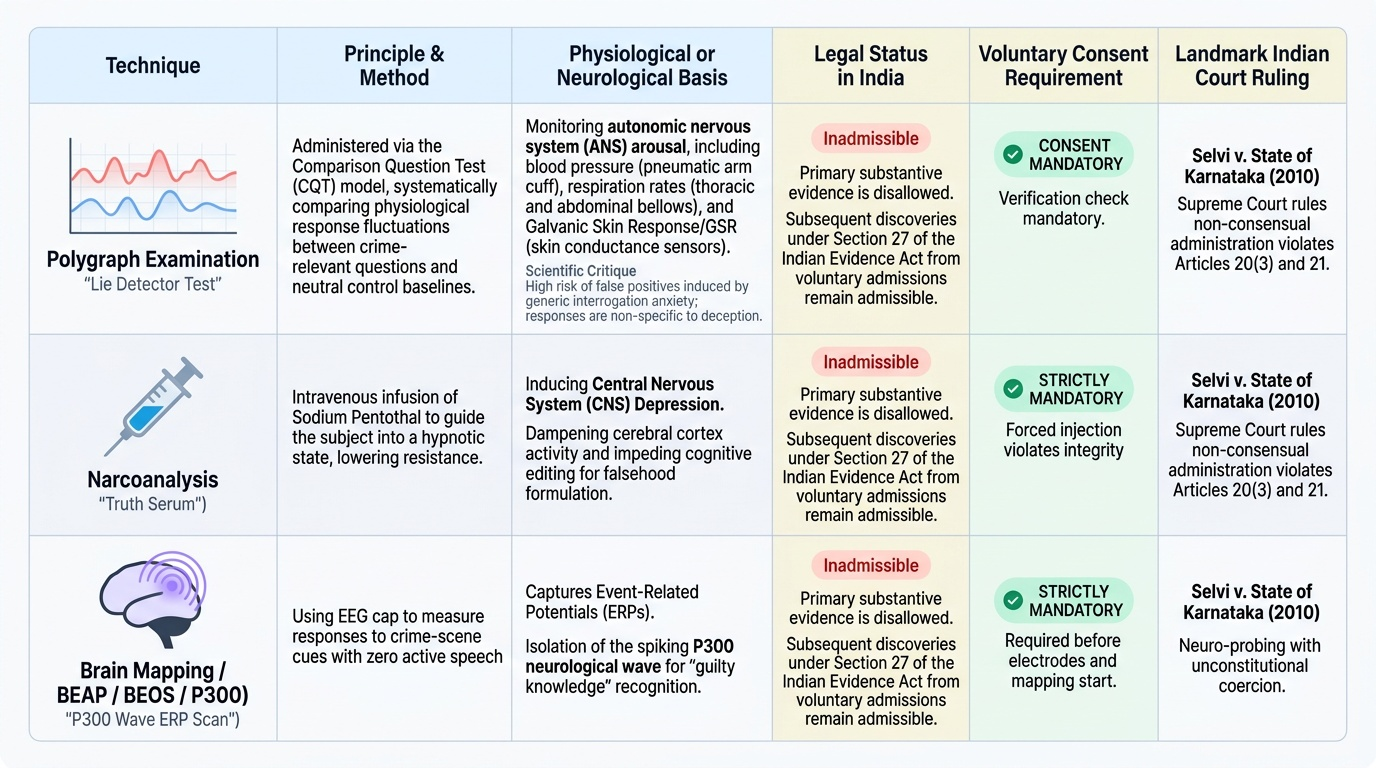
Three psychophysiological or neuroscientific techniques are used in forensic investigations to assess truthfulness or detect concealed information: the polygraph examination, narcoanalysis, and brain mapping (also called BEAP — Brain Electrical Activation Profile or Brain Electrical Oscillation Signature, BEOS — a P300 event-related potential technique). Each operates on a different theoretical basis, and all three are subject to the same critical legal ruling in India.
Polygraph examination measures multiple physiological parameters simultaneously during questioning: blood pressure (via a cuff), respiration rate and depth (via bellows over the chest and abdomen), galvanic skin response (GSR, measuring skin conductance as a correlate of sympathetic arousal), and sometimes finger pulse rate. The theory is that a person who is lying will exhibit involuntary autonomic arousal — elevated blood pressure, altered breathing, increased sweating — in response to relevant questions compared to neutral questions. The Comparison Question Test (CQT) format compares responses to crime-related questions against control questions. The scientific critique of polygraph is fundamental: autonomic arousal is a non-specific response to anxiety, not a specific marker of deception. An anxious innocent subject may "fail" a polygraph; a trained psychopath may "pass" one. Scientific consensus holds that polygraph accuracy rates are significantly better than chance but substantially below the standards required for legal evidence.
Narcoanalysis involves the intravenous administration of a barbiturate drug — most commonly sodium pentothal (thiopentone sodium) — at a sub-anaesthetic dose that induces a twilight (hypnotic) state. In this state, the subject's critical inhibitions are reduced, and they are less able to maintain deliberate deception. The statements made during narcoanalysis are recorded. The theoretical basis is pharmacological disinhibition — the drug reduces cortical inhibition without abolishing consciousness. The scientific critique is significant: a hypnotic state does not compel truth-telling — it reduces inhibition but does not eliminate the capacity for confabulation, suggestion effects, or false statements. Statements made under barbiturates may reflect what the subject believes or has been led to believe, rather than factual events.
Brain mapping / BEOS / P300 testing measures the P300 event-related potential (ERP) — an electrophysiological response of the brain occurring approximately 300 milliseconds after a relevant or surprising stimulus. The theory is that a guilty person's brain will generate a stronger P300 response to crime-specific information (a photograph of the weapon, the victim's name) than an innocent person's brain, because the crime-specific stimulus is "recognised" from stored memory. The technique was pioneered in India primarily by forensic scientist Dr CH Sharma and marketed as the BEOS (Brain Electrical Oscillation Signature) system. The scientific critique acknowledges a genuine neurological basis for the P300 response but challenges whether it reliably distinguishes "recognition from personal experience" from "recognition from media exposure or suggestion."
The Selvi ruling — the critical legal constraint (exam-critical):
In Selvi v State of Karnataka (2010), the Supreme Court of India considered three petitions from individuals on whom polygraph, narcoanalysis, and brain mapping had been compulsorily administered during criminal investigations. The Court held:
1. Compulsory administration of polygraph, narcoanalysis, or brain mapping violates Article 20(3) of the Constitution (right against self-incrimination) — because statements made under these techniques are testimonial in nature.
2. Compulsory administration also violates Article 21 (right to personal liberty) — because subjecting a person to these procedures without consent is an intrusion on bodily integrity and mental privacy.
3. Results of these techniques are NOT admissible as evidence in court, irrespective of the method used.
4. These techniques MAY be administered ONLY with the voluntary, informed consent of the subject, and only after independent legal advice. Even then, the results remain inadmissible as substantive evidence; they may at most lead investigators to discover further evidence, which itself is admissible if independently obtained.
Provided image
| Technique | Principle | Physiological/Neural Basis | Admissible in India? | Consent Required? |
|---|---|---|---|---|
| Polygraph | Measures autonomic responses to questions | Blood pressure, respiration, GSR (sympathetic arousal) | No — Selvi v Karnataka (2010) | Yes — voluntary only |
| Narcoanalysis | Barbiturate disinhibition | IV sodium pentothal → reduced cortical inhibition | No — Selvi (2010) | Yes — voluntary only |
| Brain mapping (BEOS/P300) | P300 ERP response to crime-specific stimuli | EEG event-related potential (300ms post-stimulus) | No — Selvi (2010) | Yes — voluntary only |
The practical implications for the forensic medical officer are important. A doctor who administers narcoanalysis without the subject's voluntary informed consent is not only acting outside the legal framework — they are potentially liable for criminal assault and professional misconduct. The Selvi ruling treats compulsory administration as a fundamental rights violation. A doctor asked to assist in narcoanalysis must verify that valid voluntary consent has been obtained and documented, that the subject has had access to legal advice, and that the procedure is being conducted in a medically safe setting with the capacity for emergency airway management (sodium pentothal can cause respiratory depression).
SELF-CHECK
Under the ruling in Selvi v State of Karnataka (2010), which statement correctly describes the legal status of narcoanalysis results in Indian courts?
A. Narcoanalysis results are admissible as substantive evidence if the subject consented to the procedure
B. Narcoanalysis results are admissible if administered by a qualified physician and the results are corroborated
C. Narcoanalysis results are NOT admissible as evidence in Indian courts; the technique may only be used with voluntary consent, and even then the results cannot be used as direct evidence
D. Narcoanalysis results are admissible only in cases involving terrorism or serious organised crime
Reveal Answer
Answer: C. Narcoanalysis results are NOT admissible as evidence in Indian courts; the technique may only be used with voluntary consent, and even then the results cannot be used as direct evidence
The Supreme Court in Selvi v State of Karnataka (2010) held that results of narcoanalysis (as well as polygraph and brain mapping) are NOT admissible as evidence in Indian courts, even when the subject consented to the procedure. The Court's reasoning was that such results are testimonial in nature and their admission would violate Article 20(3) (right against self-incrimination). Voluntary consent only allows the procedure to be conducted — it does not render the results admissible as substantive evidence. The practical value is investigative: voluntary narcoanalysis may lead to the discovery of evidence that is independently admissible. Options A, B, and D all incorrectly suggest conditions under which the results could be admissible — the Selvi ruling has no such exceptions.
CLINICAL PEARL
The Selvi rule is absolute and examination-critical: In examination questions about lie-detection methods in India, the answer is always the same: polygraph, narcoanalysis, and brain mapping results are NOT admissible as evidence in Indian courts, per Selvi v State of Karnataka (2010). No qualification based on consent, corroboration, or seriousness of the crime changes this. Many students confuse 'voluntary consent allows the procedure' with 'voluntary consent makes the results admissible' — these are two completely different propositions. The procedure can be done voluntarily; the results remain inadmissible as direct evidence. Additionally, remember that a doctor administering narcoanalysis without verified voluntary consent is personally liable for assault and professional misconduct under the NMC Act 2020.
KEY TAKEAWAYS
FM12.6 covers seven advanced forensic technologies. The key facts for each:
DNA profiling:
• Standard method: STR (Short Tandem Repeat) profiling at 13-20 loci simultaneously
• Works from: any nucleated cell source — blood (WBCs), semen, saliva, skin, hair roots, tooth pulp, bone
• Applications: individualisation, exclusion, kinship, mass disaster identification
• Indian law: DNA Technology (Use and Application) Regulation Bill — introduced but pending full enactment
Facial reconstruction:
• Technique: build up soft-tissue approximation from skull morphology (clay or digital)
• Status: investigative lead-generation tool; NOT proof of identity; not used for conviction
Virtual/digital autopsy:
• Techniques: PMCT (post-mortem CT), PMMRI, photogrammetry, post-mortem angiography
• Advantages: 3D skeletal imaging, non-invasive, permanent digital record
• CANNOT replace: histopathology, toxicology, direct soft-tissue examination
• Indian status: supplementary; conventional autopsy under BNSS remains standard
Lie-detection technologies — Selvi v State of Karnataka (2010):
• Polygraph: autonomic physiological measurements — NOT admissible — voluntary consent required
• Narcoanalysis: IV sodium pentothal disinhibition — NOT admissible — voluntary consent required
• Brain mapping / BEOS / P300: EEG event-related potential — NOT admissible — voluntary consent required
• All three: results are investigative only; any independently discovered evidence is admissible
REFLECT
Consider these questions about the technologies you have studied:
- A defence lawyer argues that the DNA evidence in a murder case should be excluded because 'the suspect did not consent to having his DNA profiled.' Is this argument legally valid in India? What distinguishes DNA profiling from narcoanalysis in terms of the self-incrimination doctrine?
- Virtual autopsy using PMCT is requested in a suspected homicide by stabbing. The body shows multiple stab wounds. List three pieces of information that PMCT will provide well, and two pieces of information for which you would still need conventional autopsy or additional specimen collection.
- A judge asks you, as an expert witness, whether the brain mapping (BEOS) evidence submitted by the prosecution is reliable scientific evidence. What is your professionally correct answer, citing both the scientific basis and the legal framework?
- The DNA Technology Regulation Bill proposes a national DNA database. What specific privacy and consent safeguards would you, as a physician-citizen, consider essential for such a database in the Indian context?